Hans returns Peter van Holp’s lost purse
Hans Brinker, or The Silver SkatesHans Brinker returns Peter van Holp’s lost purse during the boys’ skating excursion to Haarlem, restoring the money on which their journey depends. The episode turns a sudden collective crisis into a quiet test of character: Hans gives back what he finds, and refuses a reward even when the grateful Peter offers to divide the purse’s contents with him.
The purse disappears in Haarlem
By nearly one o’clock, Captain Peter van Holp and his companions have skated almost seventeen miles since morning and reached Haarlem in high spirits. Their first concern is lunch. Near a coffeehouse, Peter plunges his hands into his pockets with the confidence that he has enough money to feed the party; instead, he discovers that the purse containing all their money is gone. The abrupt change—from talk of a substantial meal to the prospect of having neither lunch nor dinner—makes the loss immediate and communal.
Peter searches in mounting desperation, opening his underjacket, removing his hat, and feeling through every pocket. He explains that without money they cannot continue, and that there is no one in Haarlem from whom he can borrow even a few guilders. Amsterdam would offer a different prospect, but it is not where they are. The practical dependence of the whole party on one missing object is thus made plain: the purse is not merely Peter’s private property but the means by which their excursion can go on.
The purse held sixty guilders, with each boy having contributed exactly ten. Peter blames himself for having brought the group to this disappointment and even says that another boy might have made a better captain. Carl Schummel responds bluntly that the loss was an accident, but presses Peter to find money somehow, suggesting that he sell his watch. Peter refuses: it was his mother’s birthday present, and he would rather part with his coat or hat. The exchange makes the purse’s disappearance costly in more than one way; it threatens the outing and puts Peter’s personal possessions and responsibility under pressure.
A group without an easy remedy
The boys consider whether someone in Haarlem might lend them money, but no workable offer emerges. Carl knows wealthy people in the city, yet will not ask them for help because he fears his father would punish him. The maxim written over his father’s summer-house gateway, “An honest man need not borrow,” becomes an ironic obstacle: in a moment when the party needs assistance, Carl is constrained by the very rule he cites. The scene does not turn that refusal into a general judgment on borrowing; it shows how a family principle, as Carl understands it, closes off one possible solution.
Peter, meanwhile, does not shift the consequences of the loss onto Jacob Poot. He makes clear that Jacob had proposed putting the boys’ contributions together in Peter’s purse for what seemed the best arrangement. Peter insists that the accident was not Jacob’s fault. His response contrasts with Carl’s sharpness and with Peter’s own self-reproach: responsibility for the missing money is treated as a misfortune, not as grounds for blaming the person who suggested the arrangement.
Peter also refuses to let the party simply suffer for his carelessness. He declares that he has three times sixty guilders in his strongbox at home. The claim establishes that he could replace the lost sum, though it does not make the purse’s recovery any less urgent at that moment. His insistence on taking responsibility prepares the scene’s later reversal: instead of Peter having to rescue his companions financially, Hans arrives with the lost money itself.
Hans finds and returns it
Hans has left home that morning in great trouble. While skating, he is so absorbed that he pays little attention to his surroundings; after stumbling against some lumber, he rubs his knee and notices a purse nearly hidden beneath a log. He recognizes it as Peter’s because he had seen it the previous day, when Peter paid him three guilders for making a whitewood chain and told him to buy skates. Its yellow leather makes the earlier sighting a practical clue, not a lucky guess.
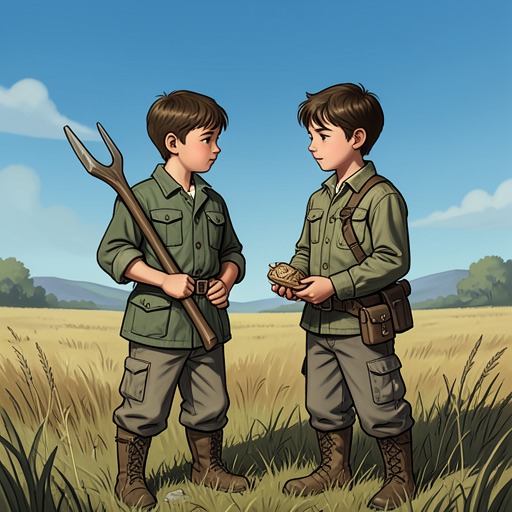
When Hans reaches the group, he holds out the missing purse. The boys erupt in cheers, but Peter’s gratitude is more personal: he thanks Hans in a tone that makes Hans feel as if a king had knelt to him. The contrast in their circumstances is sharp. Peter is the young captain whose companions have entrusted him with their money; Hans is the poor boy who has come to Haarlem troubled by his own family’s situation. Yet it is Hans who can now help Peter, as he tells him, and the purse’s return restores the party’s lost resource without asking them to overlook the accident that caused its disappearance.
Peter asks how Hans knew whose purse it was and where he found it. Hans connects the yellow leather to the previous day’s payment, then describes the lumber, his stumble, and the purse beneath the log. Peter recognizes the place: as the boys passed it, he had taken his tippet from his pocket and probably flipped out the purse at the same time. The explanation turns a mysterious loss into a specific, accidental sequence. Hans’s attention to an object he might easily have passed by has preserved the money; Peter’s recollection identifies how it was lost.
Refusing a reward
After pouring out the contents, Peter invites Hans to share the money as a pleasure the boys could offer him. Hans quietly refuses. He makes no display of virtue and offers no elaborate explanation; Peter feels rebuked and silently puts the silver back. The refusal is decisive because it separates restoring another person’s property from claiming a benefit for doing so. Hans does not treat the purse as a windfall or his useful act as a claim on the group’s money.
The scene’s moral force rests on this contrast between material need and conduct. Peter has just feared that the boys would go hungry and be unable to continue, and the purse contains a substantial sixty guilders. Hans, for his part, has come to Haarlem under the weight of a serious trouble of his own. Still, he returns the purse intact and declines the proposed division. The narration emphasizes his plain, unpretentious manner rather than a performance of generosity: his honesty is shown through what he does and what he will not take.
The recovery also alters Peter’s view of Hans. Peter privately recognizes that he likes the boy whether rich or poor, then asks about the trouble that has brought him there. Hans says that he has waited too long and is going to Leiden to see Dr. Boekman. Thus the purse does more than restore the excursion’s funds: it creates a moment of trust in which Peter’s gratitude opens the way for Hans to speak of his own urgent purpose. The episode closes not with a recorded account of the boys’ meal or the continuation of their trip, but with that shift of attention—from the money returned to the hardship Hans still carries.