Hans seeks work and is hired at the van Holp family workshop
Hans Brinker, or The Silver SkatesHans seeks work and is hired at the van Holp family workshop after selling his beautiful skates and going from employer to employer in Amsterdam. The action turns his sacrifice into a practical means of supporting his family: a city that has no place for an eager boy gives way to an opportunity arranged through Peter van Holp’s personal intervention. The offer is for a specific task, carving summer-house doors, and a workshop equipped for him until the work is finished.
The Need to Earn
The search begins with Hans already having given up the skates he had hoped to keep at least until the race. He does not regret parting with them, though the thought that he could not hold on to them a little longer still troubles him. He keeps that boyish disappointment in check and thinks of the money he will take home to his mother. He has not yet told her that he sold the skates without asking her permission; in his mind, her burdens are already great enough.
That resolve takes him through Amsterdam’s streets looking for employment. For a short time he earns a few stivers by helping a man drive a train of loaded mules into the city, but the small payment is not steady work. He would accept a place as a porter or errand boy, yet neither occupation opens to him. His strong arms and willingness to work do not overcome the ordinary barriers that employers put in his way.
A Day of Refusals
At the shops, Hans encounters several versions of the same rejection. Some proprietors have already hired the help they need; others want a more lightly built and better-dressed boy, though they do not put the preference so plainly. Some tell him to return in a month or two, when the canals may be broken up, and others simply shake their heads. The responses make the search feel less like a test of effort than a succession of doors closing for reasons he cannot change.
The factories offer no better prospect, despite the range of work taking place across the city. Hans imagines that a strong, eager boy ought to find some task among the producers of woolen, cotton, and linen goods, dyes and paints, cut diamonds, meal, bricks, glass, or china. Instead, he hears that there is no need for more hands. The busy hiring period before Saint Nicholas’s Day (December 6) has passed, and employers now have more boys than they require.
The refusals do not mean that everyone is unmoved. Hans does not know how plainly his concern for his mother and Gretel shows in his face, or that even gruff employers sometimes turn him away with discomfort. Some fathers are kinder than usual to their own children that evening after remembering the frank young face they have rejected. One man resolves to ask his head man, Blankert, to give the boy from Broek something to do if Hans comes back. That possible opening remains beyond Hans’s knowledge; he must make his next choice without knowing that his persistence has affected anyone.
Peter’s Offer
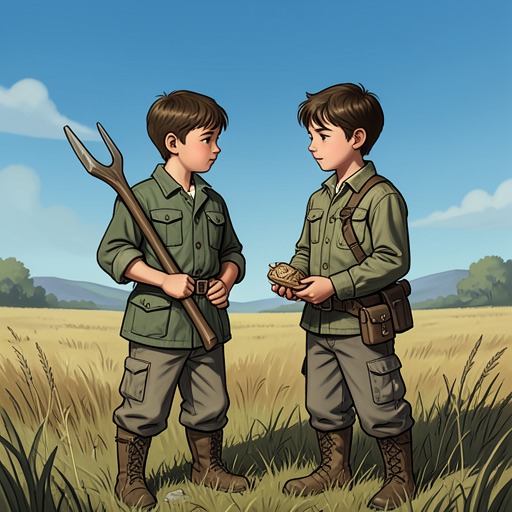
Toward sundown Hans starts back to Broek, uncertain whether the choking feeling in his throat comes from discouragement or determination. He has one more possibility: Peter may have returned. Peter had been reported in Haarlem the previous night on business connected with the skating race, but Hans decides to try rather than assume he is still away. In fact, Peter is home when Hans arrives and is just about to set out for the Brinker cottage. He recognizes the weary boy, welcomes him inside, and offers him a chance to warm himself.
Hans enters with care. Embarrassed by his heavy shoes, which would offend a Broek housewife if they dirtied the floor, he kneels to take them off and leaves them outside. Peter then tells him that he is to start at once on the summer-house doors. There is a comfortable workshop on the property, available until the carving is complete, and it contains every tool Hans will need. The arrangement does not pretend that he has already learned the trade: Hans admits he has never been taught it, but believes he can do the work, and Peter answers with confidence in him.
Peter’s offer is more than a sudden piece of luck. He has skated all the way to Haarlem to arrange the plan with Mynheer van Holp, but does not tell Hans this. The boy sees only the result—the work and the workshop—and leaves the Van Holp home with a lighter heart. Peter’s undisclosed journey makes the offer an act of deliberate assistance, not merely a convenient vacancy.
Work, Trust, and Outcome
The opening also belongs to a relationship shaped by Hans’s earlier conduct. When he found Peter’s lost purse, he returned it and refused Peter’s offer to divide the money. Peter’s admiration for him was already evident; the workshop opportunity now gives that regard a practical form. Rather than asking Hans to accept charity, Peter gives him a task to perform, tools to use, and a place in which to work. The distinction matters to a boy intent on earning money for home while protecting his mother from another worry.
As Hans leaves, Peter asks after his father. Hans replies that Raff Brinker is better and improving every hour. The brief exchange places the new employment within the family’s larger struggle: Hans is seeking work while watching his father recover and trying to provide for his mother and Gretel. The episode ends not with a permanent position or a completed carving, but with an immediate, workable beginning. After a day in which willingness alone could not secure him a place, a trusted connection turns his effort into employment.