Hilda’s gift of skate money to the Brinker children
Hans Brinker, or The Silver SkatesHilda van Gleck’s offer of skate money to Hans Brinker and Gretel Brinker turns an act of generosity into a carefully negotiated exchange. The eight kwartjes could open the race to the poor siblings, whose makeshift skates hinder them; Hans’s insistence that help must be earned leads Hilda to propose a wooden chain in return. The episode makes assistance concrete, but also shows how dignity and reciprocity shape whether it can be accepted.
The Need Behind the Offer
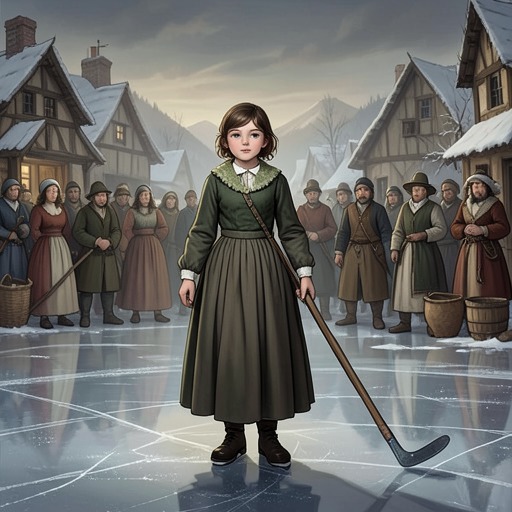
Hilda approaches the siblings intending to help, but her concern is mixed with self-reproach. She tells them she has been careless and cruel, though she meant no harm, and falters as she tries to explain her errand. Hans immediately offers to be of service. Rather than ask directly about their poverty, Hilda turns to the approaching race and asks why neither will enter. The shift lets her raise the possibility of help without making their need the only subject of the conversation.
Hans explains the practical obstacle: their skates have hard wooden soles. Once damp, they stick and trip the skater, limiting them to a few strokes among the competitors. Gretel, remembering Hans’s mishap that morning, suppresses a smile, then asks whether they may at least come to watch. Their answer establishes that the barrier is not willingness or ability, but inadequate equipment.
Hilda sees how different the siblings’ feet are in size and asks which is the better skater. Gretel answers at once that Hans is. Hilda has only eight kwartjes left, having spent much of her monthly allowance on lace and finery. She recognizes that the money cannot buy a pair for each child—or even one good pair—yet gives it to Hans and asks the siblings to decide which has the better chance of winning and buy skates accordingly. The offer is limited by her means, but it is directed toward a particular opportunity: making a genuine race entry possible.
A Gift Recast as Exchange
Hans is electrified by the money, but he does not simply accept it. He stumbles after Hilda, one skate string untied, and calls her back. When she asks why, he bows clownishly while looking at her with dignity and explains that the siblings have not earned the gift. His refusal is not indifference to the help: he has already imagined what the skates might enable. Rather, he objects to receiving money without giving something in return.
Hilda answers by noticing the pretty wooden chain Gretel wears. She asks Hans to carve one like it. Hans agrees wholeheartedly, promising to make it from the fine whitewood at home, and hastily tries to return the money. Hilda refuses, saying the sum would be a poor price for the chain. In one exchange, what looked like charity becomes payment for his skilled labor. She still gives him the money needed for the siblings’ decision, while he can understand the transfer as compensation for something he will make.
The bargain does not erase the difference in their circumstances: Hilda has money to give, while Hans must work to make its acceptance feel just. But neither treats that difference as a reason to abandon the exchange. Hilda adapts her offer to Hans’s objection; Hans accepts once he has a task to perform. The chain supplies a form of reciprocity without requiring either of them to pretend that the siblings can otherwise afford suitable skates.
Labor and the Cost of Acceptance
After Hilda glides away, Hans’s long, bewildered look gives way to resolve. He tells Gretel that they may keep the money, then calculates what the promise will demand: working hard every minute and sitting up half the night if their mother will let him burn a candle. His acceptance therefore carries a cost in labor and time. The scene does not present the chain as an effortless token; Hans treats it as a responsibility he must fulfill.
The offer also changes the siblings’ immediate position. Before Hilda intervenes, they expect to watch the race rather than enter it, because their wooden skates cannot carry them reliably. Now they have money to decide which sibling should receive skates, and Hilda’s question has already established Hans as the stronger skater. The episode stops short of showing what they ultimately buy, so its significance lies in creating the possibility of participation, not in guaranteeing a prize.
Reciprocity Beyond the Offer
Hans’s response belongs to a wider pattern of giving and refusal in his encounters with Peter van Holp. When Hans returns Peter’s lost purse, Peter offers to divide its contents with him. Hans quietly refuses; Peter puts the silver away, feeling rebuked, and recognizes the boy’s integrity across the difference between rich and poor. Like his refusal to take Hilda’s money as an unearned gift, this moment shows Hans accepting help or recognition only on terms consistent with his own sense of fairness.
At the race, the exchange takes another form. When Peter’s skate strap is nearly cut through, Hans removes his own skate and urges Peter to use its strap. Hans says he will not race and insists that Peter take it, despite Peter’s first refusal. Peter finally yields, calls Hans a noble fellow, and joins the racers as the handkerchief falls and the bugle sounds. The act is more costly than the chain bargain: Hans gives up his own chance to skate so his friend can take his place. Together, these episodes frame Hilda’s offer not as an isolated act of benevolence but as an encounter with Hans’s strong preference for assistance that preserves mutual respect. Her ingenuity makes the first gift acceptable; his later actions show that he, too, can give without seeking a reward.