Holland
Hans Brinker, or The Silver SkatesHolland is the water-shaped setting of Hans Brinker and the object of the book’s travel-like attention: a country whose lowlands require constant defense, yet whose people have made that necessity the basis of public works, commerce, and daily life. The narrative moves between its canals and cottages, winter roads and windmills, presenting the landscape not as scenery alone but as a system that governs how people work, travel, and remain safe.
Land and Water
Holland is described as a country of unusual physical reversals. A large portion lies below sea level, and the sea can press against the coast with enough force to threaten the land. Dikes, built at great cost and through sustained labor, hold the water back; some are high and broad enough to carry roads, buildings, and trees. From a road atop a dike, a horse may look down on cottages, while the keels of ships can rise higher than the roofs of houses. The country’s scale and levelness make distant objects plainly visible, but the dikes and canal banks also shape what can be seen and where people can travel.
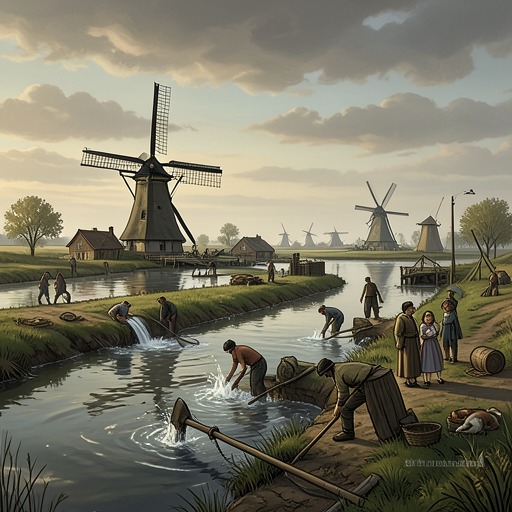
Water is not confined to the coast. Ditches, canals, ponds, rivers, and lakes recur throughout the landscape, often beside damp fields. The narrative makes the boundary between land and water seem uncertain: green growth appears on fish ponds, and waterways catch much of the country’s activity. This is the setting the children know from everyday life, rather than an exotic view encountered only by visitors. When the story turns from the Brinker family’s cottage to a broader view of Holland, the shift makes their domestic circumstances part of a national condition: the same water that defines the landscape can become a danger requiring vigilance.
Dikes, Windmills, and the Work of Staying Dry
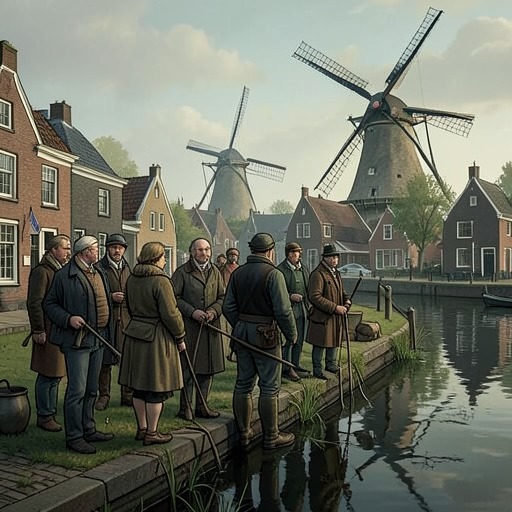
The country’s water-management works form a connected infrastructure. Dikes contain lakes and rivers; sluice gates regulate their passage; canals carry water and provide routes for boats and skaters. Near Halfweg, Lambert explains that the IJ and Haarlemmermeer meet where the river stands five feet above the land. Strong dikes and sluice gates are therefore necessary to prevent flooding. The explanation turns engineering into practical knowledge passed among travelers: the landscape’s unusual appearance has consequences that can be measured in height, strength, and risk.
Windmills add another working layer to this system. The account estimates that Holland has at least 9,900 large windmills, with sails from eighty to one hundred and twenty feet long. They saw timber, beat hemp, grind, and perform other kinds of work, but their chief use is pumping water from lowlands into canals and guarding against inland floods. Their annual cost is said to approach ten million dollars. Some are primitive, while newer examples adjust their sails to the wind: they spread to catch a faint current and draw back when a heavy gust threatens. This ingenuity does not remove the need for human labor or public maintenance; it helps organize both.
The scale of that obligation is made explicit in the account of upkeep. Millions of dollars are spent each year repairing dikes and regulating water levels, because neglect would make the country uninhabitable. Dike failures have buried towns and villages and caused the deaths of nearly a million people over time. The All Saints' Flood of 1570 is identified as one of the worst inundations, following twenty-eight earlier floods that had overwhelmed parts of Holland. These disasters give the country’s everyday infrastructure a historical gravity: maintenance is not merely improvement, but a condition of survival.
Movement Across the Landscape
Waterways also serve as roads. During winter, the frozen canals carry skaters, iceboats, push-chairs, and small sleds. On the route along the canal near the high dike beside Haarlemmermeer, the long straight waterway and rows of bare willows frame a busy passage across the flat country. Guards keep the canal surface clear of obstructions and garbage; after snowfall they sweep the ice before it hardens. Their routine work makes skating possible and shows how shared maintenance supports ordinary recreation as well as safety.
The same landscape changes with the season. On the twentieth of December, the ice near Amsterdam on an arm of the Zuider Zee remains firm beneath warm sunlight, and the windmills rest in still air. The frozen surface draws people from the city and surrounding countryside to the skating race. Gentry arrive in coaches, while children from charitable institutions and peasants in regional dress gather among them. Holland’s waterways, then, do more than separate settlements or threaten them: when frozen, they become public spaces that bring different groups into view together.
A Nation of Industry and Resistance
The book balances the country’s exposure to flood with an account of what its inhabitants have accomplished. Holland is called carefully cultivated and prosperous despite its wet, unstable ground. Its people are credited with perseverance, courage, and substantial achievements in discovery, invention, commerce, navigation, learning, science, education, and public charity. The apparent contradiction between a vulnerable landscape and a resourceful society is central to the portrait: the country’s difficulties are not treated as evidence of weakness, but as circumstances that have demanded organized work and endurance.
That portrait also reaches beyond engineering. Holland is associated with religious freedom, art, music, literature, and a history of patience, resistance, and victory. The book describes it both as a European battlefield and as a refuge for the oppressed of many nations. Its national character is thus presented through a combination of conflict and shelter, danger and enterprise. The narrator’s defense of the Dutch counters the familiar joke that their country might float away at high tide: the people’s labor, in this account, is what keeps Holland firmly in place.
Holland in the Story
The book deliberately combines travel description with domestic narrative. Its preface promises careful attention to Dutch localities, customs, and general characteristics, while grounding the story of Raff Brinker in fact. The narrator invites readers to look outward from the Brinker cottage toward the broader country, then returns to the family’s life within that landscape. Descriptions of canals, dikes, and local habits therefore serve both as a guide to Holland and as the material world in which the family’s fortunes unfold.
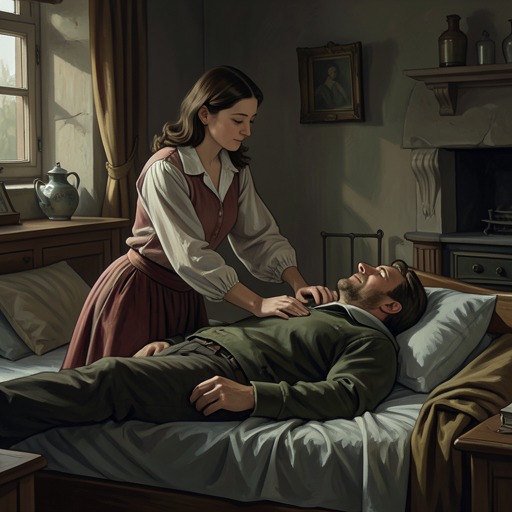
Holland is also a place of departure and return. Raff Brinker recalls helping a distraught stranger travel several miles by boat after the man said that he had to flee the country, believing himself responsible for a death. Later, Thomas Higgs’s nationality becomes a subject of gossip in the community where he lives abroad: his English name and uncertain accent do not resolve the question, though he responds strongly to talk of Holland. These episodes connect the country to memory, exile, and unanswered questions as well as to its geography.
The final view looks forward to a changed family life. Hans becomes the famous Dr. Brinker, travelling by coach to visit patients or skating on Amsterdam’s canals with his children; Annie Bouman is now Annie Brinker, his wife. Peter van Holp and Hilda also marry, while the frozen waterways remain a setting for companionship and movement. Holland’s landscape persists across the story’s changes: the same canals that once shaped childhood journeys continue to carry the next generation, and the country’s history of care, labor, and endurance remains present in ordinary life.