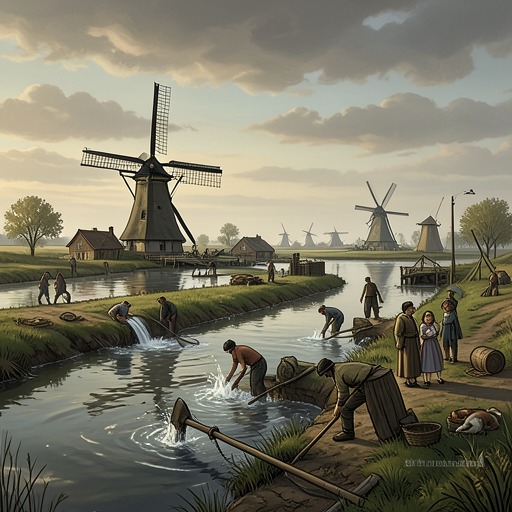
Holland will not float off while there is a Dutchman left to grapple it
Hans Brinker, or The Silver SkatesHolland will not float off while there is a Dutchman left to grapple it expresses the central paradox of the book’s portrait of Holland: a country exposed to water is also a country made habitable by human persistence. The phrase turns the threat of inundation into a declaration of collective resolve, connecting the national landscape to the family story of Hans Brinker, Gretel Brinker, and their father, Raff Brinker.
Meaning and Context
The expression appears in a discussion of Holland’s history and character. The narrator acknowledges the joke that the country might float away at high tide, then reverses it: Dutch people have proved themselves heroes, and their country will endure as long as someone remains to grapple with the danger. The image makes endurance active rather than effortless. Holland is not secure because water has ceased to threaten it, but because people continue to resist that threat.
That claim belongs to a book deliberately combining travel instruction with domestic narrative. Its preface promises careful descriptions of Dutch places, customs, and general characteristics, while identifying Raff Brinker’s story as founded on fact. In the 1873 prefatory letter, the narrator looks back to the time when Hans and Gretel skated on the frozen IJ, presenting the country as still remarkable for not being washed away. The expression thus links the book’s account of national character to both its present-day travel observations and its earlier family plot.
A Country Held Against the Water
The phrase gains force from the geography described in the book. Large parts of Holland lie below sea level, and dikes keep the ocean back at enormous cost in money and labor. Waterways fill the landscape: ditches, canals, ponds, rivers, and lakes complicate any easy distinction between land and water. The country’s precariousness is not an abstract national trait but a physical condition, visible in the embankments and in the water pressing against them.
That condition demands ongoing maintenance. In spring thaws, rivers can become blocked by ice and overflow before their waters reach the ocean, while the sea bears against the dikes. Engineers and workmen watch threatened places day and night; when a general danger signal sounds, inhabitants rush to help. Workers press large straw mats against embankments, then strengthen them with clay and heavy stone. In this setting, grappling is both a figurative expression of courage and a description of practical, collective labor.
Labor, Risk, and the Family Story
The book’s account of a prisoner forced to pump in an Amsterdam jail extends the same image of relentless effort. Faced with water pouring into his cell, the prisoner must either work at the pump or drown. The narrator compares this predicament to Holland’s need to pump for its very existence: the expression’s defiance does not erase the exhausting necessity behind it. Survival requires work repeated on a national scale.
Raff Brinker’s history brings that labor into the domestic plot. He had worked on the dikes for years. During a threatened inundation, in a terrible storm of darkness and sleet, he fell from scaffolding at a weak point near Veermyk Sluice and was left insensible. He never worked again; his mind and memory were gone, though he remained alive. Gretel could remember only the strange, silent man whose eyes followed her vacantly, while Hans retained memories of the cheerful father who carried him on his shoulder and sang. The national struggle against water therefore has a direct and painful human cost in the Brinkers’ household.
Narrative and Thematic Significance
The expression gathers the book’s contrasts into one image: a country physically vulnerable yet resourceful, a landscape requiring constant work yet made rich by care and industry. Its confidence is qualified by the account of floods, including the catastrophic inundation of 1570, and by the continuing need to repair dikes and regulate water levels. The promise of endurance is not a claim that disaster cannot happen; it is a claim about the resolve to meet danger together.
The phrase also serves as a bridge between the book’s national portrait and its story of individual hardship. Holland’s survival depends on many hands maintaining defenses against water; the Brinker family’s history shows how one worker’s service at those defenses can alter a household for years. In joining collective perseverance to personal consequence, the expression makes the country’s resilience concrete: it is sustained by labor, vigilance, and people willing to confront a danger that never entirely disappears.