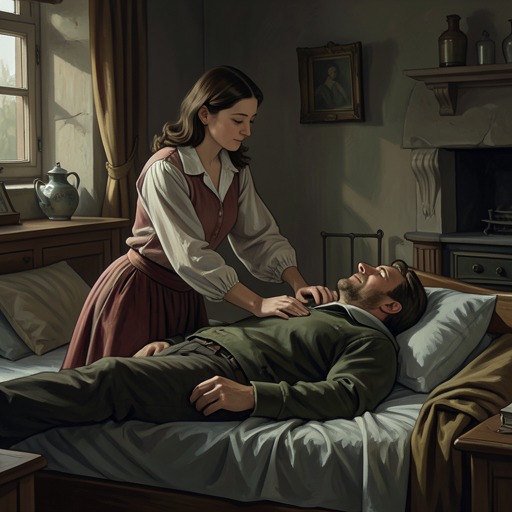
Meitje Brinker
Hans Brinker, or The Silver SkatesMeitje Brinker, also known as Dame Brinker, is Raff Brinker’s wife and the mother of Hans Brinker and Gretel Brinker. In the crisis surrounding Raff’s operation and recovery, she must make a decision for an unconscious husband, sustain the household through his return to awareness, and confront the loss of the money he believes was safely saved. Her arc is defined less by command than by care: prayer, consent, practical tending, and the effort to protect Raff from distress even when the truth bears directly on their shared life.
Identity and Family
Meitje is presented through her relationships within the Brinker household. Hans addresses her as his mother when he needs to speak privately about the decision facing the family; Gretel watches her mother closely and, unable to understand what is happening, seeks comfort by putting her arms around her and weeping. Raff is her husband, unconscious and pale when the family must decide whether Dr. Boekman should proceed with an operation. These relationships place Meitje at the center of a household in which each person responds differently to danger: Hans takes responsibility for speaking, Gretel expresses her fear through physical closeness, and Meitje must give the consent that the doctor requests.
Her role is not merely that of a person receiving medical instructions. The choice concerns Raff, but its consequences will fall on the family, and the doctor explicitly asks her whether the operation is to be done. The scene gives her the authority to answer while showing the emotional weight of exercising it. She is neither depicted as detached nor as instantly certain; her decision emerges from a pause of anguish and prayer.
The Decision About Raff’s Operation
When Dr. Boekman presses for an answer, Hans approaches his mother but initially cannot speak. He turns his eyes away, then firmly asks to speak with her alone. Gretel, who does not understand the exchange, gives Hans an indignant look and walks away. Hans calls her back and asks her to sit down. The small interruption matters: the family’s decision is not a private matter in feeling, even if Hans first tries to speak to their mother alone. Gretel senses the gravity around her without knowing its cause.
After Hans has spoken, Meitje looks for a long moment at Raff, pale and unconscious in bed, and drops to her knees beside him. Dr. Boekman examines Raff’s head while his assistant turns away and coughs. When the doctor asks whether she will consent, Meitje first asks whether the operation will cause pain. He cannot promise that it will not, answering only that it probably will not. His uncertainty leaves her without reassurance about the immediate cost of the procedure.
The narrative marks her answer as a decision reached through prayer rather than through certainty supplied by the doctor. A quick prayer rises from her heart; then she turns toward Dr. Boekman and consents. Her choice is direct, but not casual: the account places the pause, her concern about pain, and her prayer before the answer. It presents her as accepting responsibility for a grave medical decision while hoping for guidance beyond what the available assurances can provide.
Care During Raff’s Recovery
When Dr. Boekman visits the Brinker cottage the next day, he finds a strikingly changed domestic scene. Meitje sits knitting beside the bed, Raff sleeps peacefully, and Gretel quietly kneads rye bread at the table. The doctor notices the household’s cheerful, comfortable air before asking a few questions and examining his patient’s pulse. His assessment is cautious: Raff remains very weak and needs nourishment. Meitje answers that the family has black bread and porridge, foods that have always agreed with him.
Her answer is practical and specific. The doctor calls for food that is strong and of the best, but Meitje names what the household actually has. The exchange sets medical instruction alongside domestic means: she is ready to feed Raff, though the available provisions are black bread and porridge. Her knitting beside his bed and Gretel’s work with the rye bread give the recovery a household rhythm. The scene’s happiness does not erase Raff’s weakness; it exists alongside the careful attention his condition still demands.
That evening Raff feels well enough to insist on sitting up in a rough, high-backed chair by the fire. The family’s attempt to lift him causes a commotion. Hans is needed because Raff is heavy and requires something firm to lean on, while Meitje, alarmed by the bold step of moving him without the doctor’s orders, nearly pulls him over even as she believes herself to be supporting him. The moment makes her care visible as action, but also shows its anxious, imperfect physical reality: good intentions do not make the task easy or safe. Raff jokes about feeling old and feeble; Meitje laughs and explains that fever has left him weak, then settles him into the chair she has made snug and warm.
The Lost Money and the Limits of Protection
As Raff improves, his recovery brings an old concern back into the room. He tells Meitje that he feels much better and speaks of the family’s money as having been well saved, asking whether it lasted through all those ten years. Meitje starts to answer that she does not have it. Her halting words show that she is about to tell him the whole truth, not that she has found a way to resolve the loss.
Hans lifts a warning finger and whispers that Raff must not be worried, recalling the doctor’s instruction. Meitje responds tremblingly that Hans should speak to his father. Her reaction holds two pressures in view: Raff has asked directly about their money, and the family has been told to guard his health from worry. She begins to disclose what happened, then stops when Hans intervenes. The passage does not make that silence easy or triumphant. Her distress remains apparent, and the question of the missing savings is left unresolved in this moment.
Narrative Role
Meitje’s actions link Raff’s medical crisis to the ordinary labor of keeping a family together. At the bedside she faces a decision no one can make painless; the next day she knits while the doctor assesses Raff and answers with the food the household has; later she helps lift and settle her recovering husband, then confronts his question about their lost savings. These episodes give her care several distinct forms: consenting, feeding, supporting, reassuring, and trying to speak honestly without endangering a fragile recovery.
The narrative also contrasts her attentive domestic knowledge with the doctor’s clinical attention. Dr. Boekman checks Raff’s pulse and names his weakness; Meitje knows which foods have suited him and prepares the chair that makes sitting by the fire possible. Neither replaces the other. Her care works within the limits set by Raff’s condition, the doctor’s warning, and what the household has available. When Raff’s question makes those limits emotionally painful, Meitje’s interrupted confession leaves the tension open rather than pretending that affection or improvement can restore what has been lost.