Peter van Holp
Hans Brinker, or The Silver SkatesPeter van Holp is a skilled young skater, elected captain of a boys’ journey across the frozen canals, and one of the book’s clearest examples of privilege put to generous use. He leads his companions with a mixture of sociability and consideration, helps Hans Brinker find paid work, and responds to Hans’s assistance by accepting his sacrifice in the final skating contest. His later marriage to Hilda van Gleck completes a relationship first glimpsed in their shared world of skating.
Identity and Introduction
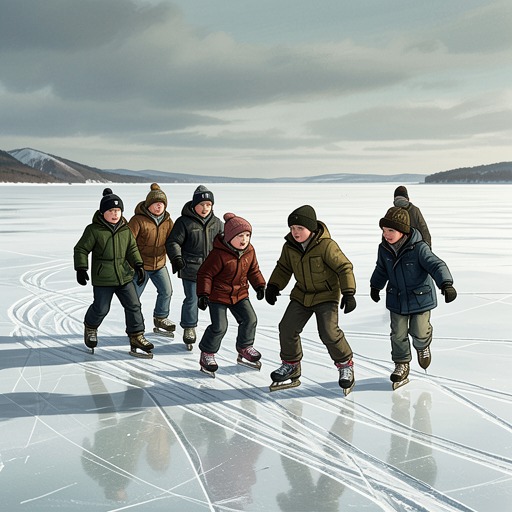
Peter first appears among a large party of young skaters moving along the canal. He is in the company of Carl Schummel, Ludwig van Holp, Jacob Poot, and others, among nearly twenty boys and girls caught up in the day’s sport. The gathering crosses social distinctions: Hilda van Gleck wears costly furs, while Annie Bouman, a peasant girl, skates in a scarlet jacket and blue skirt. Peter belongs to this lively group, but the narrative soon gives him a distinct role through the trust his companions place in him.
Jacob chooses Peter as captain for the skating excursion. Peter takes the responsibility seriously enough to call the roll when the group assembles on the canal, turning the start of the journey into an organized undertaking. Yet his authority is not presented as mere command. He consults the others, adjusts to their circumstances, and repeatedly tries to make the trip enjoyable for the whole party.
Captain of the Skating Journey
Peter’s plan gives the outing a broad itinerary. He proposes stopping at Haarlem to see the great organ, continuing to Leiden for its sights, and spending a day and night in The Hague, where his married sister lives, before setting out for home the next morning. The plan reflects his enthusiasm for travel and his willingness to share what he knows of the country with his friends.
When fatigue threatens the excursion, Peter tries to keep disappointment from turning the return into defeat. He urges the boys to make the best of a difficult situation and travel back in good spirits. His confidence helps restore the party’s energy. At another point, he insists that Jacob’s wishes should be considered because Jacob began the excursion. Carl dismisses the need to defer to him, but Peter’s intervention gives Jacob the chance to decide for himself. Jacob says the boys should continue, and the group does so.
Peter’s leadership also becomes practical when Jacob grows too exhausted to skate farther. The party faces the problem of getting him to Leiden: the first people Peter hails do not respond, loaded runners cannot take the boys, and a fast iceboat passes before they can board it. Peter continues trying, hailing a shabby iceboat as it comes into view. The scene makes his captaincy visible not as ceremony, but as responsibility for a tired companion when the journey no longer goes according to plan.
That evening, Peter keeps the group’s plans moving while attending to his own errand. He intends to find Dr. Boekman, who usually stays at the Golden Eagle Inn when in Leiden, and proposes that the boys who are still awake visit the museum or city hall with Benjamin Dobbs. Jacob chooses to go with Peter rather than rest, explaining that he feels well enough and has never before stopped in Leiden. Peter’s schedule accommodates both the party’s sightseeing and his effort to reach the doctor.
Hans Brinker: Respect, Assistance, and Work
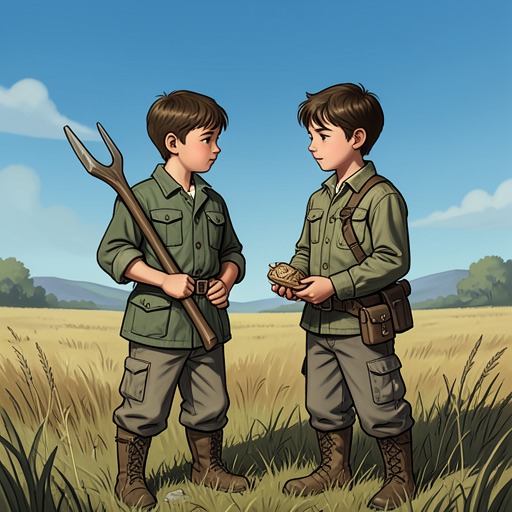
Peter’s connection with Hans begins with the missing purse. Hans explains that, while preoccupied with trouble at home, he stumbled against lumber and noticed Peter’s purse almost concealed beneath a log. Peter recognizes where he probably dropped it and offers to divide the money with the boy who found it. Hans refuses. Peter puts the silver away, feeling rebuked by Hans’s quiet refusal, and recognizes that the boy’s worth is independent of whether he is rich or poor.
When Peter learns that Hans is going to Leiden to seek Dr. Boekman, he offers to make the journey on Hans’s behalf. Hans explains that distance is not the chief difficulty: he fears leaving his mother alone for too long. Peter then listens as Hans describes his search for employment, repeatedly frustrated by employers who tell him to wait until spring.
Peter turns that conversation into a concrete offer. His father needs help carving a portal for a new summer house, and had already noticed the chain Hans made, judging that he had the skill for carving. Peter tells Hans that the work will be paid and that his father would be glad to employ him. Hans is delighted but admits that he has never attempted work on that scale. Peter assures him that he can introduce himself as the boy Peter has recommended.
The offer is not an incidental kindness: Peter takes steps to make it real. After Hans later returns from a fruitless search for work in Amsterdam, he finds Peter at home. Peter has brought word from Haarlem that Hans can begin work on the summer-house doors immediately, with a workshop on the property available until the carving is complete. Peter has skated to Haarlem to arrange the plan with his father, but does not tell Hans this; the narrative instead emphasizes the joy the news brings to the boy. Peter’s assistance thus respects Hans’s need for paid work and his desire to contribute to his family, rather than treating him only as an object of charity.
The Skating Race and Reciprocal Friendship
At the great skating race, Peter is among the leading competitors. In an early finish, Hans and Peter are both in contention, but Carl Schummel gathers speed at the last moment and passes them at the goal. In a later mile, Peter is announced as the winner. The successive contests establish both the uncertainty of the competition and Peter’s standing as a strong skater.
Before the decisive boys’ race, Peter’s skate strap is nearly cut through as he tries to adjust it with a knife. He does not want to take Hans’s strap, urging him instead to return to his place before the start. Hans insists, reminding Peter that he has called him a friend and telling him to take the strap at once. Hans withdraws from the race, believing he cannot win and that the contest is between Peter and Carl. Peter finally accepts the help and reaches his starting place just as the signal falls.
Peter wins the silver skates. The victory is therefore bound to an exchange between the two boys: Peter’s earlier aid helped Hans secure employment, while Hans gives up his own chance to race so that Peter can compete. The text presents Peter’s acceptance as a response to urgent friendship, not as indifference to what Hans is giving up. In the celebration, the crowd names Peter as the winner, but the circumstances of the victory keep Hans’s generosity close to its center.
Relationships and Later Life
Peter’s kindness extends beyond Hans. After a burglar is caught at the Red Lion Inn, Carl says that the man ought to be imprisoned immediately and boasts that he would have killed him if he had been in Peter’s place. Peter answers calmly that the robber was fortunate to fall into gentler hands. He recognizes the seriousness of the attempted burglary and the knife, but speaks of the accused man with pity rather than vengeance. The contrast with Carl reveals Peter’s instinct to combine judgment with mercy.
Peter’s family is also part of the book’s social world. His sister lives in The Hague and is among those expected to welcome the traveling boys. At the skating race, she has brought hothouse-flower bouquets for the winners, fulfilling the promise associated with her household. The later account identifies her as married and places her, with the Van Holp family, in a pavilion with her brother and the family’s other children.
In the closing glimpse of the characters’ futures, Peter is married to Hilda van Gleck. Their future is described as a continuation of the earlier image of the two skating beside one another over a frozen, sunlit river: companionship on the ice becomes a figure for their shared life. Peter’s role in the narrative rests on that same continuity between action and relationship. He leads without making authority an excuse to dismiss others, offers practical help without diminishing its recipient, and accepts help when friendship requires it.