Peter van Holp—Hans Brinker
Hans Brinker, or The Silver SkatesPeter van Holp and Hans Brinker’s relationship is built through acts of trust that move beyond money or social rank. Hans returns Peter’s lost purse and refuses a reward; Peter answers with offers of friendship and work. When Peter later needs a skate strap to join a race, Hans gives up his own chance to compete so Peter can take his place. Their bond develops through practical help, but its measure is the dignity with which each gives and receives it.
Unequal Circumstances, Shared Regard
Peter first enters this relationship as a young gentleman who has paid Hans three guilders for a whitewood chain and told him to use the money to buy skates. The payment establishes an unequal economic footing, but it also recognizes Hans’s skill: Peter’s father has admired the chain’s carving and sees promise in the boy’s work. Hans is not simply an object of charity in Peter’s eyes; he is a capable artisan whose effort has value.
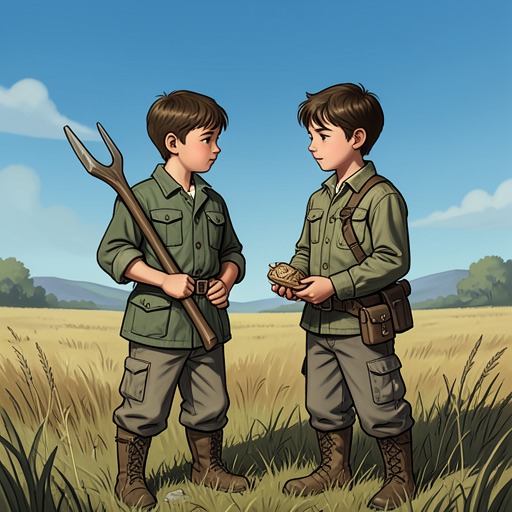
That distinction matters when Hans returns the purse. He has left home in trouble and is skating without paying attention when he stumbles against lumber. While rubbing his knee, he notices Peter’s purse almost hidden beneath a log. Hans connects it to Peter because of their recent transaction: Peter had paid him for the chain the previous day. The lost money is therefore recovered through Hans’s memory of their work together as well as his honesty.
The Returned Purse and Refused Reward
Hans presents the purse to Peter, and the boys around them celebrate. Peter’s thanks affects Hans so deeply that he feels as though a king had knelt to him. The response briefly reverses their apparent positions: Peter has wealth and status, but his gratitude acknowledges Hans as someone whose action deserves honor.
Peter asks how Hans knew the purse was his and where he found it. When Hans explains that he had seen it beneath a log, Peter recalls that he may have dropped it while taking a tippet from his pocket. He says it would have been lost without Hans and pours out the purse’s contents, asking Hans to accept a share. Hans quietly refuses. Peter puts the silver away without pressing him, feeling rebuked by the refusal. The episode does not turn honesty into a profitable transaction: Hans returns what is not his, and Peter recognizes that an offered reward cannot define the worth of the act.
Help Offered Without Purchase
After Hans refuses the money, Peter asks about the trouble that brought him onto the ice. Hans explains that he is going to Leiden to seek Dr. Boekman. Peter is astonished, but Hans insists that the doctor is kind beneath his busy, severe appearance and asks Peter to pass along what he has said. Hans’s urgent journey gives Peter a way to help that answers a need rather than merely rewarding the purse’s return.
Peter hopes the doctor will come. He also tells Hans that, if he needs a friend, he should go to Peter’s mother in Broek and say that Peter sent him. Peter offers him some guilders, explicitly presenting them as a gift rather than a reward. Hans declines again. He explains that he would be glad to find work, but employers keep telling him to wait until spring. His refusal preserves a distinction between accepting support and being paid for his labor; he is seeking a chance to work, not a payment for having done right.
Peter can then offer the kind of assistance Hans wants. His father needs help at once with a carved portal for a new summer house, and Peter recalls that the whitewood chain pleased him. His father believes Hans has a clean cut suitable for carving and will pay well for the job. Hans responds with sudden joy and confidence that, though he has never tried work on that scale, he can do it. Peter tells him to identify himself as the Hans Brinker he has recommended. Their connection thus turns a small commission into a route toward paid work, while keeping the help grounded in Hans’s demonstrated skill.
Friendship Tested on the Ice
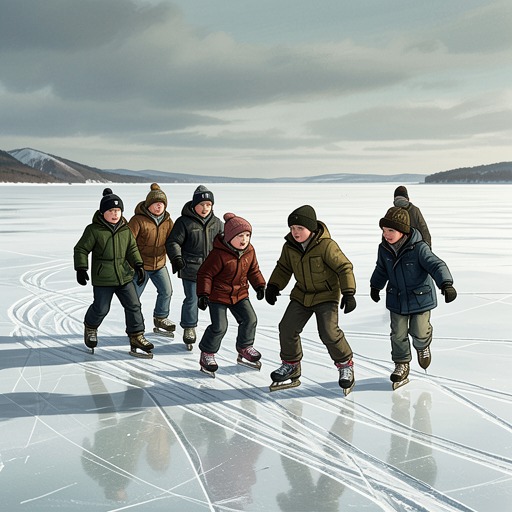
The clearest later proof of their friendship comes during a skating race. Peter has cut his strap nearly in two while trying to tighten it and make a new hole. Hans immediately pulls off his own skate and offers the strap. Peter initially refuses, thanking him but telling him to go to his post before the bugle sounds.
Hans insists that Peter take it because Peter has called him a friend. He says he will not skate this time and judges himself out of practice; he also urges Peter to hurry, pointing out that Madame is motioning for him to join the racers. Hans believes the contest lies between Peter and Carl Schummel, so the borrowed strap carries a real opportunity for Peter to compete. Peter finally yields and reaches his place just as the white handkerchief falls and the bugle sounds.
The moment echoes the earlier purse exchange but reverses its direction. Before, Peter offered Hans a share of his money and Hans declined; now Hans gives up something immediately useful to himself, not for payment but because he considers Peter a friend. Peter’s acceptance completes the exchange: their regard is not a one-way rescue, and neither man’s standing is fixed by who possesses more. Peter’s first gratitude and later reliance on Hans, set against Hans’s repeated refusal of unearned money, make friendship the relation that binds their acts of assistance.