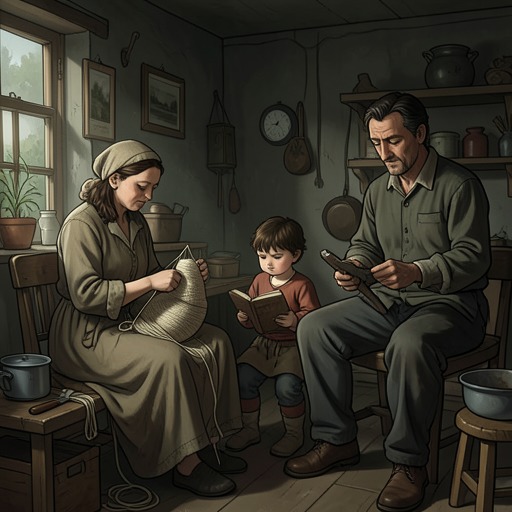
Raff Brinker
Hans Brinker, or The Silver SkatesRaff Brinker is the father whose sudden injury reshapes the lives of Hans Brinker, Gretel Brinker, and Dame Brinker. Once remembered by Hans as hearty and cheerful, he spends ten years unable to understand his surroundings; his eventual recovery restores him to his family and brings back a crucial fragment of another man’s past. The contrast between the father his children remember and the helpless man they care for makes Raff’s story one of the novel’s central reckonings with memory, family devotion, and the consequences of a single disaster.
Identity and Background
Before his injury, Raff Brinker worked for years on Holland’s dikes. He was on duty at a threatened embankment near Veermyk Sluice during a storm, when workers struggled in darkness and sleet to protect a weak point from inundation. Raff fell from the scaffolding and was brought home with his head bruised and cut. He never returned to work: although his body remained strong, his mind and memory were gone.
The disaster divides his children’s memories of him. Gretel Brinker can recall him only as a strange, silent man whose vacant eyes followed her. Hans Brinker, who was old enough to know his father before the fall, remembers a cheerful voice, being carried on his shoulders, and a careless song that seems to linger in his thoughts. The two memories describe not different sides of one ordinary personality but the sharp break the accident imposed on the family.
Raff’s wife, Dame Brinker, supports the household through vegetable-growing, spinning, and knitting. In earlier years she had also done hard labor on barges and towing ropes, but Hans grew strong enough to take over much of that work. Raff’s need for constant care adds another burden to her poverty. Though he understands less than a small child, he remains physically powerful, and she sometimes struggles to control him.
Life with His Family During the Illness
Raff’s condition is not simply quiet absence. His strength persists without the judgment or understanding that once governed it, making care unpredictable and at times dangerous. During one episode, Dame Brinker kneels by the hearth to blow the peat fire into a blaze, one of Raff’s few pleasures. He suddenly seizes her and holds her close to the flames, laughing as her gown begins to smoke. Hans rushes in from the canal after hearing her scream, tries to pull her free, and then strikes Raff with a stool when the fire catches her clothing. Raff throws Hans aside.
Gretel Brinker manages to divert her father by placing on the floor a porringer of food he likes. He lets go of Dame Brinker and crawls toward it like a child. She has suffered only a partial burning of her clothes, but the family remains awake tending Raff as he passes the night in a high fever, his hands pressed to his head. Hans later tells Dr. Boekman that his father has lately held his head in this way, as if in pain. The episode shows how the family’s affection operates alongside real danger: they understand that Raff would not harm even a kitten if he were himself, but they must still respond to what his altered condition makes him do.
An object Raff entrusted to Dame Brinker on the night of his injury connects his illness to a separate, still-unresolved story. He had handed her a watch and asked her to keep it until he requested it again, but after his fall he could not recognize it. Dame Brinker has shown it to him many times without success. In moments of need she has considered selling it, yet she repeatedly resists, believing it should not be parted with while the family still has any alternative. Her restraint preserves an object whose history Raff alone can explain.
Operation and Recognition
Ten years after the accident, Raff lies in bed in the Brinker cottage, pale and feverish, unable to understand what is happening around him. Dr. Boekman examines his condition in conversation with his student and assistant. He compares Raff’s symptoms with a previous case in which a fall was followed by increasing mental incapacity and a hand repeatedly raised to the head. In that case, an operation had uncovered and removed a small sac pressing on the brain. The comparison gives the doctor grounds to attempt treatment, though his account does not establish in advance that Raff’s case will have the same cause or outcome.
After the operation, Raff’s first movements are tentative. His hands rise to the bandage on his forehead, no longer in restless confusion but with a questioning touch. He then recognizes Dame Brinker and asks where little Hans is. Hans is beside him, and the doctor holds him back as Dame Brinker calls Gretel to see that their father knows them. The recognition is the family’s first clear sign that the man they have waited for has returned to them.
That evening, Raff feels well enough to sit upright in a rough, high-backed chair beside the fire. Hans helps support his heavy body while Dame Brinker anxiously assists, worried that they are lifting him without the doctor’s orders. Raff speaks of feeling weak and asks how long it has been since the night when the waters were coming in. When told that ten years have passed since the last Pinxter week he remembers, he struggles to understand the lost time and asks whether he has been feverish ever since. His recovery restores recognition before it restores the intervening years: he knows his family, but his own life still seems to him to have stopped at the dike accident.
The Watch and the Recovered Memory
As Raff regains his strength, the watch leads him back to a night he had never been able to explain. He recalls working far down the dike line, across from Amsterdam, when a pale, distraught young man asked him to row him several miles along the river. The stranger said it was a matter of life and death, and that although the skiff was unlocked, he would be reluctant to rob its owner. Before leaving the boat, he told Raff that a man was dead and that he had to flee Holland, while insisting that he was innocent. Raff remembered objecting that a good Hollander should not help someone evade the country’s laws, but eventually pulled away faster.
The fugitive gave Raff the watch and asked him to take it to his father after a week, along with a message: if his father ever wanted him to return, he would brave everything and come back. Raff could no longer recall the father’s name or where to send the letter. He did remember the young man opening the watch, taking something from inside it, and kissing it. The memory came back unevenly, like a dream interrupted by the sound of rushing water; Raff could see the young man’s face but not recover every detail. He had never delivered the watch, and the promise entrusted to him had remained unfinished throughout his years of incapacity.
The missing name returns later in a flash of recognition. In the cottage, Raff springs from his seat, snaps his fingers, and dances a few lively flourishes before lifting Dame Brinker in delight. He announces that the name is Thomas Higgs and urges Hans to write it down. What had seemed an unidentifiable keepsake is now attached to the fugitive’s identity, giving the long-kept watch a purpose beyond the Brinkers’ own history.
Change, Family, and Narrative Significance
Raff’s return does not erase the ten years of illness or the labor his family performed in his absence. It changes their circumstances by restoring a husband and father who can again participate in family life and explain what happened on the night of his fall. His recovery also makes visible the care that sustained him: Dame Brinker kept the watch safe, Hans took on demanding work, and Gretel responded to danger with resourcefulness even while she was still a child.
In the years that follow, Raff and Dame Brinker live comfortably in Amsterdam. They remain a faithful, happy pair, and often visit a summer house near their old cottage with their children and grandchildren. This later domestic ease stands against the poverty and strain of the earlier years without suggesting that those years were insignificant. Raff’s family has not merely regained his presence; it has reached a future in which the former dike worker can share ordinary pleasures with those who once had to watch and protect him.
Raff’s character joins two strands of the plot. His fall embodies the human cost of the constant labor required to defend Holland from water, while his recovered memory unlocks the history of Thomas Higgs and the watch entrusted to him. The watch survives when Raff’s recollection does not, and the family’s decision to keep it allows his restored memory to become consequential beyond the cottage. His arc moves from remembered strength, through a decade of dependence and danger, to recognition, renewed affection, and the recovery of a promise he had been unable to fulfill.