Raff Brinker—Dame Brinker
Hans Brinker, or The Silver SkatesRaff Brinker and Dame Brinker’s marriage is shown through a stark change in their shared life: the capable, cheerful man she recalls becomes a helpless and often unrecognizing husband, and she becomes his principal caregiver. Her care is bound up with the family’s poverty and daily labor, but the story also gives it intimate form—in the watch she keeps for him, the shoes she tries to keep on his cold feet, and her refusal to leave his bedside when he is gravely ill.
Their Life Before Raff’s Injury
Dame Brinker remembers Raff as steady and exceptionally wise, a man whose judgment even the burgomaster sought. Hans, their son, remembers another side of that earlier life: a hearty, cheerful-voiced father who carried him on his shoulders and sang. The memories establish what has been lost in the marriage. Raff was not always the silent, vacant presence his daughter Gretel knows; before his injury, he was an active and affectionate husband and father, respected beyond the household as well as cherished within it.
Dame Brinker’s recollections also measure the change in recognition. She grieves that Raff no longer knows his wife and children. Gretel has no memory of him as he was, while Hans can still summon the sound of his father’s song. The difference between the children’s memories makes the loss uneven within the family, but Dame Brinker’s account anchors it in the marriage: she remembers the man who once shared their life and sees the stranger his injury has left in his place.
Injury, Dependence, and Household Work
After Raff was called out during the dangerous Pinxter week, he returned home near death, his head bruised and cut. The fever eventually passed, but the dullness remained and worsened. In the years that followed, he became so helpless that Dame Brinker had to care for him constantly. Though his understanding was no greater than a little child’s, he remained strong-armed and hearty, and at times she struggled to control him. The account presents care as demanding physical work as well as devotion: his condition made him dependent, but not necessarily easy to manage.
The family’s livelihood left little room for that work to be separated from other burdens. Dame Brinker supported the household by raising vegetables, spinning, and knitting. In earlier days she had also labored aboard barges and, on occasion, been harnessed with other women to tow a pakschuyt between Broek and Amsterdam. When Hans grew strong enough, he insisted on taking that heavy work in her place. His help reduced the labor she had to perform outside the cottage, while Raff’s increasing helplessness made her continued presence at home necessary.
Her care appears in brief domestic actions rather than in declarations. When Raff takes hold of a knitting needle, she warns Gretel to remove it before he hurts his eyes; she asks that a shoe be put back on his feet, which are often cold, though she cannot keep them covered. She continues spinning, and the wheel’s whir fills the cottage as she half wails and half hums. The scene joins work, vigilance, and grief in the same room: care does not replace the labor needed to keep the household going, but proceeds alongside it.
The Watch and Her Fidelity to Raff
The watch Raff entrusted to Dame Brinker connects their present hardship to the night his life changed. When he came home that evening, he handed it to her and told her to keep it until he asked for it again. Before he could say more, a warning arrived that the dike was in danger; Raff seized his tools and went out. He returned near midnight with his head badly injured, and Dame Brinker never saw him in his right mind again. Because Raff could no longer recognize the watch, its promised return remained unresolved along with the memory of that night.
The watch also tests the family’s material desperation. More than once, Dame Brinker took it from its hiding place when the household was in severe need and considered selling it. Each time she overcame the temptation, holding to the promise that she would not become faithless to Raff unless starvation left them no choice. Her decision gives the object a meaning specific to their relationship: it is both something the poor family might exchange for relief and a trust from a husband who can no longer remember having placed it in her care.
Care During the Family Crisis
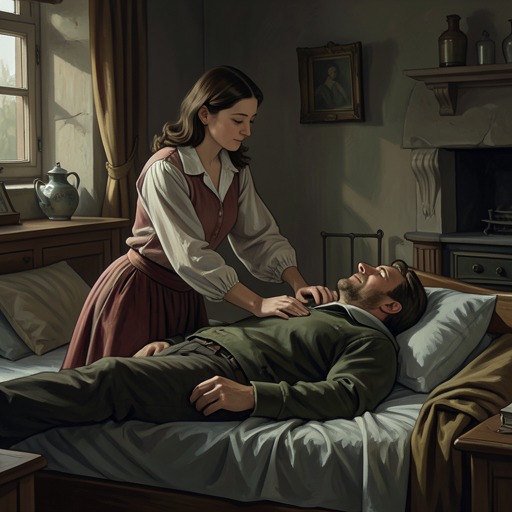
When Raff lies moaning on his rough bed, Dame Brinker bathes his forehead and lips, weeping and praying that he will not die. Gretel has wiped the brick floor, built up the slow fire with peat, and melted ice for her mother, then tries to persuade her to rest. She has straightened the willow bed and gathered soft things for it, but Dame Brinker will not leave her post or turn her eyes from her husband. The scene repeats the central pattern of their marriage in its altered form: Raff can no longer share responsibility for the household or respond as the man she remembers, while she remains beside him through exhaustion and fear.
Her refusal to sleep is not presented as an abstract ideal of marriage. Gretel points to the hours her mother has already spent awake and to her reddened eyes; Dame Brinker answers those visible signs of strain by staying at Raff’s side. The children can assist with the floor, fire, and preparations for rest, but they cannot persuade her to abandon her vigil. In this emergency, the devotion that has sustained her ordinary care becomes an unbroken watch over the injured man.
The Relationship’s Significance
The marriage is defined by continuity of care under a profound change in circumstance. Dame Brinker’s remembered husband was respected for his judgment, recognized by his family, and capable of carrying Hans and filling the home with song. The Raff she tends is cognitively diminished, difficult to control, and unable to recognize those closest to him. Yet her regard persists: she recalls who he was, protects the watch he entrusted to her, and tends his body when he is helpless.
The narrative places that private fidelity amid practical pressures rather than apart from them. Vegetable growing, spinning, knitting, former barge labor, Hans’s assumption of the towing work, and Raff’s need for constant supervision all shape what their household life requires. Dame Brinker’s care therefore appears both emotional and material: it is remembrance and loyalty, but also the repeated work of clothing, feeding, watching, and tending a husband whose former self survives chiefly in the family’s memories.