Raff Brinker’s recovery
Hans Brinker, or The Silver SkatesRaff Brinker’s recovery is the return of his memory and recognition after ten years unconscious, restoring him to his wife and children while exposing the cost of the lost decade. His first responses establish that he knows his family; his later bewilderment shows how much of their shared life has changed beyond his knowledge. The recovery therefore brings both joyful reunion and the painful discovery of time irretrievably missed.
The First Signs of Recognition
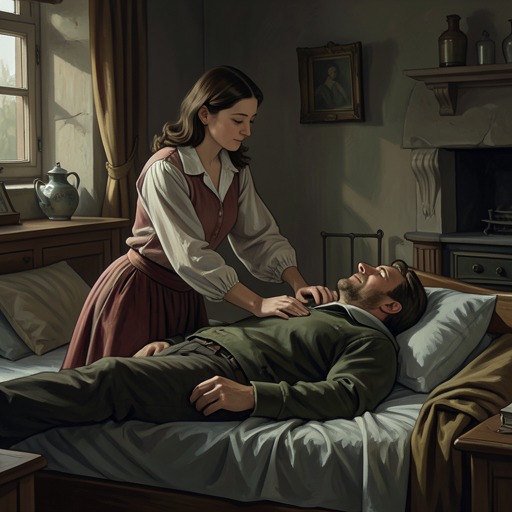
The change begins with a slight movement on the bed. Dr. Boekman leans forward as Raff’s hands twitch and then move steadily toward his forehead. His touch finds the bandage with a questioning gesture, not the restless movement associated with his former confused state. The doctor watches closely, waiting to see what the movement means.
Raff’s first words confirm that recognition has returned. He addresses his wife, Meitje, and asks where little Hans is. Hans answers that he is there, but Dr. Boekman holds him back. Meitje cries out that Raff knows them and calls Gretel to come see her father. The family’s response is immediate: after years in which Raff could not recognize them, a question about his son has made their relationship present again.
His recognition reaches beyond the children. He asks whether the baby is asleep, using the family’s old understanding of Gretel as an infant. Meitje realizes that he knows her and Hans, but has no awareness of the ten years that have passed or of Gretel growing up. His memory has returned with an earlier family still intact inside it, while the people around him have lived through a decade he cannot recall.
Medical Care and the Household’s Response
Dr. Boekman calls the case remarkable, but directs the family’s attention to Raff’s immediate needs. He insists on perfect quiet, says he will return the next day, and instructs Meitje to give the patient no food that day. His caution sets a limit on the household’s joy: recognition is a crucial change, but Raff remains a patient under care. He leaves with his assistant, while his coach and horses have been waiting near the canal.
As Raff becomes able to sit up, Meitje and Hans help him settle into a chair. Gretel brings things to support and cover him, moves the carved bench under his feet, and joins the practical work of making him comfortable. Hans tends the fire. These small acts mark the recovery as a family undertaking as well as a medical event: the people Raff has just recognized now care for him in the altered household he has not yet learned to understand.
Waking into a Changed Life
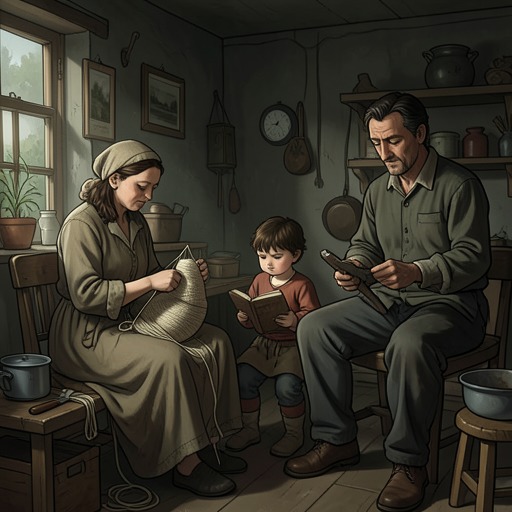
Raff looks around in bewilderment. The child he had called little Hans has grown into a young man who can nearly carry him; the baby he remembers is Gretel, now over four feet tall and sweeping the hearth. Meitje, too, has changed during the years he cannot remember. In the room, the pine table he made before his marriage, the Bible on the shelf, and the cupboard in the corner remain familiar. These unchanged household objects give him points of recognition amid a family and a life transformed by time.
The narrator presents the loss as more than a gap in recollection. Raff has missed ten years of adulthood, household happiness and care, work, and enjoyment of the outdoors. Once awake, he must meet the people he loves as they are now while confronting the blank between his earlier life and the present. His tears register that double force: the family has been restored to him, but the years themselves cannot be restored.
Work, Recovery, and the Dikes
Raff’s first expressed wish after sitting up is to return to work on the dikes. He tells Meitje that his brain still seems to turn like a spinning wheel and will not be right until he is back there, then asks when he can go. Meitje is delighted by his desire to work but frightened by his readiness to leave his chair. Their exchange shows that his return to familiar purpose is also a practical concern: wanting to work does not mean he is already ready to do so.
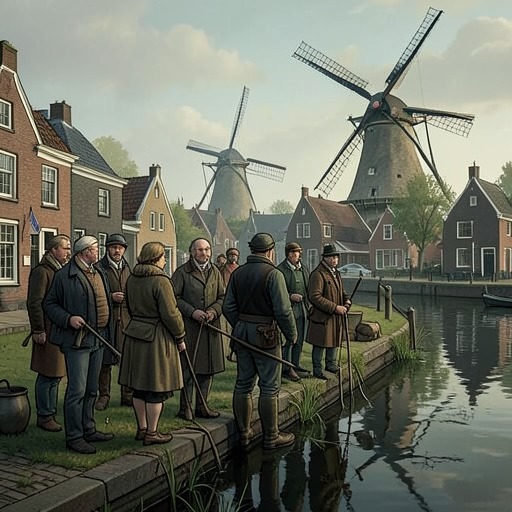
The dikes carry particular weight in the book’s account of Holland. The country depends on continued repair and water regulation; the historical account of the 1570 flood describes the catastrophic consequences when defenses failed. A school lesson on the Hero of Haarlem likewise explains why the work of sluicers and the constant watch over water matter to the survival of the land. Against that background, Raff’s wish to resume dike work reconnects his personal recovery with the labor that shaped his life. The novel’s emphasis remains on his family and his own gradual return, but his first ambition points toward a familiar role in a country where vigilance against water is never finished.
The Meaning of the Return
Raff’s recovery does not erase his incapacity or make the missing decade a simple interval. It restores the recognition on which family life depends, while leaving him to encounter the consequences of his absence: grown children, a changed wife, and a world whose continuity he can grasp only through familiar faces and objects. The scene balances a clear medical breakthrough with the slower work of adjustment.
The family’s relief culminates in shared prayer after Dr. Boekman has left. Their gratitude follows the recognition itself, but the doctor’s instructions and Raff’s bewilderment keep the moment grounded in ongoing care. His recovery is thus both a reunion and a beginning: Raff knows who his family is, yet must learn who they have become—and how to live again in the years that continued without him.