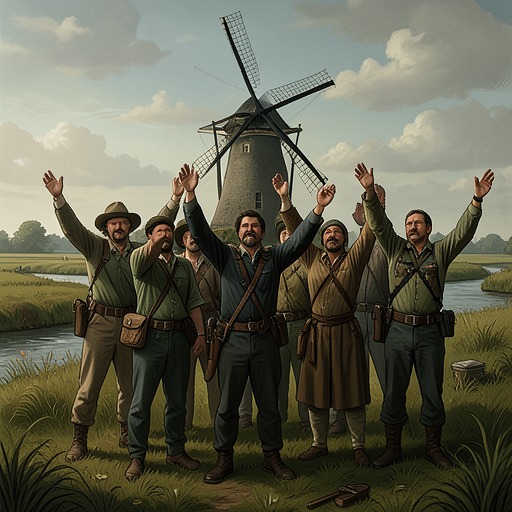
Siege of Leiden in 1574
Hans Brinker, or The Silver SkatesThe Siege of Leiden in 1574 is presented as a prolonged trial of civic endurance, with surrender refused even as provisions ran out and disease spread. Ben recounts the siege to his companions during their visit to Leiden, celebrating the resolve of the city’s people and the relief that finally came by water. The episode joins military resistance to the landscape that shaped life in Holland: water, normally a persistent danger to the low-lying country, becomes the means by which the city is relieved.
Background and Circumstances
The siege enters the story through Ben’s conversation with Lambert van Mounen. When the boys are in Leiden, Ben recognizes it as the place associated with the siege and urges his companions to honor Adrian van der Werf, the city’s burgomaster. Lambert cautions him against cheering loudly in the street at midday, explaining that the police might object. Ben’s enthusiasm, and Lambert’s reminder of their present surroundings, frame the historical account as a remembered struggle encountered amid ordinary travel.
Ben describes Leiden as surrounded on every side by the Spanish enemy. Great forts sent fire into the city, while its defenders maintained that there would be no surrender. The account emphasizes that resistance did not belong to soldiers alone: Ben calls the men, women, and children brave, showing the siege as a collective ordeal in which the whole population shared the consequences of encirclement.
The city’s hardship deepened as its provisions dwindled. Ben says that people ate the grass between paving stones and resorted to animals including horses, cats, dogs, and rats. Plague followed, with hundreds dying in the streets. These details make the refusal to surrender more than a declaration of patriotism: it was sustained under conditions in which hunger and sickness pressed upon the inhabitants alongside the military threat.
Resistance Under Van der Werf
As the people’s strength failed, they gathered in the public square and begged Van der Werf to give up the city. Ben recounts the burgomaster’s answer as an uncompromising pledge to continue its defense with God’s help. He represented his own body as something the starving inhabitants might take for food, but insisted that they should expect no surrender while he remained alive. In Ben’s telling, the appeal turns the question of military resistance into a personal and civic commitment: the leader offers himself to the people but refuses to abandon the city.
Ben nearly turns the recollection into a public cheer. Lambert playfully covers his mouth, and the boys tumble into a brief scuffle. The interruption is comic, but it also marks the distance between the remembered crisis and the present-day street: Ben’s admiration is immediate, while his companions must still observe the rules of their visit. His account presents Leiden’s resistance as worthy of celebration even when that celebration must be restrained.
Relief by Water
The siege’s reversal comes when the wind changes and the waters rise. Ben explains that Dutch boats were then able to sail over land, carrying men and provisions to the city gates. In this account, the flood that threatened the surrounding country becomes an instrument of relief: a change in wind and water alters the military situation and gives the besieged a way to receive aid. The arrival of supplies follows months of isolation and deprivation, making the environment part of the event’s decisive turn rather than a passive setting.
Carrier pigeons also carried letters to and from the besieged city. Ben says that the birds served during the crisis and were reverently kept after their deaths, stuffed and placed in the town hall. Lambert confirms that visitors can see them in the same building as Van der Werf’s portrait. The preserved birds and the portrait give the siege a material presence in Leiden: its communication network and its civic leadership remain objects of public memory after the immediate danger has passed.
Aftermath and Remembrance
The siege is recalled not only through the arrival of relief but through what the people did before eating the bread brought by the Dutch ships. Ben imagines the scarred and famished survivors, led by Van der Werf, going to the great church to sing an anthem because Leiden was free. Their thanksgiving began before the first meal. The song rose through the congregation and then gave way to sobbing, as the accumulated strain of the siege overtook the people. The account treats that interruption not as a failure of celebration but as part of its meaning: the city’s freedom was won amid suffering too great for the survivors to contain in song.
During the boys’ visit, the old tower associated with the siege supplies another image of endurance. From its wall they recall the watcher who, for months, could report no help and saw only the enemy surrounding the city. The view connects the present city to its period of isolation, when its people waited for the waters to rise and for rescue to become possible. Later, Ben contrasts Leiden’s resistance with the still more heroic example he attributes to Haarlem, while insisting that Leiden’s ordeal remains one of his own historical touchstones. Through his recollection, the siege becomes both a particular struggle for survival and a lasting emblem of Dutch resistance, in which collective resolve and the country’s difficult relationship with water are inseparable.