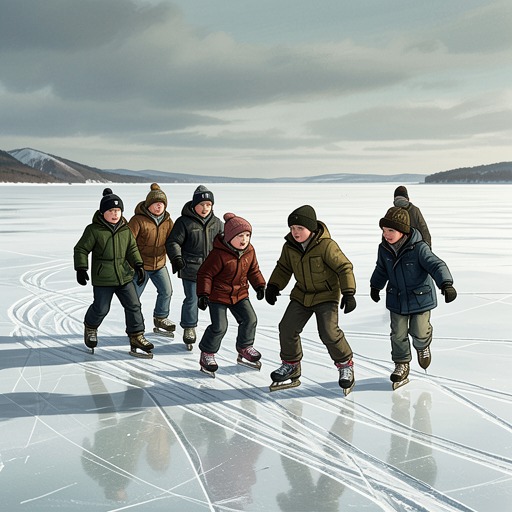
The Brinker boys’ skating journey to The Hague
Hans Brinker, or The Silver SkatesThe Brinker boys’ skating journey to The Hague turns a long winter excursion into a chain of tests, mishaps, and recoveries. The boys skate from Broek to The Hague and back, covering more than forty miles, but the journey is not simply a feat of distance: Jacob Poot’s exhaustion forces the group to reconsider its pace, an iceboat offers unexpected relief, and the purse they lose and recover becomes entangled with the capture of a robber. The return to Amsterdam ends the expedition in a burst of collective cheering.
The Excursion and Its Stakes
The journey belongs to a book deliberately shaped to unite the knowledge of travel writing with the interest of a domestic tale. Its preface describes the Dutch settings and customs as carefully observed and says that many incidents are drawn from life. Within that design, the boys’ excursion makes travel more than a sequence of places: the route creates occasions for companionship, rivalry, fatigue, and practical cooperation.
The destination is The Hague, and the return route makes the undertaking a round trip from Broek. The scale of the effort becomes clear in the sister of Peter van Holp’s account: the boys had skated over forty miles and seen unusual sights along the way. The distance gives weight to the journey’s later reversals. A tired companion is not a minor interruption when the party is far from home and has spent the day moving across the ice.
The story also places this adventure within a larger portrait of Holland. Its narrator invites young readers to imagine canals serving as both streets and waterways, alongside gabled houses, windmills, warehouses, and the mingling of trees and ship masts. The frozen routes the boys travel are part of that distinctive landscape: familiar paths and public thoroughfares transformed by winter into skating ground. Travel observation and plot thus meet in the same setting, where the country’s geography shapes what the boys can do and how they must respond when their plans falter.
Fatigue and the Iceboat
On the return journey, the party’s progress becomes a question of whether to continue or rest. Peter van Holp proposes that the group consult Jacob’s wishes, since Jacob had started the excursion. Carl Schummel dismisses the idea and mocks the possibility that anyone is tired, while Ludwig van Holp and Lambert van Mounen are anxious about losing the distinction of having skated all the way from Broek to The Hague and back. Even so, both agree that Jacob should decide. The exchange reveals how the expedition’s shared ambition can pull against its members’ physical limits: the honor of completing the route matters, but Jacob’s condition cannot simply be ignored.
The narrative later identifies one of the party’s falls as the occasion for an iceboat sail. Jacob becomes so exhausted that skating farther that day is impossible, and the group must find another way to get him toward Leiden. Their resolve not to abandon him sits alongside their private longing for a ride in an iceboat. A breeze is blowing southward, but the first sail Peter hails does not respond. Three drays on runners pass, already full; then an appealing little iceboat flashes by before the boys can board it. With no better option, they prepare to support Jacob with their arms and take him to the nearest village.
At the last moment, a shabby iceboat comes into view. Peter hails it with little hope, waving his hat. The later account of the adventure remembers the fall not only as a setback but as the chance for a grand sail. The episode changes the journey’s character: what began as an attempt to cover the distance on skates becomes, through fatigue and improvisation, a shared ride in a different kind of winter conveyance.
Lost Purse and the Robber
The journey’s other reversals gather around the party’s purse. In recounting the boys’ adventures, Peter’s sister says they lost it and found it again. The purse makes the expedition’s fortunes tangible: the boys have to recover what they have misplaced rather than simply proceed as if nothing has happened. The account then gives the capture of a robber a particular consequence. By catching him, the boys save their slippery purse for a second time, turning a travel mishap into an episode of alertness and collective action.
The available account also shows the boys pursuing another practical concern: Peter and Jacob inquire about Dr. Boekman, but cannot find him. They learn only that he was seen in Haarlem that morning. At the Red Lion Inn, the other boys have already returned to a blazing fire; Peter and Jacob arrive after their unsuccessful inquiries. The warm welcome of the fire contrasts with the uncertainty of their search, while the doctor’s absence leaves the excursion’s immediate business unresolved. The journey therefore gathers more than scenic impressions: it tests the boys’ ability to handle fatigue, loss, and failed plans without dissolving the party.
Homeward Journey and Narrative Shape
The boys leave their kind entertainers early on Monday morning and set out for home. Peter lingers at the door to exchange parting words with his sister. Benjamin Dobbs notices the affection in their farewell and thinks of the kiss his own sister Jenny gave him when he left home; the same tenderness, he recognizes, crosses national boundaries. Ludwig, by contrast, accepts his sister’s extra kiss for their mother with matter-of-fact embarrassment. This quiet domestic moment brings the travel episode back to family ties, placing the boys’ public adventure beside the ordinary attachments they carry with them.
As the party reaches Amsterdam, Lambert van Mounen calls for three cheers at the great Western Dock. The boys answer together. Their English-style cheering, introduced to the party by Lambert, is treated as an exploit and creates a sensation among the small boys on the wharf. The noisy arrival gives the return a social as well as geographical conclusion: the travelers are home, and their expedition has become a story worth telling.
That story is explicitly retold afterward through the sister’s account: more than forty miles of skating, rare sights, a lost and recovered purse, a companion’s fall, an iceboat sail, and a robber caught. This compressed retrospective gathers separate incidents into a coherent adventure, while the full journey lets each interruption alter the boys’ progress. Its significance lies in that balance between itinerary and episode. The road to The Hague and back supplies the structure; the companions’ responses to fatigue, mishap, and one another give the excursion its human shape.