The Hague
Hans Brinker, or The Silver SkatesThe Hague is the capital and intended high point of the boys’ nearly fifty-mile skating journey from Broek. In the itinerary, it is both a destination to explore and a place where Peter van Holp’s married sister can welcome the travelers, joining the novel’s Dutch travel writing to its domestic story.
The Hague in the Dutch Travel Narrative
The book frames its family tale as a journey through Dutch places and everyday life. Its preface describes the work as combining the instructive qualities of travel writing with the interest of a domestic story, and says that Dutch localities and customs have been carefully depicted. The Hague belongs to that mapped landscape: it is named as the capital of Holland and made the farthest point in the boys’ proposed excursion from Broek.
The novel’s wider portrait of Holland emphasizes how geography and human labor shape the country. Much of the land lies below sea level, so dikes and water-control works are essential to keeping it habitable. Windmills pump water from lowlands into canals and help guard against inland floods; their work belongs to a national system of maintenance rather than to any specifically described feature of The Hague. This context gives the journey across Holland a practical dimension: the country’s routes and settlements exist within a landscape continually managed against water.
The Skating Journey’s Destination
The Hague enters the plot through a plan made by Jacob Poot and Ben. They receive permission for a long skating journey from Broek to the capital, almost fifty miles away, during the holiday for Saint Nicholas’s festival and four extra days allotted for cleaning the schoolhouse. The distance makes the trip an undertaking, not simply a short outing, and gives the boys’ shared holiday a clear geographical goal.
Peter van Holp proposes a route that turns the expedition into a sequence of visits. The party can stop at Haarlem to see its great organ, continue to Leiden for its many sights, and spend a day and night in The Hague. Peter explains that his married sister lives there and will be delighted to see the boys; they can set out for home the following morning. The proposed stay therefore rests on family hospitality as well as curiosity about the capital.
Place, Movement, and the Boys’ Experience
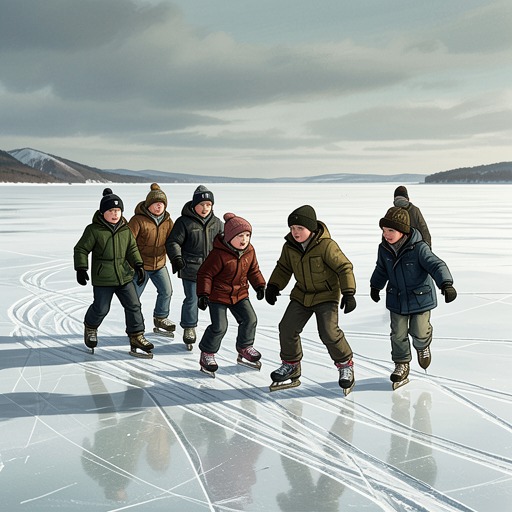
The approach to the journey is grounded in the infrastructure and winter recreation of Holland. On the canal, the boys skate past long rows of bare willow trees, while a carriage road runs along the high dike beside Haarlem Lake. The frozen water carries not only skaters but brown-winged iceboats, push-chairs, and small sleds propelled by iron-pronged sticks. The scene shows how the journey’s means of travel belong to the same landscape of canals and dikes that organizes Dutch life.
The Hague’s importance in this episode is consequently prospective: it gives the group’s journey its farthest point, while the named stops and planned overnight stay lend the route shape. The available account establishes the boys’ intention to visit and the welcome they expect from Peter’s sister; it does not, in these passages, describe their arrival or their activities in the city.
The Hague as a Link Between Travel and Home
The planned visit brings public geography into the orbit of personal relationships. Haarlem and Leiden promise sights, while The Hague also offers a relative’s home and a night of hospitality. The itinerary thus makes travel more than a catalogue of places: movement through the country is organized by friendship, kinship, and the practical question of where a party of young skaters can stay.
The city also reflects the book’s larger method. The narrator invites readers to imagine Dutch places through concrete routes, customs, and landscapes, while keeping the Brinker family and the children’s everyday experiences at the center of the story. The Hague is not given a detailed city portrait in the cited account; its narrative significance lies instead in its status as the capital, the ambitious endpoint of the skating plan, and the promised household welcome that helps make the distant journey imaginable.