The Netherlands’ longstanding flood threat
Hans Brinker, or The Silver SkatesHolland’s flood threat is not a remote danger but a condition built into the country’s geography and daily life. Much of the land lies below sea level; dikes, sluices, windmills, and the people who maintain them hold back waters that otherwise could overwhelm fields, roads, homes, and whole towns. The novel presents this struggle both as national infrastructure and as intimate family history: Raff Brinker loses his health while working at a weak dike, and his children grow up with the consequences.
A country between land and water
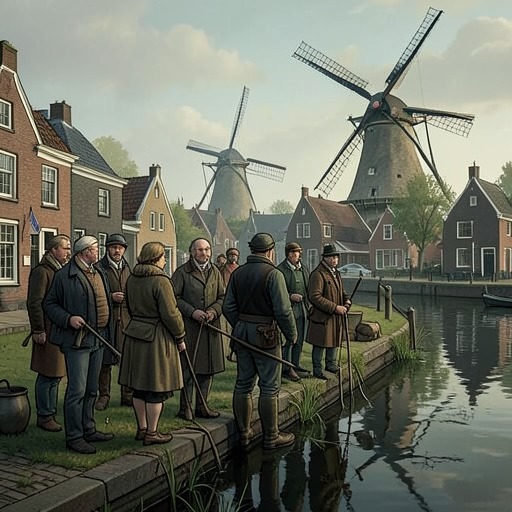
Holland is described as a place where the ordinary boundary between land and water seems unsettled. Ditches, canals, ponds, rivers, and lakes spread across the country, while substantial stretches of land sit lower than the sea. The narrator turns this geography into a visual reversal: ships can float with their keels higher than the roofs of houses, and a frog among the reeds seems nearer the stars than a stork nesting on a roof peak. Water is not merely scenery beside the fields; it occupies the same lived landscape and repeatedly threatens to take it over.
The dikes are broad, high embankments built at great cost to keep the ocean from the lowlands. Some carry buildings, trees, and public roads, making protective works part of the ordinary terrain as well as barriers against disaster. Yet their scale does not make them invulnerable. The sea can press hard against the coast, and a dike can spring a leak or break. The country’s apparent stability therefore depends on continuous work against a force that remains present even when no breach is visible.
An engineered and maintained defense
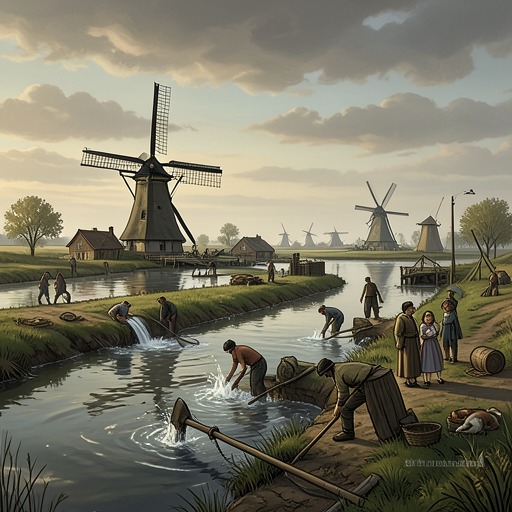
The system described in the book joins dikes to canals, sluice gates, and windmills. Windmills do many kinds of work, including sawing timber and grinding, but their principal purpose is to pump water from lowlands into canals and guard against inland floods. The narrator estimates that Holland has at least ninety-nine hundred large windmills, with sails from eighty to one hundred and twenty feet long, and that their yearly cost approaches ten million dollars. These figures convey a defense made of many dispersed machines rather than a single monumental barrier.
Some newer mills can adjust their sails to changing wind: they spread them to catch a faint current and draw them in when a heavy blow comes. Their automatic response makes them part of a network whose effectiveness depends on both design and upkeep. The narrator compares Holland’s situation to a prison cell where a prisoner must keep pumping to prevent rising water from drowning him. On a national scale, the Dutch, too, must keep pumping to remain on their land. Every year, millions of dollars go toward repairing dikes and regulating water levels; without those duties, the country would be uninhabitable.
The defense also relies on organized human labor. Thawing rivers can become choked with blocks of ice and overflow before their rising waters can reach the sea, while the sea simultaneously presses against the dikes. Engineers and workmen watch threatened places night and day. When a general danger signal sounds, inhabitants rush to help. Straw, apparently frail against water, is pressed into huge mats, then reinforced with clay and heavy stones against the embankments. The scene makes protection a collective practice: machinery and engineering matter, but so do inspection, repair, and the rapid coordination of people who share the risk.
Floods, rules, and shared responsibility
Neglected defenses have consequences on a scale that reaches far beyond damaged property. The narrative says that towns and villages have repeatedly been buried by floodwaters and that nearly a million people have been destroyed across such disasters. It singles out the inundation of 1570 as one of the most terrible. Drawing on Motley’s account, it describes a long, violent gale driving Atlantic waters into the North Sea until dikes burst in many places. Even the heavily built Hand-bos, reinforced with oaken piles, iron, anchors, gravel, and granite, was broken apart. Boats and larger vessels were swept inland; Friesland became an angry sea.
The account of 1570 gives the disaster human scale: people and domestic animals struggled in the waves, homes were inundated, and survivors crowded onto trees and church steeples. Boats went out as the storm subsided to rescue people from the water and rooftops and to gather the dead. The narrative reports that at least one hundred thousand people perished within a few hours, with thousands of animals also lost and property damage beyond calculation. The episode shows what lies behind the recurring work of maintenance: when the defenses fail, water transforms familiar settlements into a landscape of flight, rescue, and loss.
The disaster also alters the account of responsibility. The Spanish governor, previously hated because of his Spanish or Portuguese blood, earns Dutch gratitude through his efforts to save lives and reduce suffering. He introduces an improved method of dike construction and passes a law requiring owners of the soil to maintain the defenses. Fewer major floods follow for a time, although six severe inundations sweep across the country in the less than three centuries that follow. The rule makes maintenance an assigned duty, but it does not end the danger; the continued recurrence of floods keeps the obligation visible.
The threat in everyday movement and family life
Water-control works shape ordinary travel as well as emergency response. During the boys’ skating journey, a straight canal runs between rows of bare willow trees, while a carriage road lies high on the opposite dike, built to contain the Haarlemmermeer. Skaters, iceboats, push-chairs, and small sleds share the frozen route. At Halfweg, Peter explains that the IJ and the Haarlemmermeer meet there and that the river is five feet higher than the land. Strong dikes and sluice gates, he says, are necessary to prevent immediate flooding. A place that invites recreation is also a demonstration of how exposed the surrounding land would be without its engineered boundaries.
The national danger enters the Brinker family’s history through Raff Brinker’s work. For years he was employed on the dikes. During a threatened inundation, men labored in a terrible storm, in darkness and sleet, at a weak spot near the Veermyk Sluice. Raff fell from the scaffolding and became unconscious. From that hour he never worked again; although he lived, his mind and memory were gone. The crisis that demands collective labor thus also places individual workers in physical danger.
That injury becomes part of the children’s different memories of their father. Gretel can remember Raff only as the strange, silent man whose eyes followed her vacantly. Hans, who had known him before the fall, remembers a cheerful, hearty-voiced father who carried him on his shoulders; even as he lies awake, he seems to hear his father’s carefree song. The contrast links a national system of protection to a household’s lasting loss. The dike is a defense against water, but maintaining it is not cost-free: the labor that protects the country can break the life of one of the people assigned to that work.
Narrative significance
The flood threat gives Holland’s landscape a continuing causal force. Water organizes where roads rise, why canals and sluices matter, how windmills are used, and when communities must leave ordinary tasks to reinforce an embankment. The book’s account moves between a broad history of inundation and a family’s particular misfortune, refusing to make national resilience seem effortless. Dikes can hold, and the people’s perseverance is praised; yet the danger returns, and protection requires repeated expenditure, watchfulness, and labor.
The result is a portrait of security as something maintained rather than possessed. Holland’s carefully cultivated land and busy waterways depend on an infrastructure that must be repaired and operated year after year, while the consequences of its failure fall on towns, animals, households, and workers. Raff’s fall near the Veermyk Sluice gives that principle a human face: the struggle against water sustains the country, but it also enters the family as injury, silence, and a memory of the father who was there before the accident.