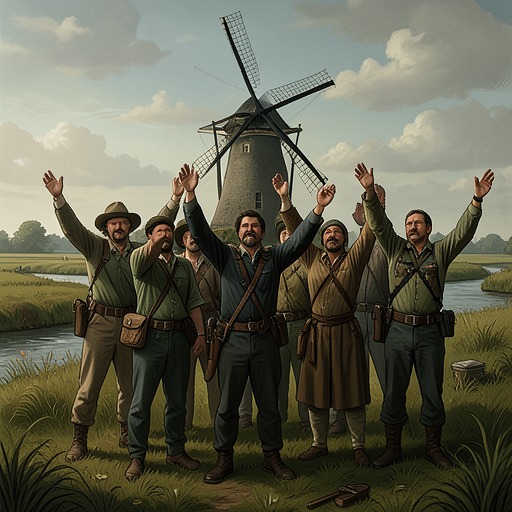
The battlefield of Europe
Hans Brinker, or The Silver SkatesThe battlefield of Europe describes Holland as a country formed by both human conflict and the struggle against its vulnerable landscape. The phrase belongs to a larger portrait of a nation marked by resistance and victory, yet also by religious freedom, enterprise, and shelter for the oppressed; its force comes from holding danger and endurance together.
A Historical Description
The expression appears in a preface to Holland’s history and character. The book presents itself as both a travel account and a domestic tale, joining descriptions of Dutch places and customs to a family story whose central incident, Raff Brinker’s fall, is said to be based on fact. Within that design, Holland’s historical reputation is not remote background: it helps explain the conditions in which ordinary lives unfold.
The phrase is paired with a contrasting description of Holland as a refuge for people oppressed elsewhere. The same national history that records patience, resistance, and victory is also associated with religious freedom, learning, art, music, literature, and public charity. The contrast prevents the image of a battlefield from becoming a complete definition of the country: Holland is represented not only as a place exposed to conflict, but as a society that offers protection and builds institutions.
Water and the Work of Survival
The book gives the phrase a material counterpart in Holland’s geography. A large part of the country lies below sea level, and dikes hold back the sea while sluices regulate water flowing through canals. Rivers can rise in spring when thawing ice obstructs their channels, even as the sea presses against the embankments. Windmills pump water from lowlands into canals, while engineers, workmen, and residents watch threatened places and join in repairs when danger is signaled. Straw mats reinforced with clay and stone are among the defenses used against a rushing tide.
This effort is described as permanent rather than exceptional. The book compares the Dutch need to pump for survival to a prison punishment in which a prisoner must keep pumping to prevent rising water from drowning him. It also reports that millions of dollars are spent each year repairing dikes and regulating water levels. The comparison makes the country’s exposure feel continuous: the threat is not only an invading army or a single catastrophic storm, but the recurring work required to keep land and settlement secure.
The history of floods sharpens that point. The 1570 inundation followed a long and violent gale that drove water against the coast until dikes failed in many places; Friesland became a sea, and about one hundred thousand people died within hours. Robles, the Spanish governor, took an active role in rescue and later introduced an improved method of dike construction and a law requiring landowners to maintain the barriers. The account notes that fewer major floods followed, though six severe inundations still occurred in less than three centuries. Disaster and administration therefore sit side by side: survival depends on shared effort, but also on rules assigning responsibility for maintenance.
From National History to Family Life
The national struggle against water enters the family plot through Raff Brinker’s work. He had been employed on the dikes for years. During a threatened inundation, in a storm near the Veermyk Sluice, he fell from scaffolding and became unconscious. He never returned to work, and his memory and understanding were lost. The episode makes the country’s defense more than a public or historical subject: the labor that protects Holland can expose workers and families to lasting consequences.
The children experience their father’s altered state differently. Gretel cannot remember him as he was before the accident, while Hans recalls a cheerful father who carried him on his shoulders. That contrast joins national memory to domestic memory: the same dike work that belongs to a story of collective endurance also marks a decisive break in one household’s life. The phrase thus gains a personal dimension without turning Raff’s experience into a military battle.
Conflict Remembered and Retold
The book also brings Dutch conflict into the children’s present through remembered history. In a school lesson, an English pupil reads about the Hero of Haarlem, whose father was a sluicer; the passage explains that a moment’s neglect of sluice duties could bring ruin to the surrounding country. The history lesson makes vigilance part of everyday knowledge, passed on even to children.
During the boys’ travels, Ben recalls the siege of Leiden and Van der Werf’s refusal to surrender. He describes months of encirclement, dwindling provisions, plague, and townspeople asking the burgomaster to give up; Van der Werf’s resolve becomes a compact image of resistance. The account is voiced as Ben’s passionate recollection, not as a new battlefield scene. Through such retellings, the book presents the phrase as a national memory carried into classrooms, journeys, and conversation. Its meaning rests in the connection between resistance to human enemies and the repeated, collective work of defending a country exposed to water.