The great skating race
Hans Brinker, or The Silver SkatesThe great skating race is the public contest for the silver skates held on December 20 near Amsterdam. Gretel wins the girls’ race, and Peter wins the boys’ after Hans gives him his skate strap rather than compete; the event thus joins athletic victory to a more personal test of loyalty and generosity. Before the crowd, Gretel’s speed overturns the contempt attached to her poverty, while Hans’s choice helps his friend reach the finish first.
Setting and Public Occasion
The race takes place on a faultless plain of ice near Amsterdam, on an arm of the Zuider Zee known as the IJ. The date brings ideal winter weather: sunlight warms the level landscape, but the ice holds firm across lake, canal, and river. With the air still, the windmills near Broek have stopped working for the day. Their millers take in their sails and join the crowd, leaving the machinery that ordinarily grinds, crushes, and saws idle for the occasion.
The event draws far more than the competitors and their families. Spectators gather along the north side of the frozen IJ; townspeople, visitors, and northern peasants who have come to Amsterdam to trade all make their way to the ice. Men, women, and children arrive on wheels, skates, or foot. Their clothing ranges from furs and winter wraps to garments more suited to autumn, giving the scene the air of a holiday shared across the town and countryside.
The frozen landscape is already a public thoroughfare, not an empty stage prepared solely for the race. Canals carry skaters, brown-winged iceboats, push-chairs, and small sleds propelled by iron-pronged sticks. Earlier, the boys had travelled along a straight canal bordered by bare willow trees, with a raised carriage road running along the dike beside the Haarlemmermeer. Dikes, sluices, canals, and managed waterways shape both the landscape and the journeys that bring people to the contest. The race depends on winter ice, but it unfolds within a country whose movement and safety also rely on constant water management.
Contest and Competitors
Twenty girls and twenty boys take part, racing in turn, with the girls given the first run. The rules, read aloud by the crier, require each group to skate from the united columns to the flagstaff line, turn, and return to the starting point, a mile for each run. The contest continues until one girl and one boy have each beaten the others twice. A flag marks the judges’ stand; Madame van Gleck gives the start by dropping a white handkerchief, after which a bugle sounds.
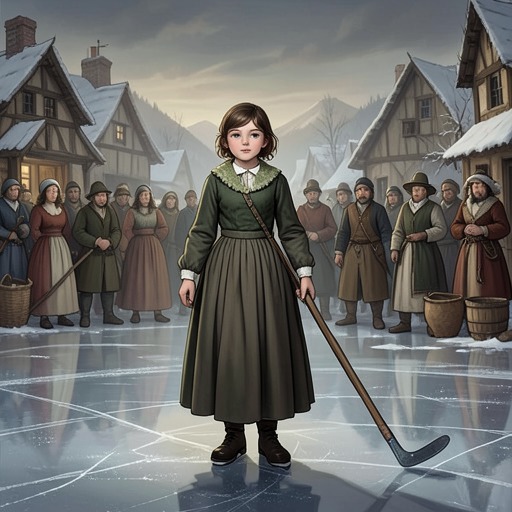
Hilda, Rychie, and Katrinka are among the girls at the line. Gretel is there too, wearing a red jacket, a new brown petticoat, and a new cap: clothes that make her strikingly different from the poor child the crowd might expect a “goose girl” to be. Annie Bouman also enters. Janzoon Kolp’s sister is admitted, but Janzoon himself has been excluded by the directors because he killed a stork and was caught robbing a bird’s nest, an offense under Dutch law. The decision makes the race a regulated public occasion as well as a sporting spectacle: conduct outside the contest affects who is permitted to join it.
Gretel Wins the Girls’ Race
When the girls return from the course, Gretel is ahead of Rychie, Katrinka, Annie, Hilda, and the other skaters. In earlier races she had only been playing; now she skates in earnest, and the narrator presents her determination through the sudden difference in her effort. Her small, lithe figure seems almost to move without strain, yet she cannot stop until she has passed the goal. The crowd recognizes her victory before the crier can make the announcement: Gretel has won the silver skates.
Her first response is not to seek the center of the celebration. She looks about timidly and wants to dart toward the sheltered place where her parents are standing, but Hans is beside her and the girls crowd around. Hilda’s joyful greeting meets her amid the excitement. The victory changes Gretel’s standing in public: although she remains the same poor girl, she is no longer to be despised as a goose girl. The account calls her the acknowledged queen of the skaters, making the race a sharp reversal of the social judgment that had diminished her.
Hans Gives Peter His Chance
As the girls’ triumph is celebrated, Hans turns to see whether Peter is watching. Peter is not looking toward Gretel. He is kneeling over his skate, troubled because, while trying to tighten its strap and make a new hole, he has cut it nearly in two. The mishap threatens to keep him from the boys’ race just as it is about to begin.
Hans immediately offers his own strap. Peter initially refuses, tells Hans to return to his place, and points out that the bugle will sound within a minute. Hans presses him to accept: Peter has called him a friend, there is no time to lose, and Hans says he is out of practice and cannot possibly win. He urges Peter to hurry because Madame van Gleck is motioning for the racers to assemble, and identifies Carl Schummel and Peter as the likely contenders. Peter finally accepts the strap and springs to his post as the handkerchief falls and the bugle sounds.
The choice costs Hans his own chance to race. He does not merely lend Peter equipment and then return to the line; by putting his strap on Peter’s skate, he makes it possible for his friend to compete and leaves himself out of the contest. Afterward, Hans borrows a strap from the cake boy and stands near the head of the procession, but the account does not present this as a return to the race for the silver skates. The decisive act has already been made: he has placed Peter’s opportunity ahead of his own.
Peter’s Victory and the Awards
The boys set off amid cheers, and the crowd follows the changing leaders as they speed around the course. Peter wins the boys’ race. The crier announces his name, but a hundred voices are already calling it; he is the favorite boy of the place. His victory is therefore both the official result and a popular celebration. Hans, who could not compete after giving up his strap, watches Peter’s success as the consequence of his own intervention.
After the races, the competitors form a single-file procession. Peter leads because he is tallest, while Gretel takes her place at the end because she is the smallest. The line curves and doubles among the arches, then resolves into boys and girls standing in a double semicircle before Madame van Gleck’s pavilion. Peter and Gretel are placed together at the center, in front of the others. When the silver skates are placed in their hands, Gretel trembles and can scarcely hear what is said over the surrounding noise. The skates flash in the sunlight across the two winners’ happy faces.
Gretel’s joy then carries her away from the formal ceremony. She gathers the skates and bouquets into her apron, hugs them to her, and darts through the dispersing crowd to find her parents. The conclusion brings the public prize back to the family she first wanted to reach: the girl celebrated by the spectators runs to share her triumph with those waiting for her. Together, the two victories give the race its defining contrast. Gretel earns recognition through her own speed; Peter wins with the help of Hans, whose unselfish act turns the contest into a demonstration of friendship as well as skill.