Amsterdam
Hans Brinker, or The Silver SkatesAmsterdam gives the book a vivid urban center and a way to see Holland at several scales: as a place of crooked houses, canals, commerce, and public collections, and as a country whose survival depends on managing water. Hans and Gretel’s earlier world of skating journeys is revisited from the perspective of a traveler writing in 1873, while later episodes bring the Brinker family into the city for practical errands and, finally, Hans’s professional life.
A city observed and revisited
The preface describes the book as joining travel writing to domestic fiction, with careful attention to Dutch places and customs. Amsterdam makes that double purpose concrete. In a letter dated July 30, 1873, the narrator invites readers to imagine walking there together, then inventories what a visitor might notice: gable-ended houses, small mirrors outside windows, wooden shoes and dogcarts, warehouses, canals, and a distant line of windmills. The city is not merely a scenic backdrop; its streets and everyday practices are presented as evidence of a distinctive national life.
The narrator also reports a visit to an old house in the business quarter, where a woman earns her living selling hot water and burning peat. Children carry away boiling water and peat in a stone pail, paying a Dutch cent. In another part of the city, washerwomen work over tall tubs in public streets, rubbing clothes in cold water. These encounters shift the travel account from celebrated architecture to household economy: Amsterdam’s character appears in small adaptations that make heat, food, and washing possible for people with limited means.
The 1873 letter explicitly looks backward more than twenty years to the time when Hans and Gretel skated on the IJ. It also notes that the cities have grown and that contact with other nations has worn away some older peculiarities. Amsterdam therefore stands between two moments: a city remembered through the children’s earlier adventures and one observed by the narrator in the present of the letter, still recognizable but changing.
Canals, bridges, and the water landscape
The book introduces Amsterdam through the boys’ arrival on skates. In less than half an hour they cross a masonry dike and reach what the narrative describes as a walled city of ninety-five islands and nearly two hundred bridges. For Ben, who is visiting with Dutch companions, the city is a succession of marvels: tall houses with forked chimneys, merchant storerooms high beneath the roofs, and long cranes that raise and lower goods past household windows. Public buildings stand on wooden piles driven into marshy ground. Narrow streets, canals, bridges, locks, and mixed costumes fill the view; shops and dwellings even press close against church fronts, their chimneys rising beside the sacred walls.
The city’s curious details also reveal how its residents watch and move through shared space. Mirrors fixed outside nearly every window let householders observe the street or see who is at the door without being seen themselves. The canals serve as both waterways and routes of travel, while bridges and locks connect a city divided among islands. The boys’ swift skating arrival thus depends on a landscape organized by water and crossings, not on streets alone.
That urban network belongs to a wider system of Dutch water management. The book explains that much of Holland lies below sea level and is protected by costly dikes; canals, sluice gates, and windmills help control water and defend lowlands from flooding. It gives a national estimate of at least 9,900 large windmills, many used chiefly to pump water, and describes their continual maintenance as necessary to keep the country habitable. Near Halfweg, Lambert explains that the IJ and Haarlemmermeer meet where the river lies five feet above the land, making strong dikes and sluice gates essential. This regional account helps explain the engineered landscape through which travelers approach Amsterdam, without reducing the city itself to a monument: its routes and daily life are bound to the same practical struggle with water.
Museums, markets, and family errands
Amsterdam is also a place of learning and exchange. During the boys’ visit, they enter a museum that is a picture gallery, with works by Dutch masters and nearly two hundred portfolios of rare engravings. Hinged panels allow pictures to be swung forward into better light. Ben studies a work by Gerard Douw called “Evening School,” while Peter points out the qualities of “The Hermit” and recounts an anecdote about the artist. The episode makes the city’s cultural institutions part of the journey: the boys move from skating through an engineered landscape to looking closely at art and hearing its history.
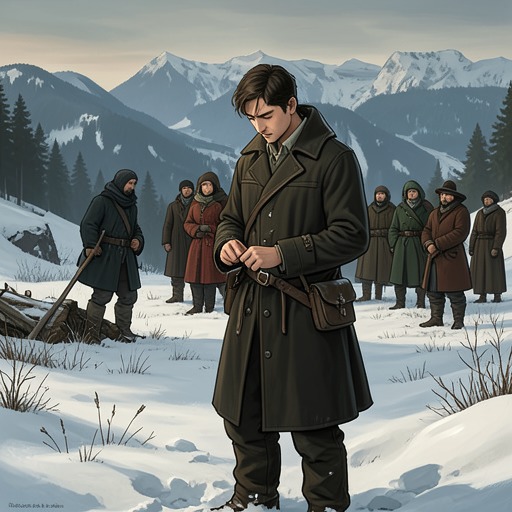
For Hans, Amsterdam has a more immediate pull. While skating toward it across the frozen IJ, he considers whether people in Broek really use gold kitchen utensils and wonders whether a local cheese seller prepares cream in golden pans. The narrative then records his decision to buy skates. Later, after the family’s thousand guilders have been recovered, Hans and Dame Brinker go to Amsterdam for peat and provisions. Their new means bring a sudden abundance of imagined wants, but the small bundles they carry home contrast with the scale of Dame Brinker’s hopes. In these episodes, the city is where desire meets the household’s practical needs: it offers goods, but the Brinkers’ return to security is measured in fuel and provisions, not extravagance.
Public spectacle and later life
On December 20, Amsterdam is the setting near which the great skating race draws a large crowd. The selected course lies on a level stretch of ice near the city, on the arm of the Zuider Zee that Dutch speakers call the Eye. Spectators arrive from the city and surrounding countryside, including people who have combined the race with a day’s trading. Coaches, children in charitable uniforms, orphan girls, boys from the Burgher Orphan Asylum, townspeople, and peasants in varied Dutch dress make the event a public cross-section of society. The frozen waterway temporarily becomes a meeting place as well as a route, bringing different groups together to watch the competition.
Amsterdam also supplies the book’s final image of Hans’s changed circumstances. Years later he is known as Dr. Brinker, riding in a grand coach to visit patients or skating on the frozen canal with his children. The city that first appeared as a place a poor boy approached on squeaking wooden runners becomes the setting for his established professional life. Its return at the close links mobility with advancement: the canals still offer a skating path, but Hans now crosses the city as a physician with a family and a practice.
Narrative significance
Amsterdam binds the book’s travel and family strands without making them identical. For Ben, it is a spectacle to be examined; for Hans, it is a destination associated with purchases, work, and changing prospects; for the 1873 narrator, it is a living city through which readers can be guided. The city’s houses, museums, streets, and waters make Dutch life visible, while the dikes and sluices around it remind the reader that this ordinary urban world rests on sustained engineering and labor. Its final appearance in Hans’s successful adulthood gives that setting a personal arc: the city remains recognizably tied to ice and canals even as the boy who once skated toward it becomes one of its leading physicians.