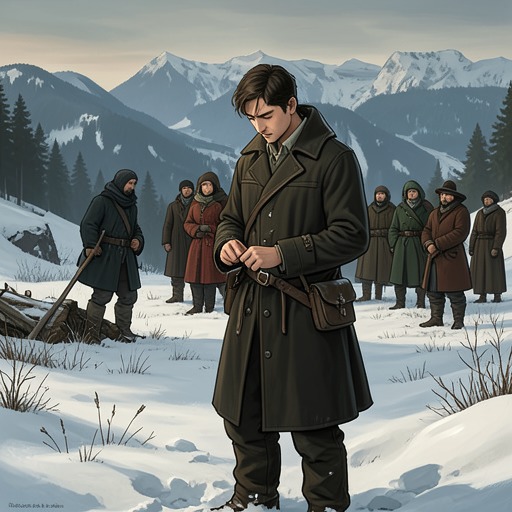
Carl Schummel
Hans Brinker, or The Silver SkatesCarl Schummel is a sharp-tongued, competitive member of the skating party whose contempt for poorer children repeatedly tests the generosity of Peter van Holp. He is neither simply an antagonist nor a reformed hero: the story gives him moments of bluster and exclusion, but also a grudging capacity to make peace, and an adult life marked by reversals and dependence on another man’s kindness.
Identity and Social Posture
Carl moves among the better-off young skaters and is especially sensitive to rank, prowess, and who belongs in the group. His response to Hans Brinker and Gretel Brinker makes that prejudice visible. When the siblings arrive on the canal with homemade or makeshift equipment, Carl mocks their appearance and treats their skates as evidence that they do not belong among the other skaters. Hilda van Gleck instead recognizes that Hans may have made his own skates and that learning on such equipment would have been difficult. Carl is abashed by her answer, a small but telling interruption: his contempt is not left uncontested, and the contrast between his sneer and Hilda’s practical sympathy establishes the social choice he repeatedly resists.
Competition intensifies his worst habits. During the boys’ trials on the ice, Peter van Holp wins three of four races, and Carl is in a poor humor. He has already directed his irritation at the smaller Voostenwalbert Schimmelpenninck, who stays near the others without feeling fully included. Carl then urges the boys to prevent Hans and Gretel from joining the race, invoking their poverty and the girls’ objections as grounds for exclusion. Peter deliberately interprets Carl’s appeal in reverse: a boy with manhood, he insists, would not deny two good skaters entry merely because they were poor. Carl objects to having his meaning turned against him, but the exchange exposes the choice underneath his rhetoric. Peter sees ability and fairness where Carl sees status and an opportunity to keep rivals out.
Encounters with Peter and the Brinker Siblings
Carl’s antagonism toward Hans recurs on the journey from Haarlem. As the party leaves the city, Carl spots Hans in patched clothes and wooden skates and complains that he seems to be everywhere. Peter, by contrast, greets Hans warmly and asks whether he can help when he notices that the boy looks troubled. Hans answers that this time he may be able to help Peter. Carl responds by skating away with a scornful remark, unwilling to share the moment of concern or the friendly exchange. The scene sets Carl’s reflexive contempt against Peter’s readiness to treat Hans as a person and a possible friend; Hans’s reply also shows that the supposedly inferior boy has something to offer the party.
Carl’s disregard for other people’s needs appears in a different form when Jacob Poot is tired during the return journey. Peter proposes that the group consult Jacob, since Jacob began the excursion. Carl dismisses the concern, asserting that they can rest later in Leiden. Ludwig van Holp and Lambert van Mounen look disappointed at the possibility of losing the distinction of having skated all the way from Broek to The Hague and back, yet both accept that Jacob should decide. Carl’s response reduces the question to endurance and public credit; the others’ willingness to defer to the exhausted organizer makes his lack of consideration stand out.
The Robbery and a First Reconciliation
At the Red Lion Inn, Carl’s quick judgments again prove unreliable. Ludwig notices one of the men by the fire and quietly tells Carl that the man looks suspicious. Carl brushes the concern aside. When a robber is later caught, Carl steps forward with an air of bravado and claims credit for having gone to raise the alarm. The other boys tease him about where he had been, and the contrast between his earlier dismissal and his later claim makes his performance part of the episode’s comedy.
Afterward, Carl takes a severe view of the captured man, saying he should be jailed immediately and that he would have killed him had he been in Peter’s place. Peter answers calmly that the robber has been arrested before on a housebreaking charge, that breaking the door fastenings constitutes burglary, and that being armed makes the case worse. Even so, Peter pities him. Carl mocks this compassion and says that he is naturally hard, adding that fine ideas do not affect him and that this is his own concern. His declaration sounds like a defense of fixed character, but the exchange does not end there. Peter recognizes some goodwill in Carl’s awkward admission and offers his hand, proposing friendship despite their disagreement. Carl returns the handshake and concedes that they agree more than Peter thinks. The reconciliation is modest: it does not erase his earlier conduct, but it shows that he can accept an overture rather than preserve hostility for its own sake.
The Race and Its Reversals
The final skating contest gives Carl a public achievement amid his repeated antagonism. In the one-mile race, Hans is initially ahead, Peter closes the distance, and Carl makes a final surge past them to reach the goal first. The crier announces Carl as the winner. His victory matters in the scene because the boy who has tried to exclude Hans is now racing on the same course and earning the crowd’s formal recognition through performance. The result does not settle the broader conflict between them, but it briefly makes skill, rather than social standing, the measure of success.
Carl’s success is followed by a fall. After Peter is announced as winner of another one-mile race, a crowd gathers around Carl near the column. He is not seriously hurt, though he is stunned; the others forget about him once he is back on his feet. The episode reverses his earlier position as the boy who judges and taunts: for a moment he is the vulnerable center of attention, but the group’s response is limited. The narration connects his isolation to his sullen manner, suggesting that sympathy is harder for him to receive when he has made little effort to cultivate it.
Adult Life and Narrative Significance
The novel’s later account gives Carl’s difficult manner a social context without presenting it as an excuse. His father suffers business reverses, Carl has few warm friends, and, in the narrator’s assessment, he lacks the support of noble principles. He is consequently tossed about by fortune, his earlier gaiety worn down by hardship. As an adult he becomes a bookkeeper in the Amsterdam firm of Boekman and Schimmelpenninck. Voostenwalbert Schimmelpenninck, the junior partner, treats him kindly; Carl, in turn, treats Voostenwalbert with respect, despite privately or familiarly making light of his unusually long name.
That later position echoes the tensions of Carl’s youth without offering a simple redemption story. The boy who used poverty to belittle Hans grows into a man whose fortunes are damaged by his father’s business failure and who benefits from another person’s generosity. His respectful conduct toward Voostenwalbert suggests an ability to respond to kindness, while the record of his hard life and thin circle of friends preserves the consequences of his earlier disposition. Carl’s role is therefore less that of a villain than of a recurring test of the group’s standards: Peter answers his harshness with fairness, Hilda challenges his class prejudice, and the skating races expose how readily ability can unsettle the hierarchies he tries to defend.