Dr. Boekman
Hans Brinker, or The Silver SkatesDr. Boekman is Holland’s most famous physician and surgeon, a formidable figure whose public reputation for severity conceals a capacity for compassion and enduring grief. His encounter with Hans Brinker draws him into the Brinker family’s crisis; the watch Raff Brinker returns to him then reveals that his estranged son, Laurens, is alive and innocent of the act that drove him away. The resulting reunion changes the doctor’s private life and opens a future in medicine for Hans.
Identity and Reputation
Dr. Boekman is known throughout Holland as a leading physician and surgeon. Hans has not met him before their encounter on the ice, but recognizes him from engraved portraits displayed in Amsterdam shop windows. His appearance and manner seem to confirm his intimidating reputation: he is thin and lank, with stern blue eyes and compressed lips, and is regarded as neither sociable nor easy to approach.
That reputation has practical consequences. Dr. Boekman is sought by wealthy patients, who may still have to wait for his attention; Peter van Holp therefore questions why Hans would seek him rather than another physician. Peter is astonished when Hans insists that the doctor is kind, since he has heard him described as the crossest man in Holland. The contrast between public impression and private conduct becomes central to the doctor’s portrayal: his first response to Hans is brusque, but it does not define the help he gives.
Hans’s Appeal and Raff’s Care
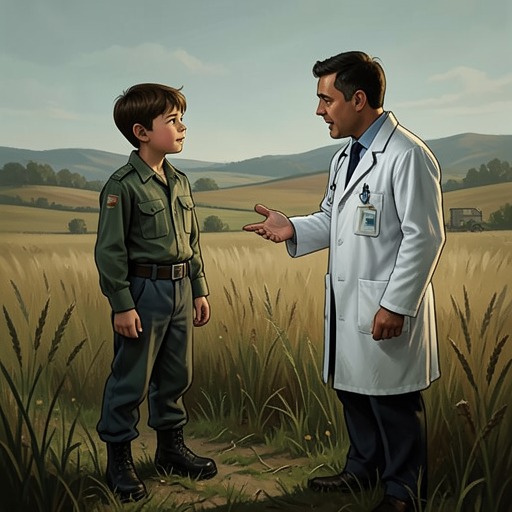
Hans approaches Dr. Boekman while crossing the frozen Y, despite the doctor’s forbidding appearance. Guided by his conscience, Hans believes the money he might use to buy skates should instead help his father. When Dr. Boekman assumes he is being asked for alms and moves to dismiss him, Hans answers proudly that he is not a beggar. He explains that Raff is alive but mentally incapacitated after falling on the dikes, and offers his small amount of silver toward a consultation.
Hans tells the story urgently, then begs the doctor to see his father, offering to work for him if that is what treatment costs. Dr. Boekman’s manner changes: he gently places a hand on Hans’s shoulder, refuses the money, and agrees to visit. He does not promise a cure. Learning that Raff has been in this condition for ten years, he calls the case hopeless, but says he will come after returning from Leiden, where he is due to spend a week.
The plan becomes urgent when Raff’s condition worsens. Hans tells Peter that the family believes his father may be dying and asks him to plead for the doctor to come sooner rather than wait the promised week. The Brinker family’s trust rests on Dr. Boekman’s word, and Peter’s surprise at Hans’s confidence underscores how unusual this response seems to people who know only the doctor’s reputation. Later, Dr. Boekman visits the cottage and sees that Raff is mending fast. His haste on arrival suggests concern, but he recognizes that the patient no longer needs him in the same way.
The Watch and Laurens’s Story
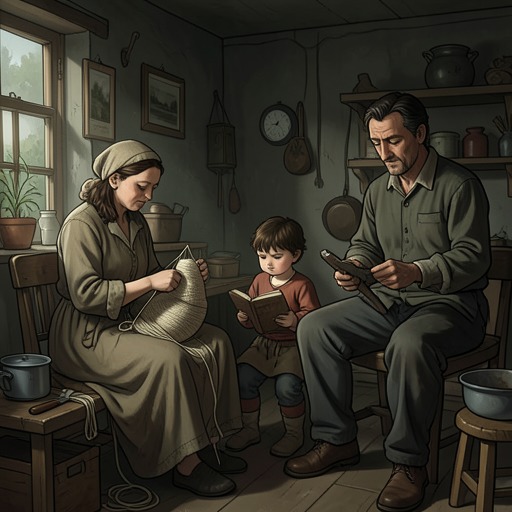
At the cottage, Dame Brinker explains that the family has just found the thousand guilders missing for ten years. Dr. Boekman scarcely attends to the apology she makes for the modest house and uncleared dinner; his attention shifts when she produces a watch associated with the young man who had entrusted it to Raff. The initials L.J.B. on the watch lead him to recognize its connection to Laurens, and he is overcome by the possibility that his son’s message has at last reached him.
When Raff explains that the young man removed something from the watch and kissed it before leaving, Dr. Boekman attempts to open the stiff case. Inside is a watch paper bearing blue forget-me-nots. He recognizes it as Laurens’s mother’s picture and understands that his son had kept her memory with him. The watch therefore does more than identify its owner: its contents contradict the doctor’s long-held fear that Laurens had forgotten his family.
Dr. Boekman then explains the misunderstanding that separated them. Laurens had served as his assistant and mistakenly prepared the wrong medicine for a patient; the medicine was a deadly poison, but Dr. Boekman discovered the error before it was administered. The patient died that day, and Laurens, apparently believing that his mistake had caused the death, left. Dr. Boekman had been detained by other serious cases until the following evening and found his son gone when he returned home. He had not known Laurens had discovered the mistake, and had interpreted his departure as youthful folly, ingratitude, or a desire for adventure. Laurens, in turn, believed his father would never receive or answer his message. The doctor now recognizes that both had been separated by mistaken assumptions rather than a deliberate rejection.
Reconciliation and Changed Priorities
Hans reassures Dr. Boekman that Laurens loved both him and his dead mother, and that they can search for him. The doctor takes Hans’s hand and asks the Brinker family to send word if Raff ever recovers even the faintest recollection of the young man. He also recalls that Hans’s eyes had reminded him of Laurens from their first meeting. Hans’s intervention has thus become personal: the boy who first asked for help for his father has helped restore the doctor’s hope for his own son.
Laurens is eventually found and reunited with Dr. Boekman. At the family hearth, the doctor appears contented, younger, and brighter than before, with the hard lines of his expression softened. He wears the silver watch Raff had returned. His relief is bound up with a clear change in his understanding: he knows Laurens was innocent, and no longer mistakes the long separation for abandonment. The reunion does not restore the past unchanged. Laurens has become a man with his own plans, and intends to sell his factory and open a warehouse in Amsterdam. Dr. Boekman had hoped to have him as an assistant again, but accepts that his son wishes to become a merchant.
A New Future for Hans
The doctor’s reconciliation with Laurens reshapes his relationship with Hans as well. He proposes that Hans study to become a physician, and makes clear that he will pay the cost rather than deprive the Brinker family of the boy’s earnings. He imagines a future with two sons: Laurens as a merchant and Hans as a surgeon. Hans accepts the offer silently, too moved to speak.
Dr. Boekman also sees a place for Raff in Laurens’s plans. Since Laurens is to open a warehouse in Amsterdam, the doctor suggests that he will need a reliable person to oversee its affairs and begins urging Raff to speak for himself. The proposal links the Brinker family’s future to the doctor’s: the man who first came to their cottage as a physician now offers both employment and education. Dr. Boekman’s arc turns on this widening of care. His exceptional professional skill matters, but so do his willingness to respond to Hans, his grief over Laurens, and his decision to support the futures of the people who helped reunite them.