Dutch dike-maintenance law of 1570
Hans Brinker, or The Silver SkatesThe Dutch dike-maintenance law of 1570 made landowners responsible for keeping the dikes in repair, turning a vital part of Holland’s defense against flooding into a continuing duty attached to the protected land. Introduced after a devastating inundation, the law belongs to a world where water levels, engineered barriers, and the labor of maintaining them shaped both public safety and ordinary life.
Water and the need for upkeep
Much of Holland lies below sea level, and dikes keep the sea from overwhelming the land. They are costly structures, sometimes broad enough to carry roads, buildings, and trees; where they fail, the consequences can reach entire towns and villages. The law addressed a danger that was not exceptional or distant: dikes required sustained attention because both the sea and inland waters continually tested them.
The book presents this dependence as a condition of life. In an Amsterdam prison, a lazy prisoner was forced to pump water from a cell lest he drown; on a far greater scale, the Dutch had to keep pumping to preserve their country. The comparison makes clear why a rule about dike maintenance meant more than a one-time repair order: safety depended on work repeated over time.
The disaster and the law
The measure followed the All Saints' Flood of 1570, described as the worst of a series of twenty-eight major floods. A prolonged gale drove water against the coastal provinces until dikes burst in many places. In Friesland, the flood turned the land into a sea; homes and graveyards were inundated, and people and animals were swept into the water. The account gives the death toll as no fewer than one hundred thousand people, with property losses beyond calculation.
Robles, the Spanish governor, took a leading role in rescue efforts. Though the Dutch had previously regarded him with hostility because of his Spanish or Portuguese blood, his actions during the disaster won their gratitude. He then introduced an improved method of constructing dikes and passed the law requiring landowners to maintain them. The account associates these changes with fewer heavy floods thereafter, while making clear that they did not end the threat: six severe inundations still struck within less than three hundred years.
Maintenance as an ongoing system
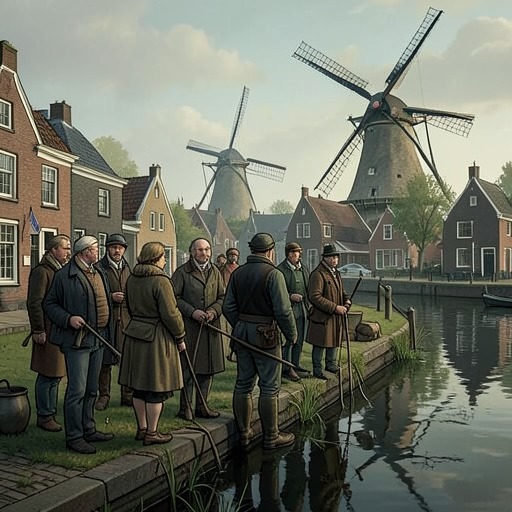
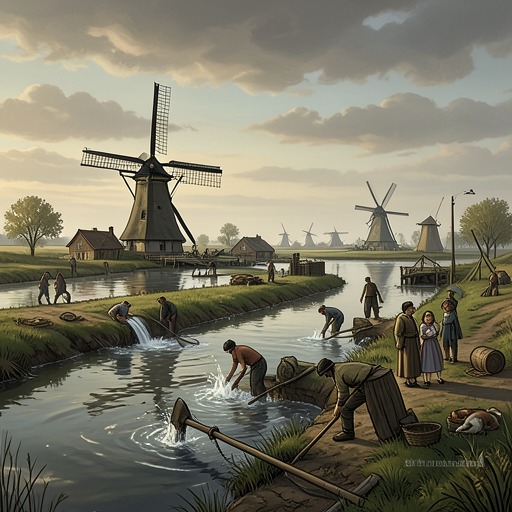
The law operated within a broader network of labor and water-control works. Windmills pumped water from lowlands into canals and helped guard against inland freshets; the book says that there were at least 9,900 large windmills in Holland, with yearly costs approaching ten million dollars. Each year, millions more were spent repairing dikes and regulating water levels. These figures convey the scale of the task: assigning responsibility to landowners did not make protection simple or inexpensive.
Seasonal danger demanded organized vigilance as well. During spring thaws, rivers choked with ice could overflow before their rising waters reached the sea, while the sea pressed against the dikes. Engineers and workmen watched threatened places day and night. When a general danger signal sounded, inhabitants joined the effort, laying huge straw mats against embankments and reinforcing them with clay and heavy stones. The legal duty of upkeep thus sits alongside a wider practice of coordinated response when ordinary maintenance was not enough.
Place in the story
The novel connects this system of protection to the Brinker family’s history. Raff Brinker had worked on the dikes for years. During a threatened inundation, amid a storm, darkness, and sleet, he fell from scaffolding at a weak point near Veermyk Sluice and lost consciousness. He never returned to work; his mind and memory were gone. The public infrastructure whose upkeep the law regulated therefore also shaped a family’s private fortunes, as hazardous maintenance work became the turning point in Raff’s life and the cause of lasting hardship for his children.
Other scenes make the engineered landscape tangible: near Halfweg, the IJ and the lake meet where the river stands five feet above the land, requiring strong dikes and sluice gates. Against that physical setting, the law’s significance is practical rather than abstract. It assigns responsibility for barriers on which settlement, travel, and work depend, while the repeated need for repairs and collective emergency action shows the limits of any single rule. Holland’s safety rests not on a final victory over water, but on keeping its defenses working.