Dutch resistance and liberation
Hans Brinker, or The Silver SkatesDutch resistance and liberation is the book’s account of a people enduring foreign rule, siege, famine, and disaster while preserving a claim to self-government. Its significance lies not only in military resistance: the narrative carries the struggle into churches, civic memory, historical relics, and the Dutch landscape itself, showing how past sacrifice informs the present.
Historical Setting and the Work’s Frame
The book introduces Dutch history as part of a work intended to combine travel description with a domestic story. Its preface says that descriptions of Dutch places, customs, and national characteristics were prepared with care, and that the story of Raff Brinker was founded on fact. The historical material accordingly shares space with scenes of everyday life: the country’s past is not separated from the places its young travelers visit.
The narrator’s 1873 address to children at home establishes this double perspective. Holland is described as still recognizable despite its cities’ growth and the changes brought by contact with other nations. The narrator praises its courage and industry while inviting readers to learn about it through the story. Dutch resistance thus belongs both to remembered history and to a contemporary account of national character; the book presents the country as marked by struggle but no longer defined only by it.
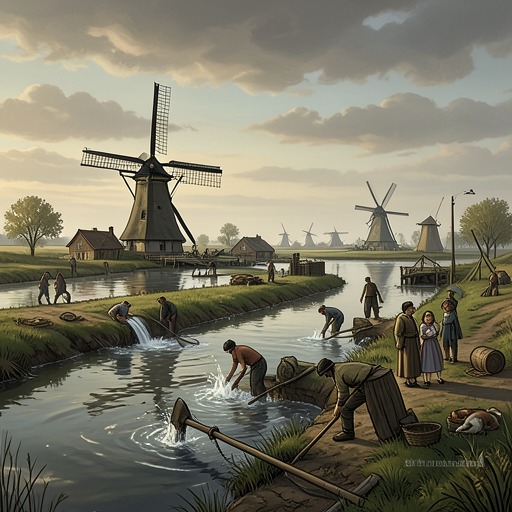
That contrast is sharpened by the physical conditions of the country. The narrative explains that much of Holland lies below sea level and depends on dikes and constant attention to water. A lesson read aloud in an English school describes the sluicer’s duty to regulate canal gates and warns that a moment of neglect could bring ruin to the surrounding country. This account concerns water management, not resistance to Spain, but it gives the book a recurring image of collective vigilance: the survival of the land, like the defense of a besieged city, requires sustained public effort.
Siege, Resistance, and the Cost of Holding Out
The siege of Haarlem is presented through Ben’s explanation to his companions. In his account, Spanish forces under Frederic of Toledo surround the city, while the inhabitants refuse to yield for months. Women take up arms alongside their husbands and fathers; three hundred serve under Kanau Hesselaer. The townspeople’s defiance includes throwing bread toward the enemy camp to show that they do not fear starvation, even as their supplies dwindle.
The account then turns from defiance to deprivation. Provisions run out, people die of hunger, and the living have little strength left to bury the dead. Faced with the prospect of a prolonged death, the strongest inhabitants resolve to form a square around the weakest and attempt to break through, accepting that the effort may end in their deaths. The Spanish side, hearing of the plan and believing the Dutch capable of carrying it out, offers terms. But the promised protection and forgiveness prove deceptive: Spanish forces gain entry by false promises, while the Duke of Alva has already ordered his son to show no mercy. Haarlem’s resistance is therefore not depicted as an uncomplicated victory. Its endurance is heroic, but the narrative also stresses how deception makes the city’s eventual defeat more grievous.
Ben compares Haarlem’s resistance with the siege of Leiden, judging the former an example of courage that preceded and strengthened the latter. The two episodes are linked by the book as stages in a broader national struggle, but they are not interchangeable: Haarlem’s story culminates in betrayal and massacre, whereas Leiden’s becomes a story of relief and survival. The distinction lets the narrative honor resistance without suggesting that courage alone guarantees the same outcome in every city.
Leiden: Relief, Commemoration, and Faith
Ben recalls Leiden as a city surrounded by the enemy and pressed by hunger and plague. The inhabitants have eaten animals and the grass between paving stones; hundreds die in the streets. When the starving people gather around the burgomaster Adrian van der Werf and plead for surrender, Ben presents him as refusing to abandon the city, even offering his own body to the hungry rather than yield while he lives. His account makes civic leadership a form of shared endurance: the burgomaster’s resolve answers the desperation of the people without denying the extremity of their need.
The siege is also remembered through the means by which news traveled. Ben says carrier pigeons bore letters to and from the besieged city and were later preserved in the town hall. In his account of relief, a change in the wind allows water to flood the approaches and Dutch boats to sail across the inundated land with men and provisions toward the city gates. The pigeons and the boats make communication and water central to the story’s reversal: a city cut off from help is reached through the very landscape that had made its defense and relief so difficult.
The narrative’s most affecting image of Leiden’s liberation is not a meal or a military triumph but an act of thanksgiving. Ben imagines the famished survivors following Adrian van der Werf to the great church to sing before tasting the bread brought by the Dutch ships. Their anthem rises, then turns to sobbing, and the people can sing no more. The sequence places gratitude before material relief while also acknowledging that deliverance does not erase suffering. The city’s freedom is remembered as both public triumph and a moment in which accumulated grief breaks through.
From Resistance to National Memory
The book makes the history of resistance visible through places and objects. In Haarlem, Ben cannot think of the town without remembering the victims of Alva’s violence; in Leiden, the city’s streets and church evoke the siege, the survivors, and their thanksgiving. The narrator describes Ben as carrying these histories with him while moving through Dutch towns, even as he observes the prosperity that followed liberation. The past shapes his response to the present rather than replacing it.
A historical collection gives this memory a material form. The young visitors see wallets and bowls once carried by the Beggar Confederates, who united under the Prince of Orange and helped free Holland from Spanish tyranny. The Dutch visitors gaze soberly at the relics and are privately proud to show them to Ben. The name Beggars, once cast mockingly upon the oppressed, had become a title they wore with pride; in the collection, everyday objects connect that transformation to the national story. Resistance appears not only in battles and sieges but also in the preservation and display of what its participants carried.
The book also sets liberation against a later period of foreign subjection. In The Hague, Ben reflects on Holland’s unwilling submission to French rule and its eventual determination to escape what he sees as an intolerable burden: wealth sent to a foreign treasury and young people taken by conscription. He is glad that the fighting has ended and that Holland is a monarchy in its own right. This later episode is distinct from the struggle against Spain, but it reinforces the narrative’s emphasis on resistance to outside control and on the recovery of national independence.
Narrative Significance
Dutch resistance and liberation is conveyed through several forms of remembrance: a traveler’s reflections, a boy’s historical account to his companions, a school lesson about vigilance, and relics displayed in a collection. These forms make history something encountered and retold rather than a detached chronicle. The children hear about sieges while moving through the country whose cities and institutions preserve their traces; the reader, in turn, is asked to see present-day Holland alongside the struggles that shaped it.
The account holds together courage, loss, and recovery without flattening them into a single celebratory story. Haarlem demonstrates the vulnerability of a people whose resistance is answered by deception; Leiden offers relief, but its anthem ends in sobbing. Later independence brings prosperity and the possibility of ordinary life, while the memory of Spanish tyranny and subsequent foreign rule remains active. The book’s central claim is that Dutch character is legible in this continuity: a nation’s freedom is remembered not as an effortless inheritance, but as something defended, mourned, and renewed.