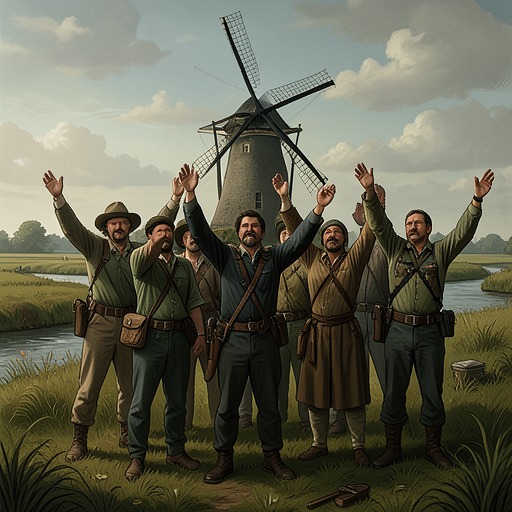
Haarlem Massacre
Hans Brinker, or The Silver SkatesThe Haarlem Massacre is presented as the Spanish violence that followed the siege of Haarlem and turned a promised settlement into betrayal. In the novel, the account reaches the reader indirectly: the boys discuss Dutch resistance, move from one siege story to another, and identify the massacre through recollection that one speaker admits is hazy. The episode’s significance lies not only in the reported slaughter but in the contrast between assurances of protection and an order to spare no one.
Historical Setting and the Siege
The conversation introduces the massacre through the wider conflict between the Dutch and Spanish rule. The boys first discuss a city surrounded by Spanish forces, its defenders enduring a prolonged siege and severe shortages. That account concerns Van der Werf and the resistance of Leiden; the exchange then turns to the Haarlem massacre. The movement between these histories makes the Dutch struggle against Spain the shared frame, but it does not make the two sieges the same event.
The novel offers a separate, concise reference to Haarlem: a recollection of an image in a shop window associates the massacre with the Spanish after the siege of the city. That passing reference establishes the broad sequence—siege, then massacre—without supplying a date, a count of victims, or a detailed chronology. The scene is therefore remembered as part of a history of Dutch suffering, rather than narrated as a fully reconstructed military episode.
Negotiation and Entry into the City
In the boys’ account, the defenders’ position becomes desperate. They resolve that the strongest will form a square around the weakest and attempt to break through the enemy, accepting that the effort may end in their deaths. The account says the Spaniards learn of this plan and, believing the Dutch capable of extreme resistance, offer terms. The offered settlement appears to provide a way out of a crisis in which the besieged have little prospect of survival.
The terms, however, are described as false. The Spanish obtain entrance to the city by promising protection and forgiveness, with an exception for people the citizens themselves would acknowledge as deserving death. This condition lends the promise an appearance of agreed limits: punishment is represented as subject to the community’s own judgment. The next revelation overturns that appearance. The Duke of Alva had already ordered his son to show mercy to none. Thus, in the story as told, the promise is not merely broken after entry; it conceals an intention that makes the terms deceptive from the outset.
The Massacre and Its Place in the Account
The boys identify the ensuing violence as the great Haarlem massacre and describe the Dutch as butchered by the Duke of Alva and his forces. The evidence does not give a number of dead or set out the massacre’s duration and particular acts. Its defining facts here are the Spanish entry under false assurances, the prior order against mercy, and the killing that follows. Keeping those limits clear matters: the novel makes the betrayal plain while leaving the episode’s scale and details largely unstated in this exchange.
The speakers also place the massacre within a reciprocal history of violence. One acknowledges that the Dutch sometimes retaliated terribly, even while insisting that accounts of Spanish treatment explain why the Dutch disliked Spain. This admission complicates the conversation’s moral contrast without equating the circumstances described: the immediate emphasis remains on the breach of the promised protection and the order to spare no one. The event is invoked as a reason for lasting hostility, not as an isolated atrocity detached from the conflict around it.
Recollection and Narrative Significance
The event is transmitted as conversation rather than as an authoritative historical lecture. The boys’ earlier discussion of Leiden supplies the setting for the transition, but the shift to Haarlem also exposes how easily separate episodes can blur in memory. A speaker recognizes the massacre as the incident he had in mind, then admits to having an indistinct grasp of historical matters. The text therefore preserves both the force of the shared memory and the uncertainty of the speaker who passes it on; it does not invite every detail of the conversation to be treated as a precise chronology.
That uncertainty does not erase the episode’s central moral structure. The sequence remains legible: desperate defenders, a proposed attempt to escape, Spanish terms, entry secured by promises, and an order from Alva’s son that denies mercy. In the surrounding discussion, Dutch resistance is remembered through named leaders and stories of endurance; Haarlem supplies its darker counterpoint, in which negotiation becomes a means of betrayal. The massacre consequently functions as a warning about the vulnerability of a besieged population when guarantees are used to gain access rather than to protect those who accept them.