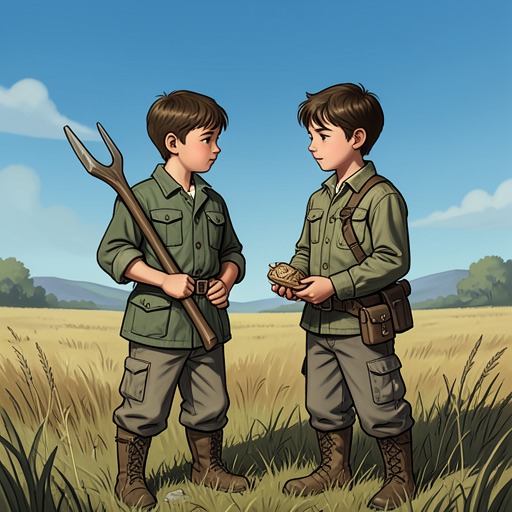
Hans Brinker and Peter van Holp’s friendship
Hans Brinker, or The Silver SkatesHans Brinker and Peter van Holp’s friendship takes shape through concrete acts of trust rather than declarations: Hans returns Peter’s lost purse and refuses a share of its money, then gives Peter his skate strap at the moment it threatens to end his race. Peter’s gratitude recognizes Hans not as a charity case or a useful helper but as a friend, while Hans’s generosity preserves its force precisely because he does not treat help as a debt to be collected.
An Unequal Meeting on the Road
Their relationship first comes into focus during the boys’ skating journey, when Hans has left home in distress and is making his way to Leyden to seek Dr. Boekman. While rubbing a knee he had hurt after stumbling against some lumber, Hans notices Peter’s purse nearly hidden beneath a log. The discovery brings together two different immediate concerns: Peter has lost something valuable, while Hans is carrying trouble of his own and has a destination he cannot afford to neglect.
Hans presents the purse to Peter, and the boys around them celebrate its recovery. Peter thanks him with unusual warmth. When Peter explains that the purse had probably slipped from his pocket as he pulled out his tippet, he offers to divide its contents with Hans. Hans quietly refuses; Peter puts the silver away without pressing him. The exchange establishes an important condition of their friendship: Peter may offer material repayment, but Hans is not willing to let an honest return become a paid service.
Peter’s response is inward as well as outward. He thinks that he likes Hans whether rich or poor, and asks about the trouble that has brought him onto the road. Hans explains that he is going to Leyden to see Dr. Boekman. Peter’s interest follows the recovered purse rather than ending with it: he recognizes Hans’s difficult circumstances and makes room for the story behind the act. The purse thus serves as the occasion for a continuing regard, not simply a momentary expression of thanks.
Trust Tested in the Race
The friendship becomes more visible at the great skating race, where Peter and Hans are both caught up in the contest’s stakes. When Gretel Brinker wins the silver skates, Hans turns to share in his sister’s triumph and sees Peter kneeling over a damaged skate strap. Peter has tried to tighten it by making a new hole, but his knife has cut it almost in two. Without a usable strap, his chance to continue is in immediate danger.
Hans offers the strap from his own skate. Peter initially resists, thanking him but urging him to return to his place before the bugle sounds. Hans insists that Peter take it, saying that Peter has called him a friend; he even tells Peter that he himself is out of practice and could not win. Hans removes his skate and fits his strap onto Peter’s, persisting despite Peter’s objections. His help is therefore more than a spare object lent without consequence: it costs him the opportunity to enter the race himself.
The moment is pressed by the approaching start. Lambert calls from the line, and Hans points out that Peter is being summoned to join the racers. He urges Peter to hurry, arguing that the contest lies between Peter and Carl Schummel. Peter finally accepts the strap and reaches his post just as the white handkerchief falls and the bugle sounds. The sequence makes Hans’s choice legible through its timing: his aid gets Peter into the race, but leaves no time for Hans to reclaim his own chance.
Gratitude Without a Price
After the race, Peter returns Hans’s strap and speaks to him privately. He says that Hans need not expect thanks, but acknowledges that Hans did him a great kindness and that he is proud to call him a friend. Peter adds, laughing, that he had not realized how anxious he was to win until he was actually in the race. The confession gives the strap’s importance a reciprocal dimension: Hans’s intervention mattered because Peter truly cared about competing, not because the object was valuable in itself.
Hans laughs with him, relieved of his embarrassment, while Dame Brinker remarks that Hans’s whole soul had been set on helping Peter win. Hans plays down his own skating prospects, saying that he had felt stiff and strange from the start and had been out of the running so long as he had no chance of winning. Peter is troubled by this explanation. His concern suggests that the friendship does not leave the sacrifice comfortably settled as a one-sided favor: Peter understands that Hans may have surrendered something real.
The account does not disclose the remainder of Peter’s confidential words. It reports only that Hans soon starts back in dismay and that Peter, looking ashamed, stammers that he will keep something because he won the race, though the arrangement is “all wrong.” The withheld conversation prevents a fuller account of what Peter proposed, so the episode cannot be reduced to a clearly stated repayment. What is plain is that Peter is uneasy about the terms, while Hans’s response is not simple acceptance. The uncertainty preserves the distinction between thanking a friend and putting a price on his help.
A Friendship Made of Mutual Regard
Across the two encounters, the direction of help reverses. Hans first restores what Peter has lost and refuses money; later Peter receives the use of Hans’s strap, while Hans gives up his own place in the race. Peter’s praise and returned strap acknowledge that sacrifice, but the story leaves any further settlement indistinct. Their friendship is defined less by a balanced exchange of objects than by each boy’s recognition of the other’s dignity: Hans will not profit from honesty, and Peter will not pretend that Hans’s help was trivial.
The relationship also crosses the social difference suggested by Peter’s formal address and his offer of money. Peter’s first response could have turned the lost purse into a simple transaction, but Hans’s refusal redirects it toward personal regard. Later, Peter’s description of Hans as his friend gives their bond an explicit name, and his gratitude after the race gives that name practical weight. Their connection is therefore built through repeated choices: Hans acts without asking payment, and Peter responds with attention, trust, and an acknowledgment that the kindness mattered.