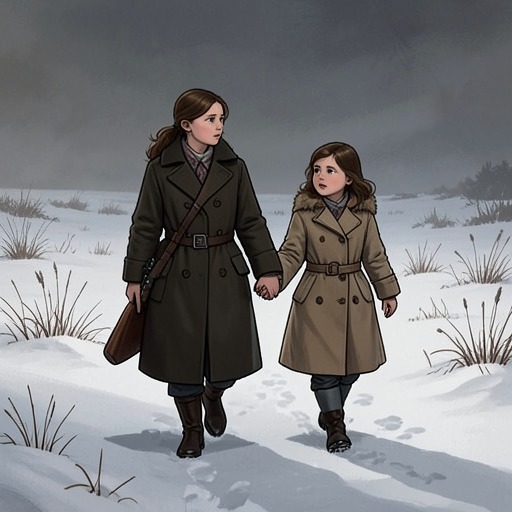
Hilda helps Gretel, frozen outside
Hans Brinker, or The Silver SkatesGretel Brinker’s flight from her father’s bedside leaves her alone outside in the cold, where Hilda van Gleck finds and revives her. The encounter is a small but decisive act of care: Hilda does not begin by demanding an explanation, but first gets Gretel moving and warm enough to face the cottage again. Gretel’s fear, meanwhile, is shaped by what she has glimpsed of the operation and by her conviction that her father may be dying.
Flight from the cottage
Gretel’s alarm begins inside the cottage as the doctor opens a leather case and takes out a succession of sharp instruments. She springs forward, pleading with Dame Brinker to spare her father, whom she believes has meant no harm. Dame Brinker cannot reassure her; she answers fiercely that she does not know what will happen. With the assistant lifting the instruments, Gretel can no longer bear to watch. She seizes her hood and runs out of the cottage.
Her flight carries her away from the people and the work on which her father’s life depends, but it does not free her from the scene. At recess, boys and girls fill the canal with play, while Gretel remains the one child whose attention is fixed on the darkened cottage. Their laughter reaches her as if from a dream. She imagines that the men inside may be killing her father and springs up in horror, then sinks back into increasingly confused thoughts. The gleam of the knives, the stork’s nest on the roof, the cold, and the memory of her new jacket mingle in her bewilderment. The scene shows fear overtaking her ability to sort what she sees and hears; she is not merely choosing to remain outside, but becoming too exhausted and cold to respond clearly.
Hilda finds Gretel
A firm hand on Gretel’s shoulder interrupts that disorientation. Hilda tells her to get up rather than lie there and freeze. Gretel slowly raises her head, sleepy enough that Hilda’s presence seems almost familiar, like something from a dream. The narration then marks her gradual return to herself: she rubs her eyes, recognizes that she has been asleep, and looks ashamed. Hilda laughs gently, but her lips are very pale, and she turns reassurance into a practical instruction: Gretel should lean on her, keep moving, and go into the cottage when she is warm enough by the fire.
Gretel refuses the proposed destination. The surgeon is still inside, she explains, and he sent her away. Hilda does not press her for an account before she is ready to give one. Instead, she accepts the refusal and encourages her to walk faster, explaining that she had seen Gretel on the mound earlier and had thought she was playing. This restraint matters: Hilda responds to the child in front of her rather than treating her fear as a puzzle that must be solved before help can begin.
Gretel explains her fear
As Hilda tries to reassure her, Gretel says that she thinks her father is dying. Two surgeons are with him, and her mother has scarcely spoken that day. She asks whether Hilda can hear his moans, but says the air is buzzing so loudly that she cannot hear and fears he may already be dead. The account makes her distress concrete: she is separated from the bedside, unable to confirm what is happening, and imagining the worst from outside.
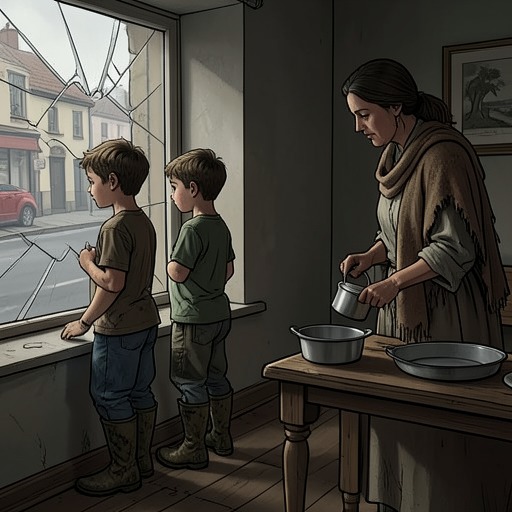
Hilda listens, but the nearby cottage is silent. She nevertheless senses that Gretel’s fear is real and runs to the window. Its sash is patched and broken, with a torn piece of paper hanging partway across it. Gretel presses her face against the small opening and sees her father lying very still with his head bandaged, while everyone’s eyes are fixed on him. What she can observe confirms the seriousness of the scene without telling her its outcome. At once she starts back, removes her heavy wooden shoes with a quick movement, and says she must go to her mother. Her attention shifts from her own cold and exhaustion to the people inside.
Care and return
Hilda does not accompany Gretel immediately. The bell is ringing, and she says she will come again soon. Gretel scarcely hears the farewell; what stays with her afterward is Hilda’s bright, pitying smile as she turns away. The scene thus gives Hilda’s help two distinct forms. She protects Gretel from remaining outside in the cold, and she offers the attentive presence that allows the child to describe what frightens her. But she does not displace Gretel’s family or decide for her what to do next. Once Gretel sees her father through the window, she acts on her own urgency and turns back toward her mother.
The episode also sets two kinds of uncertainty beside each other. Gretel fears that the instruments mean the surgeons intend to harm her father; the reader sees that this is a child’s frightened interpretation, not a confirmed account of the treatment. At the same time, the still figure, bandaged head, and silent cottage offer no immediate assurance that he is safe. Hilda can warm and steady Gretel, but neither she nor the view through the broken window resolves the medical outcome. Her kindness changes Gretel’s immediate condition and helps her return to her family, while the suspense surrounding her father remains.