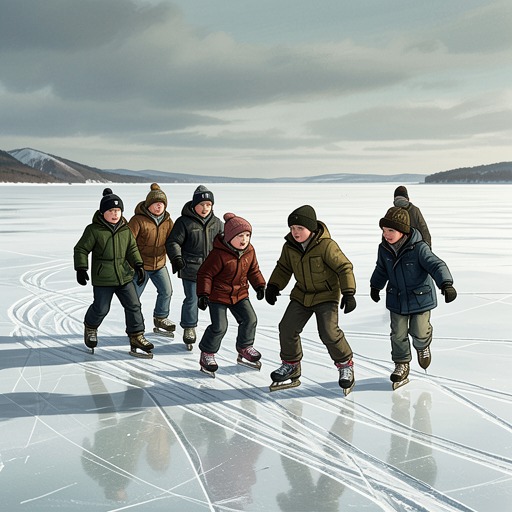
Jacob collapses while skating and is rescued by an ice boat
Hans Brinker, or The Silver SkatesJacob collapses while skating and is rescued by an ice boat in an episode that turns an energetic winter outing into a test of endurance, care, and practical cooperation. His brief recovery does not restore him to the journey on skates: the boys must find another way to get him to Leiden, and their rescue depends on both their refusal to abandon him and the traffic moving across the frozen waterways.
The route and its demands
The boys are skating from Broek along a canal that carries them through a working landscape of waterways, dikes, and winter traffic. The canal runs straight between bare willow rows; above the opposite bank, a carriage road follows the great dike holding back the Haarlemmermeer. Skaters share the long surface with brown-winged ice boats, push-chairs, and small sleds propelled by iron-pronged sticks. The scene conveys how ordinary travel in Holland depends on routes adapted to water and winter, but it also establishes the distance and effort required of the party.
At Halfweg, Lambert van Mounen explains that the IJ and the Haarlemmermeer meet there, making the location difficult to manage. The river stands five feet above the surrounding land, so strong dikes and sluice gates are necessary to prevent flooding. The same water has an economic use: its spring flow is said to have remarkable bleaching power and is used by Haarlem’s large bleachworks. For the skating party, however, this meeting of waterways is more than a lesson in engineering. It is part of the environment through which they must keep moving, and later the frozen canal becomes the place where Jacob’s strength fails.
Jacob’s collapse
Jacob has been trying to conceal how tired he is. He remains silent, conserving his breath and strength for skating, but his effort cannot keep pace with the journey. His body grows increasingly heavy and his limbs unsteady. The narration marks his distress through these observable changes before describing vertigo as an unseen force that overtakes him. The canal seems to rock beneath him and the passing sails to turn; he falls heavily onto the ice.
The fall abruptly breaks the party’s forward momentum. Ben hurries to Jacob, while Peter and Carl lift him and try to establish whether he is hurt. Jacob’s face has gone pale, and a bystander fears that he has died. A Dutchman reluctantly produces a small blue flask of schnapps, warning that only a little is needed. It is enough to bring a faint flush back to Jacob’s face; he opens his eyes and, confused and embarrassed, tries weakly to free himself from those supporting him. The episode moves from apparent crisis to recovery, but only in a limited sense: Jacob is conscious again, not fit to skate.
Finding a way onward
There is no practical prospect of Jacob continuing on his skates. The boys must get their exhausted companion to Leiden by some other means. Although they begin to feel the appeal of travelling by ice boat, they resolve not to desert him. Their decision gives the scene its central measure of loyalty: the outing’s speed and excitement matter less than keeping the group together and finding help for the boy who can no longer keep up.
Peter first hails a sailboat, but the men aboard do not respond. Three sledges running on runners pass already full, and a particularly attractive ice boat shoots by before the boys can stop it. With those possibilities gone, they prepare to support Jacob between their arms and make for the nearest village. The sequence makes their predicament concrete: help is not summoned simply because it is needed; each passing conveyance has its own limits, and the boys must keep looking while also deciding how to manage the journey on foot or skates with Jacob beside them.
The ice boat and the outcome
A shabby ice boat finally comes into view. Peter, with little hope that its crew will agree, hails it and waves his hat. The sail comes down and the brake scrapes as the boat stops. Peter asks whether the party can be taken aboard and explains that they have skated all the way from Broek and are worn out. The boatman says their destination depends on the wind, which is then blowing toward Leiden, and invites them to scramble aboard.
Getting Jacob into the boat takes all the boys’ effort. Once everyone is aboard, the boatman releases the sail, lifts the brake, and settles in the stern with folded arms. The boat carries them rapidly over the ice. Ben is delighted by the speed and asks whether Jacob feels better; Jacob replies that he does and thanks them. The rescue therefore has a modest, practical ending: Jacob is revived, lifted aboard, and able to report improvement, while the ice boat provides transport toward Leiden. He does not resume skating that day.
The episode’s change of pace is central to its effect. The journey begins amid the spectacle and shared excitement of skaters, sledges, and sails on a straight canal; Jacob’s collapse interrupts that movement and makes the party’s dependence on one another plain. The waterways are at once the route, the setting of the danger, and the means by which assistance can arrive. The boys’ care is expressed not through a single dramatic gesture but through a series of tasks: checking Jacob, supporting him, seeking transport, and finally hoisting him aboard. Their progress now depends on the wind and the boatman as much as on their own strength, and the swift passage of the shabby boat resolves the immediate problem without erasing the exhaustion that caused it.