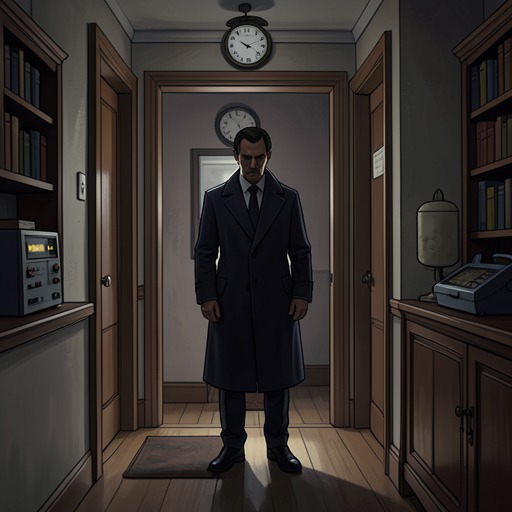
Laurens Boekman flees Holland
Hans Brinker, or The Silver SkatesLaurens Boekman flees Holland in the belief that his mistake has caused a patient’s death, although the medicine was never administered. The flight, later recalled by Raff Brinker, begins as an act of desperate escape and becomes a long-delayed message to Laurens’s father: a watch carried away from Holland, but not delivered, preserves the clue that can correct both men’s understanding of what happened.
The mistake and the mistaken belief
Laurens had been working as Dr. Boekman’s assistant when he portioned out the wrong medicine for a patient. It was a deadly poison, but Dr. Boekman discovered the error before anyone administered it. The patient nevertheless died that day. Laurens apparently learned of the death without knowing that the medicine had not been given, and concluded that he had caused it. To him, the coincidence between his mistake and the patient’s death made flight seem necessary, even though the actual chain of events did not support his fear.
Dr. Boekman was detained by other serious cases and did not reach home until the following evening. By then Laurens was gone. The doctor did not know that his son had discovered the mistake and believed himself responsible for a death. He instead interpreted the departure as youthful folly, ingratitude, or a desire for adventure. The same absence thus acquired opposite meanings: Laurens left because he believed he could not return, while his father thought he had chosen to abandon him.
The journey downriver
Raff’s account places the encounter on the very day he was hurt. He had been working far down the river line, across from Amsterdam, when Laurens approached him before daylight. Raff remembered the young man’s face as pale and agitated. Laurens asked him to take him several miles downriver, explaining that the matter was one of life and death. A skiff nearby was unlocked, but Laurens acknowledged that it might belong to a poor man and hesitated to take it without permission.
Raff initially objected that he was no boatman and also recognized that helping Laurens leave could mean evading the laws of his country. Laurens insisted that he was innocent. Raff nevertheless took him downriver, later estimating the distance at six or eight miles. Laurens then said he could run the remaining way along the shore. Raff was in haste to return the boat, so their passage was brief; the encounter ended with Laurens leaving the riverbank and Raff turning back.
The exchange is marked by a conflict Raff never resolves into a simple judgment. He considered helping a fugitive a breach of his duty as a Hollander, yet he heard Laurens’s insistence on his innocence and helped him go faster. The flight is therefore not presented as an ordinary escape or as a fully understood act of assistance. Raff acted amid urgency, with only Laurens’s distressed explanation and his own impression of the young man to guide him.
The watch and the broken message
Before leaving the boat, Laurens entrusted Raff with a watch for his father. He asked Raff not to deliver it immediately, but to take it after a week, and to say that his unhappy son had sent it. He also wanted his father to know that, if the time came when he wanted Laurens to return, Laurens would face everything and come back. The message was incomplete: Raff could no longer remember where Laurens had said a letter should be sent. The watch, unlike that missing instruction, remained in his possession.
Raff also remembered Laurens opening the watch and removing something from inside it, then kissing what he had taken out. He could recall the face and the gesture, but not the rest of the encounter with certainty. He described the episode as dreamlike, and when pressed to repeat it, his memory again failed at the destination for the letter. The limitation matters to the plot: Raff retains enough to preserve Laurens’s request and the watch, but not enough to carry the message to its intended recipient.
Recognition and consequences
Years later, Dr. Boekman opens the watch and finds a watch paper bearing blue forget-me-nots. Raff explains that Laurens had removed something else before handing it over. Dr. Boekman identifies the missing item as his dead wife’s picture, which Laurens had kept after her death when he was ten. The remembered act of taking and kissing the picture gives the father a concrete sign that Laurens had not forgotten his family, even during the flight that seemed to announce a break with them.
Raff’s recollection then supplies the explanation that the watch alone could not: Laurens had believed he was fleeing after causing a patient’s death. Dame Brinker recognizes that sending the wrong medicine was the mistake he meant, and that hearing the patient had died could have driven him away. Dr. Boekman, in turn, understands that Laurens’s absence did not mean he had rejected his father. His silence had been built on a false belief about the medical error, while the father’s silence had grown from a different false interpretation of the departure.
The disclosure changes the watch from an undelivered keepsake into evidence of an innocent mistake and an interrupted appeal for reconciliation. Dr. Boekman learns that Laurens is alive and asks Raff to send word if any further memory returns. Hans Brinker urges him to search for his son, but the scene does not yet complete that reunion: it ends with the possibility of finding Laurens newly opened. Raff’s flight narrative matters because its fragments restore the cause of the separation and make a future return imaginable.