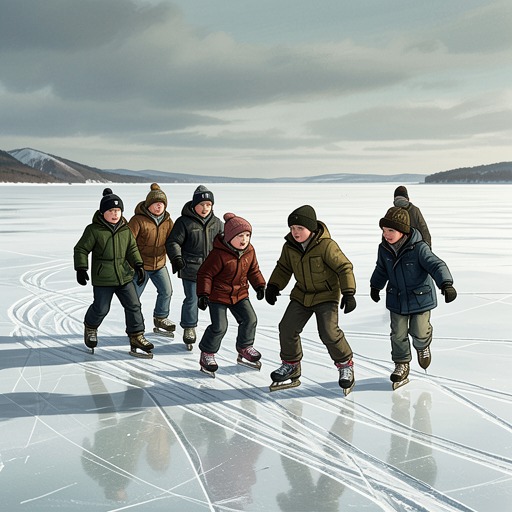
Peter and Benjamin race on skates on the way home
Hans Brinker, or The Silver SkatesPeter van Holp and Benjamin Dobbs’s race on the way home grows out of an ordinary group journey across Dutch canals, then briefly becomes a contest that tests speed, stamina, and pride. Peter wins the first direct race between them, while Benjamin’s response makes the episode a small but pointed preview of the more consequential skating competition still to come.
Setting and Route
The boys travel over a straight canal bordered by long rows of bare willow trees. On the far side, a raised carriage road runs along the great dike holding back Haarlem Lake. The canal is busy with skaters, brown-winged iceboats, push-chairs, and small sleds propelled by iron-pronged sticks. The open, crowded route gives the boys room to race, but also makes speed a public spectacle: other skaters and the canal guards are close enough to see the contest and react to it.
The wider journey has already exposed the engineering that makes such travel possible. At Halfweg, Peter tells the party to remove their skates before they inspect the sluices. Lambert explains that the Y and Haarlem Lake meet there, with the river five feet above the surrounding land, so strong dikes and sluice gates are necessary to prevent flooding. That earlier stop places the boys’ recreation within a landscape shaped by water control. The same canals that make winter travel possible depend on barriers and maintenance to keep the low country habitable.
Winter travel also involves rules and labor. Guards stationed along the canals clear obstructions and garbage, and after snowfall sweep the ice before it hardens into a slick, marble-like surface unwelcome to skaters. The boys have earlier clambered among canal boats despite the guards’ orders to get down. Against this practical, regulated setting, their race is a burst of youthful speed on a route ordinarily shared with other travelers.
The Challenge and the Race
The contest begins when Peter, having fastened the last buckle, announces that the way ahead is clear and proposes that the boys imagine it is the grand race. He counts them off and sends them forward. The opening is not a formal event with a course laid out for spectators; it is a spontaneous trial of speed folded into the return journey. Yet the challenge quickly separates the two strongest competitors from the rest.
For the first half hour the boys say almost nothing. Peter and Benjamin skate with bent bodies and eager eyes, weaving among the more placid skaters. Their pace is so striking that a guard shouts for them to slow down. Instead, the warning only seems to propel them onward with renewed force. The narration emphasizes both the exhilaration and the physical limits of the effort: the boys can accelerate, but inertia and fatigue eventually constrain them.
Jacob slows first, followed by Ludwig, Lambert, and Carl. They stop to catch their breath and are left watching Peter and Benjamin continue in the distance, still racing as if their lives depended on the outcome. Lambert observes that neither will give way until he has no choice. Carl calls their exertion foolish at the beginning of a journey, though he recognizes that the contest is genuine. His criticism is already complicated by the fact that he, too, is a fast skater and later privately wishes he had stayed with them.
The Turn and the Result
The four boys resume skating and eventually reach a point from which they can see the two racers approaching the bend in the canal. Their attention turns into a running argument over who is ahead. Carl thinks Benjamin leads, while Ludwig expects Peter to win; an iceboat briefly appears to threaten Benjamin’s path, but he gets clear. The spectators’ uncertainty makes the outcome feel unresolved until the racers reach the turn.
Peter gets there first. The bend proves to have been the racers’ goal: immediately after passing it, both boys halt. The race therefore ends not with a fall or a forced withdrawal, but with a decisive lead at a chosen marker. Carl remarks that they have at least had sense enough to stop and rest, and the other four skate on to join them.
Benjamin looks at Peter with vexation, admiration, and surprise. He tells him that Peter is an exceptionally good skater and acknowledges that Peter is the first person ever to beat him in a fair race. Peter understands English better than he can speak it, and answers the compliment with a laughing bow rather than a speech. The narration suggests that he may simply be short of breath. Benjamin insists that he is not tired, but Lambert points out that he has nevertheless been beaten fairly.
Rivalry and Foreshadowing
The result changes the boys’ expectations without turning their friendship into hostility. Peter’s victory establishes that Benjamin, for all his confidence and speed, can be surpassed. Benjamin responds with a proud, defiant laugh that treats this contest as mere practice and signals his determination to win when the grand race comes. His defeat thus intensifies, rather than settles, the question of how the two will compare in the official competition.
The other boys supply a contrasting view of the same outcome. Ludwig celebrates Peter’s win, Lambert and Jacob cheer for him, and Carl concedes that Peter has prevailed while privately imagining that he might have won had he continued. The episode distributes rivalry across the group: Peter and Benjamin provide the head-to-head contest, while the four who fall behind become witnesses, judges, and would-be competitors. What began as an improvised race ends as a shared measure of the boys’ abilities and a rehearsal for the larger event ahead.