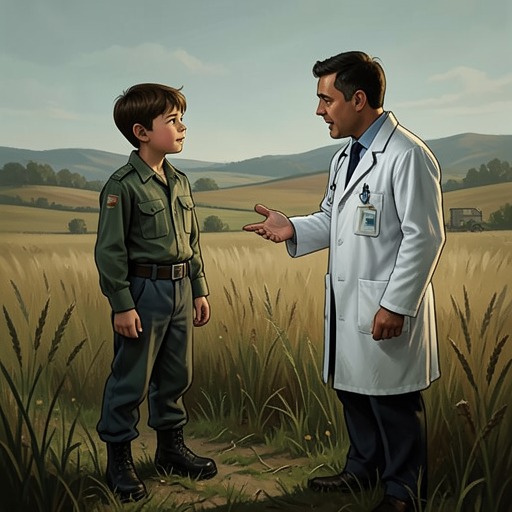
Raff Brinker’s brain surgery and awakening
Hans Brinker, or The Silver SkatesRaff Brinker’s brain surgery and awakening turn a family’s long uncertainty into a moment of recognition: after ten years without conscious knowledge of his family, Raff wakes and knows them. The operation follows Dr. Boekman’s judgment that pressure on Raff’s brain is causing a condition that will otherwise soon kill him. Dame Brinker consents despite the risk, and Hans Brinker helps the doctor carry out the procedure.
The Diagnosis and Its Precedent
When Dr. Boekman examines Raff, four days have passed since the family was last seen at his bedside. Raff’s fever has subsided, but he remains unconscious; the family has not left him, and his condition has not meaningfully changed. The doctor discusses the case with his student and assistant, Vollenhoven, before explaining his reasoning to Hans, who waits nearby.
Dr. Boekman compares Raff’s condition with that of Rip Donderdunck, who became increasingly impaired after falling from a windmill and eventually lay helpless, moaning and repeatedly lifting a hand to his head. In that earlier case, a surgeon named Von Choppem found a small sac beneath the skull pressing on the brain and removed it. Dr. Boekman offers this as a precedent for the operation he believes may help Raff, not as certainty that the two cases are identical. His explanation gives the family a possible cause for Raff’s condition and a specific, risky course of action.
The doctor’s confidence is qualified. Asked whether he can save Raff, he says that he hopes so. He believes the operation is more likely to cure than kill, but acknowledges that it may kill Raff. He also warns that the pressure on the brain is not a new illness: it has been worsening, and, without intervention, will soon take Raff’s life. For Hans, the choice is therefore not between danger and safety, but between the risk of surgery and the advancing danger of doing nothing.
Consent and Preparation
Hans listens closely and asks whether the operation may kill his father. When Dr. Boekman confirms that possibility, Hans does not let the question end there: he asks whether Raff will die if the illness continues, then asks how soon they can know whether the operation has worked. The doctor’s answer makes clear that waiting is also a decision with consequences. Hans’s questions bring the medical choice back to its human stakes: Raff is his father, and the household has already lived with his absence for years.
Dr. Boekman asks Dame Brinker whether the operation should proceed. She first asks whether it will cause Raff pain, and the doctor cannot promise that it will not. She then gives her consent. Her decision follows an exchange in which neither the danger nor the uncertainty is concealed; she authorizes the attempt despite having no assurance of its outcome. Hans stands by the window during the consultation, and the mother’s agreement converts the doctor’s proposal into action.
Gretel Brinker watches the preparations. When Dr. Boekman opens his leather case and takes out instruments, she leaves the room and crouches in a small closet beside her boxlike bed. The scene thus registers the operation not only as a clinical undertaking but as an event the children confront differently: Hans remains to help, while Gretel withdraws from the sight of the preparations.
Dr. Boekman removes his heavy coat, fills an earthen basin with water, and places it near the bed. He asks Hans whether he can depend on him, then directs him to stand at Raff’s head and places a chair for Dame Brinker at the patient’s other side. The account records these positions and the preparation, but does not describe the surgical procedure itself. Hans’s assigned place makes his participation concrete: he is not merely present as a son but is asked to assist the doctor at the bedside.
The Operation and the Awakening
The episode marks the interval of the operation with a section titled The Awakening. When the narrative returns to the cottage, the room is quiet. Gretel has come back and sits beside her mother; Dr. Boekman remains watchful. The first sign of change is slight movement on the bed. Raff’s hands twitch, then rise steadily toward his forehead. He feels the bandage with a questioning motion. The bandage confirms that the operation has taken place; his deliberate response to it is the first indication that the family may be witnessing more than an unconscious reflex.
Dame Brinker moves to him and calls his name. Raff answers faintly, identifies her as Meitje, and says that he has been asleep and thinks he has been hurt. Then he asks where little Hans is. Hans responds from beside the bed, but the doctor holds him back. Raff’s speech supplies immediate evidence of recognition: he knows his wife and remembers his son by the childhood name he used before his long unconsciousness.
Raff also asks whether the baby is asleep. Dame Brinker realizes that he is addressing Gretel as the baby she once was, while calling Hans little Hans. His questions disclose, without explanation from the doctor, how completely Raff has missed the children’s growth. Dame Brinker says that he has known nothing for ten years. The family’s response confirms that the awakening is not simply a return to movement or speech: Raff recognizes the people around him, but his last remembered family life belongs to a decade earlier.
Immediate Aftermath and Significance
The recovery is presented as a family recognition scene, not as a detailed account of medical recovery. Hans and Dame Brinker laugh and cry over Raff, while Gretel watches in glad, startled silence. Their response contrasts with the stillness of the room before he moves: after years in which the family has cared for a father who could not answer them, he now addresses them as people he knows. The scene gives the operation its decisive outcome while leaving the longer course of Raff’s recovery unstated.
The family kneels beside the bed in prayer, and Dr. Boekman bows his head with them. His silence and gesture accompany the family’s gratitude without turning the result into a claim that every danger has passed. When Raff falls asleep again, the doctor cautions that he must be kept quiet or he may still die. He instructs Dame Brinker to give him no food that day and says he will return the next day. The successful awakening is therefore a crucial change, but not a declaration of complete or secure recovery.
The event’s resolution rests on a sequence of measured uncertainties: Dr. Boekman’s comparison with an earlier case, his warning about the operation’s danger, Dame Brinker’s consent, Hans’s practical assistance, and Raff’s first recognitions. The family receives the answer it had hoped for when Raff identifies Meitje and asks after Hans, yet his reference to Gretel as a baby makes the cost of the lost decade newly legible. The operation restores contact between father and family; the immediate instructions afterward preserve the distinction between that extraordinary first awakening and the slower, still uncertain work of recovery.