Raff Brinker’s mental incapacity
Hans Brinker, or The Silver SkatesRaff Brinker’s mental incapacity follows a fall while he is working to protect a threatened dike, abruptly ending his work and changing life for his family. The condition is presented not only as a loss of memory and understanding, but as an ongoing household reality: Dame Brinker must support and care for him, while Hans Brinker and Gretel Brinker grow up with sharply different memories of the father he had been. His inability to explain what happened to the family’s savings leaves a further uncertainty that poverty makes painfully consequential.
Identity and Onset
For years, Raff Brinker worked on Holland’s dikes, part of the labor required to keep water from overwhelming the low-lying country. The danger was especially acute during a threatened inundation. In a severe storm, amid darkness and sleet, workers were trying to strengthen a weak place near Veermyk Sluice when Raff fell from the scaffolding and lost consciousness. From that hour, he never returned to his work; he survived, but his mind and memory were gone.
The accident belongs to a setting where public safety depends on continual maintenance. Holland’s canals, sluices, and dikes manage water that stands high against inhabited land; near Halfweg, for example, the river is described as five feet above the surrounding ground, making strong dikes and sluice gates essential. Against that background, Raff’s fall occurs not in an incidental workplace but during a collective effort to defend the country from flooding. The same protective system that requires skilled, strenuous labor is also the setting of the injury that removes him from that labor.
The family dates his long-standing condition to the period when the great Schlossen Mill was built, while Dame Brinker recalls its beginning through the storm and the dike emergency. The accounts establish that his impairment has lasted for many years, though they do not provide a precise chronology connecting the mill’s construction to the night of the accident. His body remains strong, but the capacities by which he knew and acted in his former life do not return during the period described.
The Father Remembered and the Man at Home
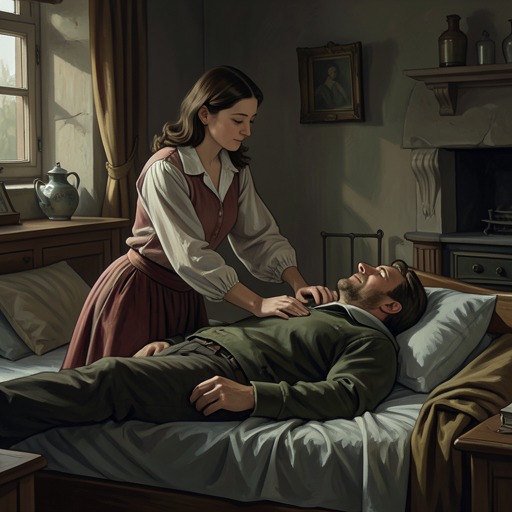
Raff’s condition divides the family’s memories. Gretel, who cannot remember him before the impairment, knows him as a strange and silent man whose eyes follow her without recognition. Hans retains a different image: a hearty, cheerful father who carried him on his shoulders and sang. The contrast makes the loss legible through ordinary acts of intimacy. The father’s former song remains in Hans’s recollection, while Gretel has only the quiet, vacant presence of the father who lives with them now.
Dame Brinker recalls him as steady, exceptionally capable, and wise enough that even the burgomaster would seek his advice. She describes a man who once knew his wife and children, set against a present in which he no longer recognizes them. Her testimony makes clear that the condition is not simply a temporary confusion after the accident: it has transformed the relationships through which his family once knew him.
At home, Raff is physically robust and can be difficult for Dame Brinker to control. She earns the family’s scant support by raising vegetables, spinning, and knitting, while also providing his constant care. She had previously done hard work on canal barges, sometimes joining other women at the towing rope of a pakschuyt between Broek and Amsterdam. As Hans grows strong, he insists on taking such labor on himself, while his mother’s care for Raff continues to occupy her. The impairment thus changes the family’s division of work as well as its emotional life.
Memory, the Watch, and the Missing Savings
Raff’s lost memory becomes especially significant when the family tries to understand the origin of a watch in Dame Brinker’s keeping. She remembers that on the night of the dike emergency, Raff came home and entrusted it to her, asking her to keep it until he requested it again. Before he could explain further, news arrived that the dike was in danger; he took his tools and went out. He returned by midnight in a grave condition, and although the fever that followed passed, his mental dullness remained and worsened.
Dame Brinker has shown him the watch many times since, but he does not recognize it. The object preserves a fragment of a moment from before the loss, yet it cannot restore the meaning he once attached to it. His failure to identify it also prevents the family from learning why it was entrusted to her. The watch is therefore both a tangible remnant of Raff’s former agency and a reminder of how little his family can recover from his silence.
A separate question concerns the family’s missing savings, said to have been kept in a purse and a stocking in a large chest. During a winter when Hans and Gretel were ill, the family nearly out of bread, and Dame Brinker unable to earn, she repeatedly tried to ask Raff where the money was and who had it. At her most desperate, she appealed to him about the precise hiding places, but he answered incoherently and could not help. Hans has heard this before and has seen his mother consider selling the watch in moments of need, only to resist because she believes it should remain entrusted to Raff. His impairment does not itself explain the disappearance, but it deprives the family of the testimony that might have resolved it.
Episodes of Danger and Dependence
Raff’s impairment also brings unpredictable danger into the cottage. On one occasion, while Dame Brinker knelt by the hearth to tend the peat fire, he suddenly held her close to it. Hans was away, and the account is given by another boy who had been nearby. The boy tried to intervene and could not immediately free her; Gretel then placed food Raff liked on the floor, and he released Dame Brinker to reach it. She escaped serious harm, though part of her clothing was affected. The family’s response afterward was care: Dame Brinker watched over Raff while he slept feverishly, and Gretel helped calm the situation by bringing him food.
This episode is described as a frightening departure from Raff’s former character, not as evidence that he had been cruel before the accident. The witness explicitly distinguishes the man who might once have acted from the impaired father who does not understand what he is doing. That distinction does not erase the danger Dame Brinker faces; it shows how the family must live with both her vulnerability and their knowledge of who Raff had been.
Family Consequences and Narrative Significance
The condition reshapes each family member’s experience differently. Dame Brinker bears the paired burdens of earning a living and tending to her husband. Hans works to relieve her of physical labor and remembers a father who was once lively and capable. Gretel grows up without that earlier relationship and knows her father chiefly through the care required by his present state. Their poverty, his dependence, and the unresolved savings question converge around an absence that no one in the household can fill: Raff cannot offer the account of his own past that the family needs.
The narrative makes this loss concrete through changes in recognition, work, and household responsibility rather than through a medical explanation. It also places the family’s private crisis beside Holland’s continuing struggle to maintain its water defenses. Raff’s earlier work helped protect the community; after the fall, he can no longer take part, and the family that depends on his former labor must carry its consequences at home. His condition is therefore both an intimate rupture in the Brinker family and a lasting result of the dangerous work on which life in the lowlands depends.