Raff Brinker’s watch
Hans Brinker, or The Silver SkatesRaff Brinker’s watch is a silver keepsake whose history remains uncertain even after it is placed back in Raff’s hands. Entrusted to Dame Brinker just before the accident that leaves him mentally impaired, it survives years of poverty because she will not betray his last request. When she finally shows it to him again, his partial recognition offers a tantalizing fragment rather than an explanation: the watch is connected to a poor boy, but neither its origin nor the boy’s identity is established in these scenes.
Identity and Custody
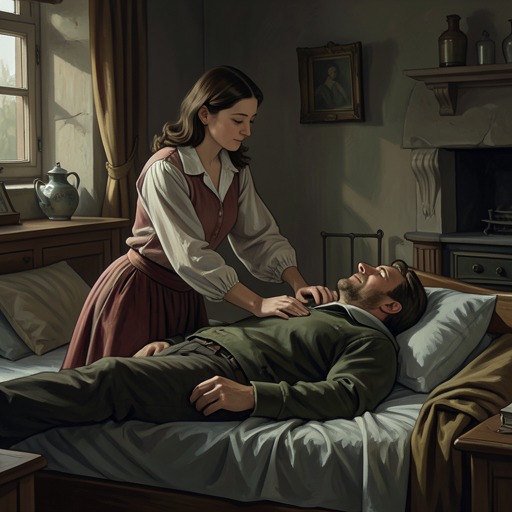
The watch enters the family’s story on the night Raff Brinker goes out to answer an emergency at the dikes. He hands it to Dame Brinker and asks her to take good care of it until he asks for it again. He gives no explanation. Before he can say more, a fellow workman arrives with news that the waters are rising and that help is needed. Raff leaves at once; by midnight he has been brought home nearly dead, his head bruised and cut. His fever eventually passes, but his mental dullness persists and worsens. The watch is therefore entrusted to Dame Brinker at the threshold of the accident, with its intended meaning left unfinished.
Dame Brinker keeps the watch for ten years. It is a substantial silver object, bright and polished, with a piece of smoothly ironed black ribbon fastened to it. She maintains its shine, but its condition does not make its history any clearer. Raff later sees the ribbon and the polished surface, yet at first seems barely to recognize what he is holding. The watch’s visible care contrasts with the gap in knowledge around it: Dame Brinker can preserve the object, but cannot recover the words Raff meant to say.
Poverty and the Refusal to Sell
The watch is kept alongside a separate and painful uncertainty: the Brinker family’s missing money. Dame Brinker says the guilders disappeared the day before Raff was hurt. At one point she wonders whether he might have used the money to pay for the watch, but she rejects the possibility. In her view, the watch was worth less than a quarter of the missing sum, and Raff had been too steady and thrifty to spend so foolishly. The family’s suspicions never become proof that the watch and the missing guilders share an origin.
Keeping it has a real cost. Dame Brinker has repeatedly taken the watch from its hiding place in hours of need and considered selling it. The money would have helped feed the children; the later account stresses how hard it was to watch them go hungry while the sale might have brought the roses back to their cheeks. Each time, however, she puts the temptation aside because Raff asked her to guard it. She fears that selling it would make her faithless to him, and insists that they must be nearer starvation before they part with it. The watch thus measures the pressure of their poverty not through what it buys, but through the sacrifice required to keep it.
Hans Brinker recognizes that sacrifice. He has seen his mother’s struggle and tells her she has done bravely to preserve the watch, observing that many people would have exchanged it for money long ago. Dame Brinker responds with indignation at the thought of doing so. Her refusal is not based on a clear understanding of the watch’s value or provenance; it rests on the obligation created by Raff’s request and on the possibility that he may wake and ask for it. For her, the object remains in his keeping even when he cannot recognize it.
Raff’s Partial Recognition
After years without an explanation, Dame Brinker decides that she cannot wait longer for Raff to speak. While Hans is in Amsterdam looking for work and Gretel Brinker is out searching for fuel, she lays the watch in her husband’s hand, hoping that a word from him will settle how he came by it. He turns the polished object over and examines the black ribbon. His first response is not an account of its origin: he remarks that Dame Brinker has rubbed it until it shines like a new guilder.
Then Raff looks at it again and murmurs about a poor boy. When Dame Brinker presses him for more, he says that he told her everything long ago, though she answers that he never did. He adds that the matter is no concern of theirs and imagines that the boy may have died and gone to heaven, since he looked close to it. These remarks make the watch more suggestive without making its history certain. Raff appears to connect it to a boy and to some earlier telling, but the scene does not identify the boy, explain how the watch came into Raff’s possession, or establish what happened to him.
Narrative Significance
The watch’s importance lies in the way it holds together a promise and a mystery. The missing guilders invite practical speculation about what Raff might have done with the family’s money; the watch raises a different question, one Dame Brinker cannot answer by searching the cottage or questioning her children. Its presence does not prove that Raff bought it with the missing funds, and his impaired memory frustrates the expectation that simply returning it to him will produce a full account.
Its gradual revelation also gives physical form to the limits of memory. Dame Brinker has guarded and polished the watch while Raff’s grasp of the past has been diminished; when it returns to his hand, he notices its shine and ribbon, then offers only a broken recollection of a poor boy. The object is at once ordinary enough to be handled and charged with a history that remains out of reach. By preserving it, Dame Brinker keeps faith with her husband; by bringing it back to him, she gives the unresolved past one more chance to speak.