Rychie Korbes
Hans Brinker, or The Silver SkatesRychie Korbes is a rich and influential girl whose preparations for a skating match expose the gap between her polished social presence and her contempt for the poor. A leading Amsterdam family gives her standing among her peers, and she uses that standing to shape their opinions. Her hostility toward Gretel Brinker makes the race more than a contest of skating skill: it becomes a test of who is entitled to take part.
Identity and Social Position
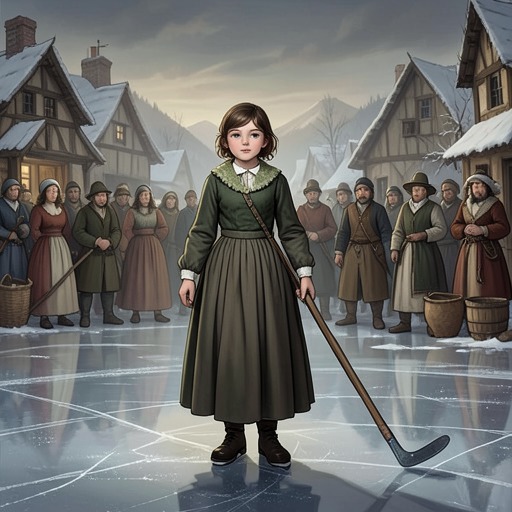
Rychie is the daughter of one of Amsterdam’s leading men and moves among a large party of young skaters that includes Hilda van Gleck, Katrinka Flack, Carl Schummel, Peter van Holp, Ludwig van Holp, Jacob Poot, and Voostenwalbert Schimmelpenninck. Nearly twenty boys and girls skate together, making her one member of a lively social group, but not an inconsequential one. The narrative identifies her as proud and beautiful, and later describes her as more sparkling and pretty than Hilda, while distinguishing outward attractiveness from inward character.
The skating party belongs to a broader public scene on the canal. Pleasure-seeking children share the ice with workers hurrying to shops and factories, market women carrying loads, peddlers, bargemen, and other travelers. Rychie is seen among the well-connected young people, not among those laboring to make a living. The contrast gives her position a material as well as social dimension: she is a daughter of privilege in a setting where skates bring people of different occupations onto the same route, but do not erase their differences in rank or circumstance.
The Race and Her Influence
Rychie acts as the acknowledged spokeswoman when the group comes to tell Katrinka Flack about the planned skating match. The event is set for the twentieth, on Hilda van Gleck’s mother’s birthday, and Hilda has been instrumental in arranging it. A splendid prize is promised to the best skater: a pair of silver skates, elaborately described by the excited children for their straps, bells, and buckles. Rychie is therefore not presented as the originator of the match, but she is the one who voices its announcement to Katrinka on behalf of the breathless group.
Her public authority matters because she is rich and powerful within the limited world of schoolgirls. The narrator says that she has followers who share her opinions, sometimes because they are careless or too cowardly to think independently. Her influence is not merely a matter of being heard; it helps determine what the group regards as acceptable. In the race preparations, that power makes a social judgment capable of becoming a collective barrier.
Prejudice Toward Gretel Brinker
Rychie’s strongest defining conflict is her attitude toward Gretel Brinker, a poor peasant girl. The narrator describes Rychie’s pride, discontent, and envy as gathering like clouds, and explains that she regards Gretel not as a fellow human being but as a sign of poverty, rags, and dirt. In Rychie’s imagined social order, poor people may work for their betters from a respectful distance, but should not hope, feel, or cross paths with them in a way that causes discomfort. Her contempt is thus more than a personal dislike: it rests on a belief that social rank should govern whose presence and aspirations count.
That belief turns directly against Gretel’s possible participation in the skating match. Rychie condemns the prospect of a peasant girl joining the race as disgraceful and shameful, and Katrinka Flack echoes her. The contrast with Hilda’s role in promoting the event is sharp: the match offers a prize for skating ability, yet Rychie’s response makes class standing a condition of belonging. Her objection does not concern Gretel’s skill; it is the fact of Gretel’s poverty and position that Rychie finds intolerable.
The episode also shows how prejudice can spread without every follower possessing the same settled conviction. Rychie’s rank gives her judgment force, while others repeat or adopt it through carelessness or fear. Her influence therefore helps convert an individual prejudice into group opinion. The exclusionary pressure surrounding Gretel is especially stark beside the circumstances at the Brinker home: Raff Brinker lies ill, his wife tends him, and Gretel tries to manage the household work while Hans has gone to seek a doctor. The narrative places Rychie’s disdain for poverty beside the labor and distress that poverty shapes, without suggesting that she understands or responds to them.
Charm, Contradiction, and Narrative Role
Rychie’s attractiveness and accomplishments complicate, rather than excuse, her conduct. She is witty, dresses tastefully, and sings charmingly; she also displays tenderness toward pet kittens and rabbits. The narrator sets these pleasing qualities against her failure to extend comparable sympathy to Gretel. Her capacity for affection is present, but bounded: she can show feeling toward small animals while denying a poor girl the full recognition she would claim for herself. This contrast makes her a more revealing figure than a simple embodiment of vanity, because the narrative stresses the distance between cultivated charm and moral regard.
Her friendship with Hilda and Katrinka further sharpens that contrast. The three girls are close in age, talent, and station, yet their dispositions differ markedly. Hilda is described as warm-hearted and noble; Rychie is beautiful and sparkling but clouded by pride, discontent, and envy; Katrinka is merry and coquettish, and readily takes her cue from Rychie in the dispute over Gretel. Rychie’s social confidence gives her judgment particular consequence within this trio and among the wider group.
As a character, Rychie helps reveal the limits of a community that can gather on shared ice without becoming socially equal. The skating race promises recognition for excellence, but her reaction exposes the prejudice that can decide who is welcome before ability is tested. Her importance in these scenes lies both in what she says and in the authority that makes others follow: she brings the class boundary into the middle of a public celebration.