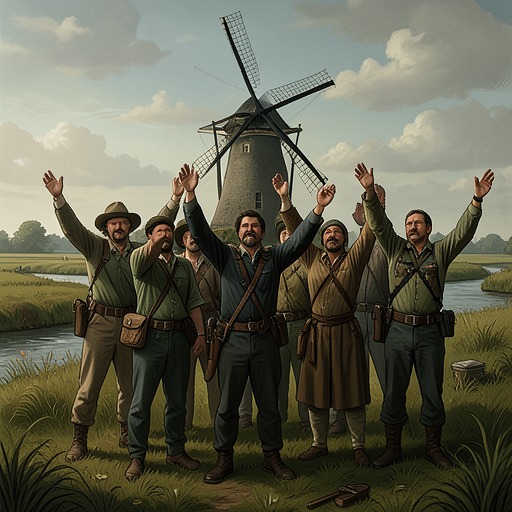
Siege of Haarlem in 1573
Hans Brinker, or The Silver SkatesThe Siege of Haarlem in 1573 is presented as a months-long struggle in which Dutch inhabitants, including women who fought beside their families, resisted Spanish encirclement until hunger left the city near collapse. In Ben’s telling, the defenders’ courage reached its extremity when they prepared to risk death in a final attempt to break through; the Spanish then offered terms, but the promise of protection concealed an order to show no mercy. The episode matters both as a history of resistance and as a story Ben uses to measure the courage of another besieged Dutch city, Leiden.
Background and the Account
The siege enters the book through a conversation about Dutch history. In Leiden, Ben is eager to celebrate the city’s burgomaster, Van der Werf, whose stand during the later siege has made him one of Ben’s heroes. Lambert asks about Haarlem, which he knows was besieged in 1573, and asks who prevailed. Ben answers that the Spaniards did. He nevertheless argues that Haarlem’s resistance displayed even greater heroism than Leiden’s, and that Haarlem’s example of courage and endurance came first.
That framing makes the account more than a bare record of military victory and defeat. Ben speaks as an admirer comparing two episodes of national suffering, while Lambert prompts him for the events he does not know. The siege is therefore delivered to the reader as remembered history within the characters’ present conversation. Ben’s admiration is explicit, but the details he gives also show what such resistance demanded: a city cut off from outside help, dwindling provisions, mounting deaths, and the prospect of a desperate last attempt to escape.
Encirclement and Resistance
The city was surrounded by Spanish forces under Frederic of Toledo, the son of the Duke of Alva. With help from outside seeming impossible, the inhabitants continued to defy the besiegers from within the walls. Ben describes resistance as shared across the city rather than confined to its men: women shouldered arms and fought beside their husbands and fathers. Three hundred served under Kanau Hesselaer, whom he presents as a commander of exceptional bravery.
The defenders also made a public display of their refusal to be cowed by hunger. They threw bread into the Spanish camps, a gesture that turned a scarce necessity into a challenge to the besiegers. Yet this act of defiance could not replenish the city’s stores. Haarlem held out for months, and, as its provisions ran out, the people grew increasingly desperate. The account’s movement is stark: outward confidence persists even as the material basis for survival disappears.
When food was exhausted, hundreds of starving people fell dead in the streets. Those still living had scarcely the strength to bury them. The city’s resistance had not simply become difficult; the inhabitants faced death from prolonged hunger while still cut off from relief. Ben presents this suffering as the condition against which their continuing refusal to yield must be judged.
The Final Resolve and the Offer of Terms
At the crisis, the strongest inhabitants resolved to form a square, place the weakest in its center, and rush together at the enemy. They expected that the attempt might end in death; their faint hope was to fight their way through the Spanish lines. The plan makes their predicament plain: with provisions gone and no rescue in sight, a dangerous collective attack seemed preferable to waiting for death by prolonged starvation.
The Spanish received word of this intention. Believing that the Dutch would dare anything, they offered terms. Ben’s account then turns on the difference between the promise made and the purpose concealed. The Spanish said that the inhabitants would receive protection and forgiveness, except for those whom the citizens themselves acknowledged as deserving death. On that assurance, they obtained entry into the city.
But the apparent settlement was treacherous. Ben reports that the Duke of Alva had already ordered his son to show mercy to none. The order casts the offer of terms in a different light: it had promised protection while the commander had been instructed in advance to withhold mercy. The account establishes the deception and its stakes, but does not describe in this passage what followed after the Spanish entered.
Historical Memory and Significance
Ben’s comparison with Leiden gives Haarlem’s resistance a particular place in the story’s historical memory. He admires Van der Werf and the stand at Leiden, yet judges Haarlem’s endurance still more heroic; he also regards it as an example for the later besieged city. The chronology matters to that interpretation: Haarlem’s ordeal came first, so its courage becomes a precedent rather than merely a parallel.
The episode’s force lies in the contrast between defiant gestures and worsening necessity. Bread thrown into the enemy camp signals courage, but cannot feed the starving city; a plan to protect the weakest expresses solidarity, but offers only a slim chance of survival; promised forgiveness appears to end the impasse, only to be undercut by Alva’s prior command. Through Ben’s telling, the siege becomes a measure of collective endurance and a warning about the gulf between a public promise and the intention behind it.