The siege conditions in Leyden
Hans Brinker, or The Silver SkatesThe siege conditions in Leiden show a city pressed at once by an enemy army, dwindling food, disease, and the water that both threatened the country and eventually helped bring relief. The episode’s decisive contrast is between physical extremity and refusal to yield: inhabitants endure hunger and plague, while Adrian van der Werf holds to his vow to defend the city. In the novel’s later recollections, Leiden’s survival is remembered not only as military resistance but as an act of communal endurance and gratitude.
A City Under Encirclement
Ben recounts a city surrounded on every side by Spanish forces, whose black forts sent fire into its heart. The besieged population endured the encirclement for months, with no surrender. The threat was not distant or abstract: the town’s inhabitants lived within reach of the enemy’s weapons, while the surrounding force sought to compel the city to give up.
The account describes conditions worsening as provisions ran out. People had already eaten the grass between the paving stones, and, as hunger deepened, they were reduced to eating horses, cats, dogs, and rats. These details mark a narrowing of ordinary life into the bare struggle to survive. The city was not simply short of supplies; the scarcity had reached the streets and exhausted even what could be found there.
Hunger, Plague, and Van der Werf’s Refusal
Hunger was followed by plague. Hundreds died in the streets, adding disease to the pressure of siege and deprivation. When the suffering became unbearable, the people crowded around Van der Werf in the public square and begged him to surrender. Their appeal makes visible the human cost of holding out: the inhabitants’ courage did not spare them from exhaustion, loss, or the desperation that drove them to ask their leader to end the ordeal.
Van der Werf refused. Ben remembers him declaring that he had sworn to defend the city and would do so with God’s help. He offered his own body to the starving people as food, but insisted that there would be no surrender while he remained alive. The offer gives the refusal its starkest measure: Van der Werf presents himself, rather than the city, as the possible price of continued resistance. His stand becomes a focal point for the siege’s moral conflict between the population’s urgent need for relief and its leader’s commitment not to yield.
Water and the Arrival of Relief
The account of the siege also belongs to a larger Dutch struggle with water. Much of Holland lay below sea level, protected by costly dikes that could leak or break under pressure. Flood prevention required continual pumping, repair, and vigilance; in spring, thawing rivers could overflow while ice obstructed their passage to the sea. Against this background, water was not merely scenery or a single, predictable danger. It was a force that demanded ongoing collective defense, and its movement could threaten settlements as readily as it could alter a military crisis.
Ben recalls that a change in the wind drove water into the besieging Spanish forces, drowning hundreds and allowing Dutch boats to sail across the flooded land. Those boats brought men and provisions to the city gates. Carrier pigeons, according to Ben’s account, had also borne letters to and from the besieged city, carrying news during the crisis. He has heard that the birds were cared for afterward and, when they died, stuffed and kept in the town hall. Van Mounen says they can be seen there alongside Van der Werf’s portrait. The pigeons thus connect the immediate ordeal to its later public memory, while the boats’ arrival answers the earlier image of a city cut off from help.
Waiting, Survival, and Remembrance
The boys encounter the siege not in its original moment but through places and remembered words. Standing on the stone wall of the ruined tower, they recall how, more than two centuries earlier, people in the besieged city called up to a watcher, asking whether help was coming and whether the waters were rising. For months, the answer was that there was no help and that the enemy was all around them. The repeated question and answer make waiting itself part of the ordeal: the city’s inhabitants must continue without knowing when, or whether, relief will come.
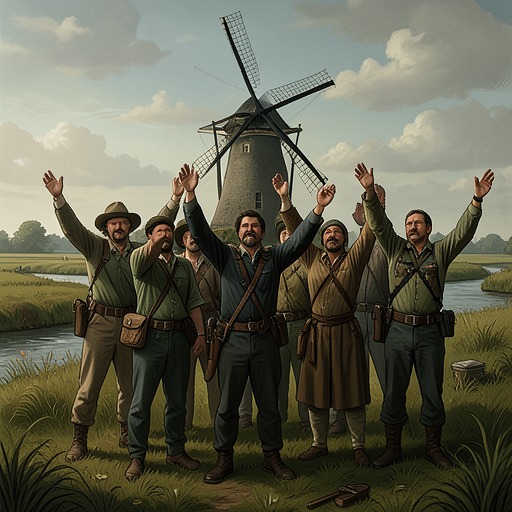
The story of Leiden’s survival culminates in a public act of thanksgiving. After the siege, the scarred and famished survivors followed Adrian van der Werf to the great church and sang an anthem because the city was free. They sang before tasting the bread brought by the Dutch ships: praise came first, food afterward. The multitude’s singing rose, then gave way to sobbing, until no one could continue. In Ben’s recollection, the interruption does not diminish the anthem; it makes audible the accumulated strain of the siege and the emotion of survival. The city’s endurance is therefore remembered through both steadfast resistance and the moment when relief could finally be received.