
The House That Promises Food
Hansel and GretelThe candy house first appears to answer the children’s hunger, then reveals how immediate comfort can conceal a predatory trap.
increasing Bearing strength in each event
 decreasing
Bearing strength in each eventdecreasingA Sweet Discovery

A Sweet Discovery
Hunger in the forest
After losing the Bread Crumbs, Hansel and Gretel wander hungry through a dark wood. They find a clearing and a house made of sweets.
The house appears miraculous because every part offers food. For children facing hunger, its abundance seems like an answer to need.
Appetite takes over
Hansel and Gretel begin eating before they know who owns the house. Their understandable hunger makes them vulnerable to the danger hidden there.
Hospitality Revealed

Hospitality Revealed
An invitation
The Witch comes out quietly and calls the children in. Her approach initially extends the impression that the house might provide welcome and food.
She soon says that she intends to eat them. The apparent refuge changes into a place of captivity.
Comfort as a trap
The house’s sweetness has drawn the children close to its owner. The story turns abundance into a warning: food alone does not guarantee safety.
Leaving the House
Leaving the House
The trap broken
Gretel kills the Witch by shutting her inside the Oven and frees Hansel. The children can finally move through the house without being controlled.
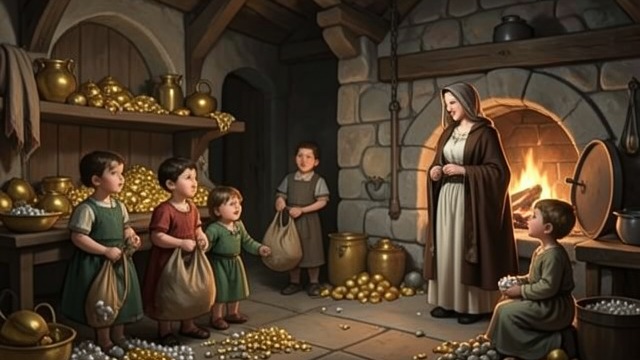
They discover bags of precious stones and pearls and fill their pockets. The house’s contents change from bait into resources they can carry away.
A new use for wealth
The children leave the forest with treasure rather than remaining trapped by the promise of sweets. Their escape converts the dangerous encounter into lasting material relief.
after hours of wandering
moments after the children eat the house
after the Witch’s defeat
