
Signals and Misleading Sounds
Hansel and GretelFalse and true signals shape the children’s understanding of danger, from the branch imitating work to the visible stones that actually guide them.
increasing Bearing strength in each event
 decreasing
Bearing strength in each eventdecreasingThe Branch’s Clapping

The Branch’s Clapping
Waiting for a parent
Hansel and Gretel sit by a fire after being left in the forest. They hear clapping in the distance and suppose their father is still working with his axe.
The sound is made by a branch tied to a tree, moved by the wind. The children’s interpretation delays their realization that the adults have abandoned them.
False reassurance
The sound imitates ordinary labor and parental nearness. Its deception deepens the contrast between what the children hope and what has happened.
Stones Made Visible

Stones Made Visible
Waiting for the moon
Hansel tells Gretel to wait until the moon rises before they attempt to return. Moonlight makes the White Pebbles stand out along the ground.
The visible markers provide reliable information where the clapping did not. The siblings can now distinguish a real route from a misleading impression.
A successful signal
Following the stones, they reach home the next morning. The scene makes careful reading of the environment a practical form of survival.
The Witch’s Mistake
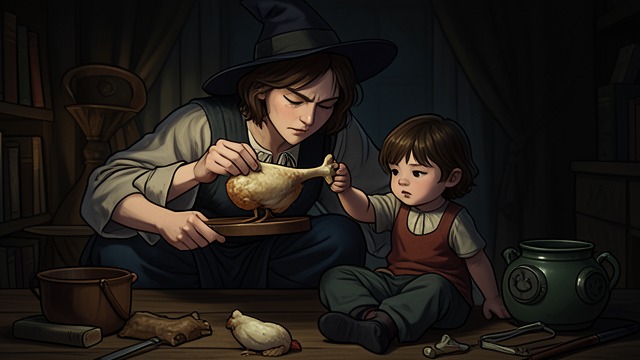
The Witch’s Mistake
A false finger
The Witch asks Hansel to show a finger so she can judge whether he is fat enough. Hansel instead holds out a chicken bone.
Because she is short-sighted, the Witch misreads the object and delays eating him. Her confidence in her own assessment is misplaced.
Survival by misdirection
The children use a deceptive signal against their captor. What begins as the adults’ misleading clapping is answered by a deliberate trick that helps the siblings survive.
the first evening in the forest
the first moonlit night
during captivity in the candy house
