
Hansel’s Resourcefulness
Hansel and GretelHansel’s clever attempts to preserve a route home first succeed with stones, then fail with crumbs, before his captivity depends on a shared deception.
increasing Bearing strength in each event
 decreasing
Bearing strength in each eventdecreasingCollecting Pebbles

Collecting Pebbles
Hearing the plan
Hansel overhears that the adults intend to abandon the children. He answers Gretel’s fear by promising a solution.
During the night, he slips outside and fills his pockets with White Pebbles. His quiet preparation turns knowledge of the danger into a practical means of resistance.
A trail of light
As the family walks, Hansel drops the stones along the way. The markers will become visible in moonlight and make a return possible.
Crumbs Against Birds
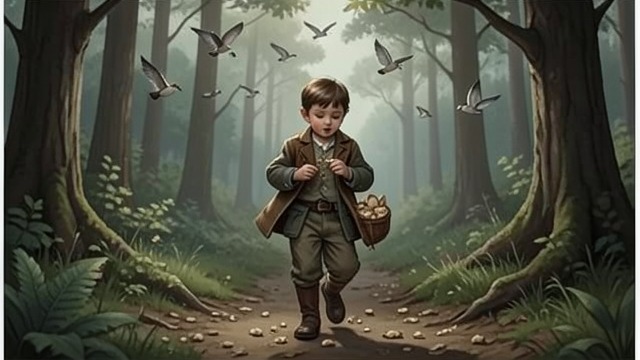
Crumbs Against Birds
A substitute marker
Locked indoors before the second abandonment, Hansel cannot gather White Pebbles. He instead drops Bread Crumbs along the path.
The change reflects his reduced options. He still tries to protect both children, but this marker is fragile in a forest inhabited by hungry birds.
A failed return
The birds eat the crumbs, leaving no trail to follow. Hansel’s resourcefulness cannot overcome a plan undermined by the natural world.
The Bone Deception

The Bone Deception
Delaying the danger
The Witch checks whether Hansel has grown fat by asking him to show a finger. Because she is short-sighted, he presents a chicken bone instead.
The deception convinces her that he remains too thin to eat. Hansel and Gretel gain time, though their confinement continues.
Survival through cooperation
Hansel’s trick depends on the Witch’s weakness and Gretel’s help. It postpones the threat rather than providing a complete escape.
the night before the first journey
during the second forest journey
during captivity in the Witch’s house
