Gretel
Hansel and GretelGretel’s story turns a child repeatedly exposed to hunger and abandonment into the person who defeats the household’s greatest danger and restores her family’s security. At first she and Hansel depend on one another to survive decisions made by adults; in the Witch’s house, Gretel becomes the strategist whose quick reading of danger saves them both. Her return to the Woodcutter with jewels and pearls completes that reversal, replacing the family’s deprivation with lasting relief.
Identity and Family
Gretel is the Woodcutter’s daughter, Hansel’s younger sister, and the child of a mother who has died. The Woodcutter has remarried, and his new wife becomes the children’s Stepmother. A famine leaves the family with almost nothing to eat, and the Stepmother persuades the Woodcutter that abandoning the children in the forest is necessary for the others to survive. He loves his children and initially resists, but finally agrees. Gretel’s peril begins not with a choice of her own but with the breakdown of the security her family should provide.
The children overhear the first plan while still awake. Hansel tells Gretel not to worry, but the episode establishes the unequal burdens they face: he has a specific means of trying to guide them home, while she must trust his plan and endure the danger beside him. Their sibling bond is expressed through this repeated cooperation. Gretel is not separated from Hansel even when their circumstances change; his safety remains central to the choices she later makes.
The First Abandonment and Return
On the first journey into the forest, Hansel secretly drops White Pebbles along the path. The children are left beside a fire, with instructions to wait while the adults work. They hear a repeated axe-like sound in the distance, believing the Woodcutter is still nearby, but the Stepmother has arranged for a branch to make the noise in the wind. As night deepens, Gretel decides it is time to go home. Hansel asks her to wait for the moon, whose light reveals the stones like a bright path through the forest. The trail leads the children back to their father’s door the next morning.
The Woodcutter is overjoyed to see them and regrets what he has done; the Stepmother is furious. The return does not resolve the conditions that made the abandonment possible. The family lives together again for a time, but a still worse famine brings the same proposal back. This time the Stepmother locks the door so Hansel cannot go out to gather White Pebbles. He leaves pieces of bread along the route instead, but the forest birds eat them. When Gretel and Hansel try to return, the path has vanished, and they are left hungry and frightened in the dark forest. The contrast between the two attempts is stark: the first return succeeds because the stones remain visible, while the second plan depends on a trail that can be consumed.
The Witch’s House and Gretel’s Strategy
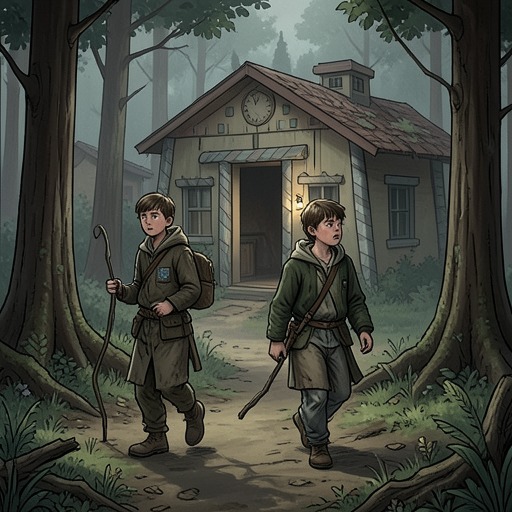
After wandering for hours, the children reach a clearing and find The candy house. Its roof is chocolate, its walls marzipan, its windows candy, its doors nougat, and its path made of sweets. Gretel follows Hansel toward the tempting food, and they begin eating before noticing the Witch emerging. The house’s abundance first seems like a reprieve from hunger; instead, it conceals a new threat. The Witch takes the children prisoner and announces that Gretel will help her while Hansel is fattened for eating.
The Witch confines Hansel in a small room and checks his condition by asking him to put out a finger. Gretel recognizes that the Witch’s poor eyesight gives them an opportunity. She instructs Hansel to offer a chicken bone through the bars, so the Witch will feel its thinness and think he is still too scrawny. The deception buys time, but it cannot end the captivity indefinitely: the Witch grows impatient because Hansel remains thin despite being fed. Gretel’s plan is a practical response to the specific weakness she has observed, and it keeps Hansel alive until she can find another opening.
The Oven and the Escape
The Witch’s next plan is to use the Oven to kill Gretel as well. She orders Gretel to climb inside and check whether it is hot, but Gretel understands that the instruction is a trap. She claims she does not know how to do it. When the impatient Witch demonstrates, moving her arms and cursing as she explains, Gretel waits for her to enter the Oven and then shuts its heavy door. The Witch is trapped and dies in the very device she intended to use against the children.
Gretel immediately runs to Hansel and releases him from his confinement. This is the decisive change in their roles: Hansel had earlier reassured his sister and led them along the White Pebbles, but in the Witch’s house Gretel identifies the danger, devises the bone trick, and acts at the critical moment. Her escape is not simply a lucky discovery of a way home; it depends on her ability to understand the Witch’s intentions and turn the Witch’s own impatience against her.
Homecoming and Significance
After freeing Hansel, the children find large bags in the Witch’s house filled with precious stones and pearls. They stuff their pockets as full as they can and hurry away from the forest. After walking without resting, they finally reach the Woodcutter’s home. He greets them with joy and tells them that the Stepmother has died and will never hurt them again. Gretel and Hansel embrace him, then empty their pockets before his astonished eyes. The treasure means the Woodcutter will never again have to suffer need.
Gretel’s ending joins personal rescue to material change. She and Hansel return not only alive but carrying the means to end the poverty that made them vulnerable to abandonment in the first place. The narrative gives Gretel’s resourcefulness its clearest expression under confinement: she protects her brother through observation, deception, and decisive action. Her return with treasure completes a movement from a household unable to feed its children to one no longer subject to want, while the siblings’ reunion with their father closes the separation that began with the Stepmother’s plan.