Witch
Hansel and GretelThe Witch is the owner of The candy house and the chief danger the children encounter after becoming lost in the forest. Her welcome reverses the promise of the edible house: once Hansel and Gretel begin eating it, she takes them prisoner and makes their hunger the means by which she intends to consume them. Gretel’s quick thinking turns that threat back on the Witch, who dies in the Oven she had prepared as a trap.
Appearance at The candy house
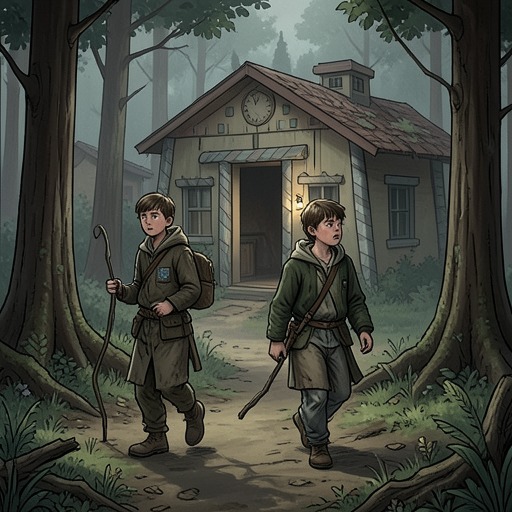
After Hansel and Gretel wander for hours through a dark, dense forest, they find a clearing and a house made of sweets. As they rush to eat its chocolate roof, marzipan walls, candy windows, nougat doors, and path of sweets, the Witch emerges stealthily and calls to them, inviting them inside. The children do not notice her approach until she has drawn their attention away from the house itself.
The invitation proves dangerous. The Witch tells the children that she means to eat them and takes them prisoner. The scene turns the house’s abundance into a menace: what first appears to offer food and refuge belongs to someone who regards the starving children as food herself.
Captivity and the plan to fatten Hansel
The Witch separates the children’s roles according to her plan. She puts Hansel in a tiny room, intending to fatten him before eating him, and keeps Gretel to help her. She dismisses Hansel as too thin to be worth eating, saying that he would amount to little more than bones. Her scheme therefore depends on keeping him alive and feeding him until he is plump enough.
At intervals, the Witch asks Hansel to put a finger through the bars so she can judge whether he has grown fat. Because she is very shortsighted, Gretel devises a deception: Hansel presents a chicken bone instead of his finger. The Witch feels how thin it is and postpones eating him. The children agree to the plan, and the bone lets them delay the danger without escaping the cage.
That delay ends when the Witch grows tired of waiting. Though Hansel has been eating all day, she complains that he remains as thin as when he arrived. She lights the Oven and orders Gretel to climb inside to see whether it is hot enough. Gretel recognizes that the instruction is a pretext: the Witch intends to trap her in the Oven and eat her too.
Reversal and death
Gretel answers that she does not know how to enter the Oven. The Witch, impatient and sure of her authority, waves her arms, curses, and insists that the task is easy; she will demonstrate. When the Witch climbs inside, Gretel shuts the heavy door and leaves her trapped. The Oven becomes the instrument of the Witch’s death, and the intended victim controls the trap instead.
The Witch cries out for someone to let her out, but she dies burned in the Oven. Gretel then runs to Hansel and frees him from the small room. The rescue ends the Witch’s immediate control over both children: the cage and the Oven, tools of her plan, have failed to protect her from their counteraction.
Narrative role and aftermath
The Witch’s threat is built from concrete reversals: an edible house becomes a prison, a meal meant to fatten Hansel prolongs his survival, and the Oven meant to enable the Witch’s violence kills her instead. Her shortsightedness creates the opening for the chicken-bone trick, while her impatience brings the children’s danger to a crisis and gives Gretel the chance to act.
After the Witch’s death and Hansel’s release, the children find bags of precious stones and pearls in her house. They fill their pockets and leave the forest, eventually returning to their father. The Witch’s defeat thus brings both immediate safety and the treasure the children carry home; the captor’s house, once the scene of their confinement, becomes the source of their escape’s material reward.