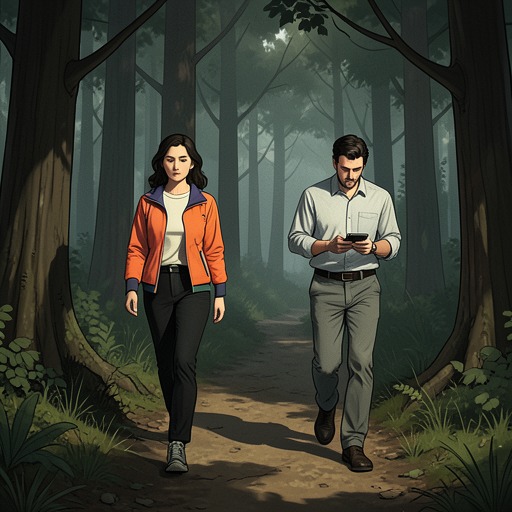
Absaroka Course wilderness trip
Happiness for BeginnersThe Absaroka Course wilderness trip is the practical ordeal at the center of Helen Carpenter’s BCSC training: in a landscape where maps, first aid, and group decisions have immediate consequences, she discovers that she can act under pressure and lead others. The trip’s lessons extend beyond survival skills. Its accidents, missteps, and moments of companionship help Helen reconsider her own capabilities and her habit of treating happiness as something still out of reach.
Experiential Learning and the Wilderness Test
Helen begins the course feeling undereducated and worrying that she might need knowledge before she has a chance to acquire it. The reassurance she receives is that BCSC teaches through experience: participants will learn as they go. The trip puts that promise into practice, not as a smooth progression from lesson to mastery but through situations in which Helen has to recall what she has been taught while uncertain of the right move.
That uncertainty becomes acute when Hugh falls across a log and is pinned by his pack. Helen removes her own pack and tries to remember the first-aid class, then freezes over the question of what to do first. The other participants are stunned, leaving her to recognize that someone must take charge. She attempts to unbuckle Hugh’s pack, but he wakes screaming and tells her not to move him. The incident exposes both the limits of her training and the responsibility she feels to use it.
Later, Helen sets out to get help while another participant remains on the trail. She promises to return, then realizes that the route does not match the map she studied. Drawing on the three-dimensional map-reading skill she had practiced with Beckett, she recognizes that the group has been descending a ravine instead of following a flat, straight stretch. The wilderness markers are sparse and difficult to notice, and the group has been traveling in the wrong direction for some time. The recognition is frightening, but it is also a practical breakthrough: classroom work has become a way to interpret the terrain in front of her.
From Mistake to Leadership
The trip gives Helen more than one chance to apply that skill. When Mason fails to orient his map, she takes out her compass and rotates the map until its north arrow aligns with the compass. The small, basic correction makes visible how much she has learned, even as she remains surprised that a skill she once doubted can matter in the field.
On a later hike, Dosie and Jake name Helen the leader, and Flash accepts the choice. She leads the group back to the barn with the map correctly oriented and confidence in her route. The group stays together and on the trail, and they are the first to return. Their only serious difficulty comes at the beginning, when they must cross a rickety bridge. The bridge creaks and sways; Jake, wearing glasses repaired with duct tape, finds the crossing harder than the others. Once the group is safely across, Helen’s navigation carries them through the rest of the hike. Beckett’s response singles her out as the one who had paid attention, and she answers with a playful gesture of triumph.
Helen’s growing capacity is not presented as proof that the course has become easy. During the urgent hike to Hugh, the fear of his danger makes her move faster, as does the memory of being called slow. She recognizes that she has become stronger without noticing the change as it happened. The quiet of the group on that hike also gives her room to take stock: she has used limited first-aid training, put map-reading into practice, and reached a landmark understanding of her relationship with her brother. At the same time, she remembers being trapped at the back with the Sisters, Hugh’s fall, her fear of choosing the wrong response, the burden of responsibility, and the discovery that the party was lost. The pleasure of solving the route problem exists alongside, not instead of, those difficulties.
Jake’s Illness and the Trip’s Private Stakes
The wilderness journey also becomes the setting in which Jake explains why he canceled and then rejoined the trip. After examinations and tests, he learned that he has an inherited vision disorder that cannot be fixed; night blindness is one part of it. He tells Helen that he has spent the past year searching through the available information and understands that he can only wait for his sight to disappear. His diagnosis gives a different weight to his presence in the wilderness: while the others complain about blisters and misunderstandings, he is carrying knowledge of a future he cannot prevent.
Jake’s illness collides with the future his father expects for him. His father calls him Doc and sees him as the high-achieving, hard-working son he had always intended him to be. Jake understands that his father has only been willing to accept one kind of son, even though Jake’s medical ambitions and his vision are both at issue. The trip reveals how much of his independent, capable appearance coexists with fear and with an uncertain future.
He also shares a list of things he wants to see and do. It includes returning to his childhood home, revisiting a merry-go-round in a park his grandmother took him to, and going to Texas to look through his father’s historical photographs of his great-grandparents, aunts, and uncles. His ambitions also include scuba diving, driving a race car, and riding the world’s scariest roller coaster. The list is personal and concrete: it joins places bound to family memory with experiences he has not yet had. In a later conversation, Jake explains that the day before Helen arrived at the party with Pickle, he had become certain of how badly his vision would deteriorate. He recalls being unable to breathe or eat as the future he had imagined—medicine, children, and scuba diving—seemed to vanish. His account clarifies that the disclosure on the trip was not a passing worry but a truth he had already been carrying through it.
Return, Reflection, and Lasting Change
At the party after the wilderness experience, Helen sees Jake directing his attention toward Windy and leaves without excusing herself. Outside, overlooking the lake, she steadies herself and takes stock of what she has accomplished. She has met the challenge she signed up for and found things to like in people she initially expected to hate. She has also made a real friend, someone who helped her look for what she wanted in a different place.
That friendship gives shape to a change in Helen’s understanding of longing. After a year spent speaking almost only to Pickle and waiting for happiness as though it were a prize to win, she recognizes that not getting what she wants can make her appreciate what she already has. The insight does not erase her desire for Jake: seeing him with Windy sends a wave of longing through her, and she waits alone by the railing for it to pass. Instead, the moment tests what she has learned. She can be proud of her achievement and accept the presence of longing without mistaking it for proof that nothing else matters.
Helen later recounts the wilderness to Grandma GiGi while sitting on the green velvet couch on the sun porch. Her account includes the blizzard, Hugh’s evacuation, getting lost during the Solo, and the discomforts of life outdoors, as well as her initial fear and shyness and the friendships she made. She tells her grandmother that she surprised herself and found ways to be brave. Grandma GiGi answers that Helen had always been brave. The trip’s final consequence is therefore not simply a set of acquired outdoor skills: it gives Helen experiences through which she can recognize a quality that someone who knew her well had seen all along.