BCSC Wilderness Course Rules
Happiness for BeginnersBCSC Wilderness Course Rules define how participants prepare for and move through a hazardous three-week expedition in the Absarokas. They govern what hikers carry, how they travel and care for their bodies, and how they respond to the wilderness as it unfolds. Introduced in Beckett’s deliberately intimidating briefings, the rules can sound like a catalogue of punishments; on the trail, they become practical knowledge that Helen must apply under pressure.
Risk, preparation, and the expedition
Before the trip, Helen signs about fifty waivers acknowledging BCSC’s lack of responsibility for possible life-threatening or fatal situations, from bear attacks, avalanches, and hypothermia to the grotesquely specific possibility of fatal diarrhea. The paperwork sits against the course’s reputation: Helen understands BCSC to favor steep slopes, rocky paths, and remote locations, and associates its public record with broken collarbones, rockslides, bear attacks, missing hikers, and hypothermia. Her unease is sharpened by the contrast between that danger and her own life as a first-grade teacher.
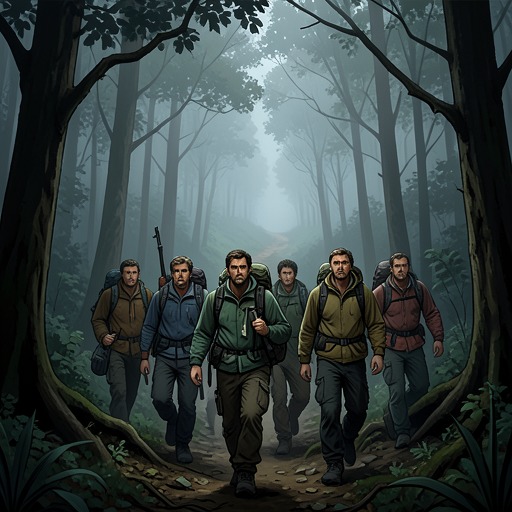
Beckett frames the route across the Absarokas as a sustained encounter with terrain that will not accommodate a participant’s preferences. He warns that the range is steep and wild, and insists that survival depends on following his rules. The group is expected to travel six to twelve miles each day, sometimes over vertical ground, and to rise with the sun. Participants hike together, then divide into tent groups of four at camp, where they set up sleeping tarps before their kitchens. These instructions make the expedition’s demands concrete: daily distance, camp labor, and shared travel are part of the course, not optional additions to it.
The preparation briefing also strips ordinary comfort from the imagined journey. Beckett tells the group to expect three weeks without showers, toilets, or toilet paper, and describes the discomfort in deliberately crude terms. His performance is not simply a list of amenities being withdrawn; it tests whether the participants can listen to instructions while confronting the prospect of fatigue, dirt, and embarrassment. Helen, unlike the thrilled younger hikers around her, recognizes that she may have chosen an ordeal she does not want.
Packing and leaving no trace
The packing rules translate the course’s austerity into a limit on personal possessions. Every ounce matters because each participant carries a life on their back. A toothbrush, two ounces of toothpaste, sunscreen, ChapStick, and a comb are permitted, while makeup, lotion, jewelry, and electronics are prohibited. One small camera is allowed only if it fits into a specified pocket; hikers may also bring one extra T-shirt, one extra set of socks, one extra pair of underwear, a required journal, and a single book for entertainment. Beckett says that BCSC will supply necessary gear at Outfitting, but participants must pack their own bags according to the company’s system. He warns that prohibited toiletries found in a pack will be made into food, an intentionally outrageous threat that reinforces the rule’s strictness.
The principle of packing everything in and packing everything out extends the same discipline to waste. Participants must carry out what they bring rather than leave it in the woods. Beckett makes the requirement explicit even for used menstrual supplies: they must be double-bagged and taken back, and leaving them on the trail is grounds for expulsion. The rule is therefore not merely a preference for an unmarked landscape; it specifies a responsibility that applies even when handling the waste is awkward or unpleasant.
Trail conduct and learning by doing
On the trail, Beckett’s instructions focus on risks that can worsen if ignored. Participants must hydrate at every rest stop, wear sunscreen, and pay attention to their feet. A hot spot inside a boot must be dealt with immediately: a small abrasion that might be managed at home by resting can become debilitating when the hiker still has miles to walk. The briefing turns bodily attention into a group obligation, since a participant who notices a problem is expected to stop the group and address it rather than conceal it until it worsens.
The teaching method is explicitly experiential. When Helen worries that she lacks necessary information, Beckett tells her that participants will learn as they go; when she asks what happens if they fail to figure something out, he answers with a dark joke about dying and his making it look like an avalanche. The joke exposes the extremity of his tone, but the instructional premise is borne out in the field: participants are expected to carry knowledge from briefings into situations that cannot be fully rehearsed in advance.
That transfer becomes consequential when Hugh falls across a log. Helen removes her pack and tries to recall the first-aid class, then hesitates over what to do because she knows a head injury should not be moved but is uncertain how to handle a possible leg injury. She eventually acts, and the emergency makes the gap between hearing a lesson and making a decision visible. The rules do not remove uncertainty; they give her procedures and concepts to draw on while she assumes responsibility in a frightening moment.
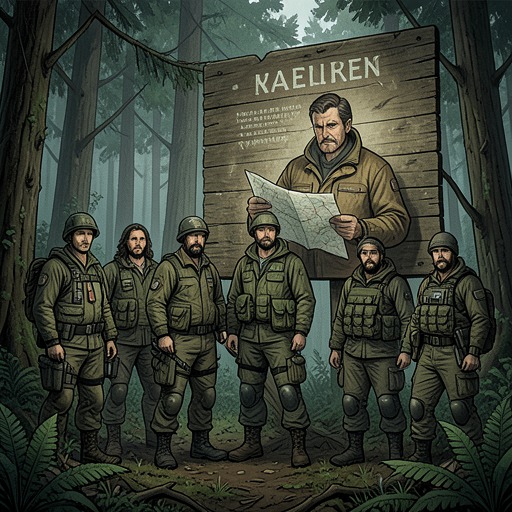
Navigation is another skill whose value emerges through practice. During the search for the separated hikers, Helen studies the map and recognizes that the route she is following does not match the terrain; she realizes the group has been traveling in the wrong direction. Later, when Mason has the map oriented incorrectly, she turns it until its north arrow matches her compass. On a subsequent return hike, she leads the group confidently along the trail, and they reach the barn first. The change is not that the wilderness becomes predictable, but that skills introduced through instruction become usable through repeated observation and correction.
Safety, responsibility, and the rules’ consequences
The course’s safety culture is demanding but not reducible to pushing onward at any cost. After Hugh’s fall, Jake considers finding the missing group, but Beckett looks at the sky and refuses to send anyone out in the dark: the hikers are off the trail, their location is unknown, and he judges that an evacuation cannot begin until morning. The decision places a limit on urgency. Even with an injured participant and a separated group, the immediate response is constrained by the danger of searching at night in unfamiliar terrain.
The rules also alter how Helen understands her own capacity. During the quiet hike after the crisis, she identifies three good things from the previous day: she had used her limited first-aid training to help Hugh, applied her three-dimensional map-reading skills, and reached a landmark understanding of her relationship with her brother. Her reflection includes the fear and frustration of the same day, but the exercise lets her register competence alongside distress. In this way, practice and reflection become part of the course’s effect: the experience supplies evidence that she can act, and the act changes how she reads herself.
At the course’s recognition ceremony, Hugh’s certificate must be mailed to him for obvious reasons, while the remaining participants receive theirs. The detail links the course’s formal completion to the injury that made its safety instruction real. Across the expedition, BCSC’s rules function both as restrictions and as tools: they narrow what hikers can carry, insist on collective discipline, and prepare participants to make consequential decisions when the terrain offers no comfortable substitute for judgment.