Back Country Survival Company
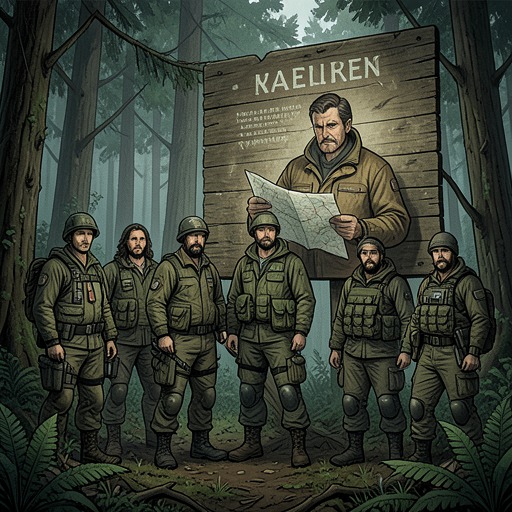
Happiness for BeginnersBack Country Survival Company, usually called BCSC, is a wilderness-training organization whose courses are known for hard terrain, demanding conditions, and real risk. In the novel, its three-week course in the Absaroka mountains brings Helen into a wilderness where classroom lessons must become practical decisions: injuries, confusing trails, and the need to keep a group moving turn the company’s training program into a test of judgment as well as endurance.
Reputation and Appeal
BCSC’s reputation precedes the course. Helen describes its trips as famously hard-core, grueling, and occasionally life-threatening; reports she and Duncan found online included broken collarbones, rockslides, bear attacks, missing hikers, and hypothermia. She also recalls that several people had died or been maimed on trips with the group. Duncan had looked into those accounts while trying to steer her toward a more reasonable alternative, but the danger was part of what drew her to BCSC. After the worst year—or six—of her life, she wanted an undertaking that felt unreasonable enough to surprise other people and herself.
The company’s appeal is therefore presented through a tension between risk and renewal. Helen insists that BCSC is under new management, but the evidence gives no further account of what changed or whether the older reputation is deserved in every instance. She has signed roughly fifty waivers accepting the company’s lack of responsibility for possible life-threatening or fatal situations, including bear attacks, avalanches, hypothermia, and even fatal diarrhea. The paperwork makes the stakes explicit before the group enters the wilderness; it does not make Helen’s choice feel safer or more ordinary.
Course and Instruction
At orientation, Beckett introduces himself as the participants’ only link to survival for the next three weeks. He asks them to give their names, ages, and reasons for coming, then describes the Absaroka range as steep and wild and tells them that survival depends on following his rules. The course moves from preparation toward immersion: the group is to visit Outfitting for needed gear, fill packs at the Pantry, eat supper, and take its last shower and sleep in a bed before departing. These details establish a deliberate crossing from familiar routines into a setting where ordinary comforts will not be available.
BCSC’s stated teaching method is experiential learning. When Helen worries that she lacks the knowledge she might need, she is told that participants learn as they go and will have to figure things out. That approach is not simply a slogan in the narrative: first-aid instruction and map-reading lessons acquire meaning when Helen must use them under pressure. The method puts a premium on transferring what was taught into unfamiliar circumstances, while leaving participants to act before they can feel fully prepared.
Risk, Skill, and Field Practice
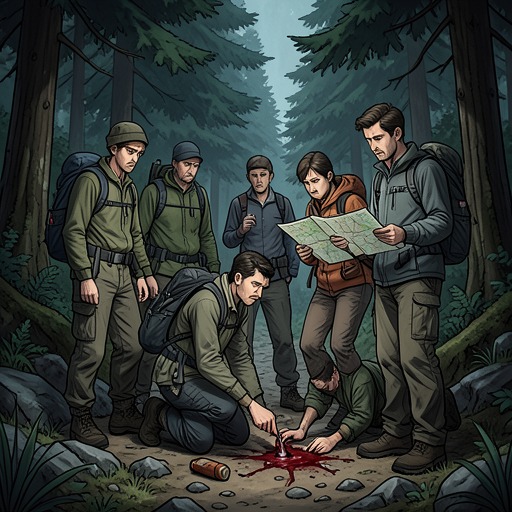
The wilderness course makes the difference between knowing a rule and using it consequential. When Hugh falls across a log and is pinned by his pack, Helen removes her own pack and tries to recall the first-aid class. She hesitates over how to respond to a possible head or leg injury, then takes the first action she can identify: attempting to release his pack. His scream makes the danger immediate, and the stunned group leaves her feeling that someone must take charge. The scene shows a student applying limited training amid uncertainty, not an effortless demonstration of expertise.
Navigation provides a second measure of what the course teaches. On a search for help after the group has gone off course, Helen notices that the terrain does not match the route she remembers from the map. She recognizes that they have been descending a ravine when the intended route should have been flatter, and uses her understanding of the map’s three-dimensional shape to see that their location does not fit. Later, when Mason has trouble orienting a map, she aligns its north arrow with her compass and rotates the map until both point the same way. The practical skill that once seemed abstract becomes a way to correct a real navigational problem.
That learning carries into leadership. When the group sets out to return, Helen is named its leader; she keeps everyone on the trail and together, and leads them back to the barn as the first group to arrive. The crossing of a rickety bridge is especially difficult for Jake, whose glasses are held together with duct tape, but the group makes it safely across. Beckett’s response singles out Helen’s attentiveness. The episode gives a concrete outcome to the course’s promise of learning through experience: Helen’s confidence is now supported by demonstrated decisions and a successful return.
Narrative Significance
BCSC is more than the provider of an extreme trip: its course creates the conditions in which Helen’s intention to do something alone becomes an encounter with other people and shared responsibility. She initially objects when Jake says he is joining the same trip, insisting that the undertaking is supposed to be hers. Yet the program is a group course, and its tests repeatedly require her to respond to other participants rather than pursue a private journey untouched by them.
The company’s approach also gives the novel a structure for connecting physical practice with changes in self-perception. During a quiet hike after a difficult day, Helen identifies three good things: she used her limited first-aid training to help Hugh, applied her map-reading skills in the field, and reached a landmark realization about her relationship with her brother and her life. BCSC supplies the demanding setting, but the significance lies in Helen’s ability to recognize what she has learned and done. Its wilderness course thus becomes a proving ground where her recovery is expressed not as a declaration but as increasingly capable action.