Bears
Happiness for BeginnersBears occupy two roles in the BCSC wilderness course: they are among the dangers participants must prepare to survive, and animals whose lives can be affected by human behavior. The course’s bear-safety lessons turn that tension into practical instruction, from hanging food beyond a bear’s reach to avoiding the creation of food-dependent bears.
Danger and expectation
Before the expedition, the narrator signs roughly fifty waivers absolving BCSC of responsibility for possible life-threatening or fatal situations, explicitly including bear attacks, avalanches, hypothermia, and even fatal diarrhea. The paperwork makes bears part of a broad catalogue of wilderness risks rather than an isolated, exceptional threat. The narrator also understands that BCSC has a reputation for choosing steep slopes, rocky routes, and remote locations; online accounts of the course include bear attacks alongside rockslides, missing hikers, and other dangers. The institution’s notoriety attracts thrill-seekers and people with little to lose, a characterization the narrator contrasts with being a first-grade teacher who has little apparent reason to seek such hazards.
Beckett’s pre-expedition briefing gives the danger a wider setting. He warns the participants that for three weeks they will have no showers or toilet paper and will be living in the Absarokas, where human toughness will be tested against nature. His deliberately harsh account is not specifically about bears, but it frames them as part of an environment that cannot be reduced to a comfortable outdoor excursion. The participants are preparing for privation and exposure as well as for the possibility of animal encounters.
Learning to keep food away
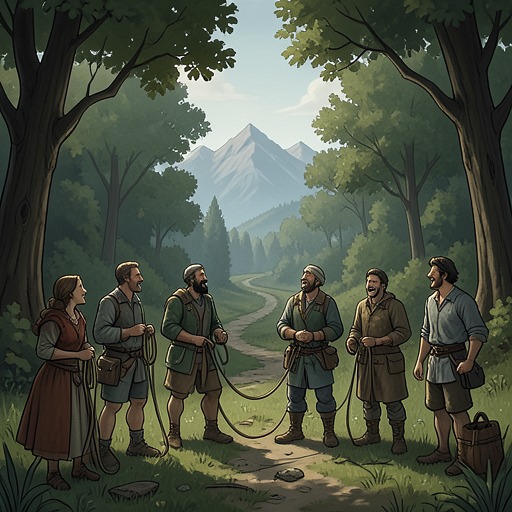
At the first wilderness camp, Beckett teaches tarp-hanging, stove use, and the bear hang. The class gathers in a wildflower-filled clearing, where the narrator takes notes with the determination of a student unwilling to fall behind. Mason correctly explains that the purpose is to hang food between two trees so bears cannot eat it. Hugh adds a second reason: keeping food away also avoids giving bears a reason to approach camp. Beckett expands the lesson beyond immediate human safety, explaining that the group must not make bears dependent on people for sustenance. His concern, the narrator observes, seems to extend to bears, fish, and algae, not only to the campers.
The procedure requires more than suspending a bag from a convenient branch. Bears are clever enough to reach food hung in a simple way, so two people climb separate trees with opposite ends of a rope, secure it between the trees, attach the food bag, and raise it to the midpoint. The arrangement makes the campers’ task a practical contest with an animal capable of working out an easier obstacle. The narrator’s notes preserve the central logic: bears are formidable, but the chosen setup keeps the food beyond their reach.
No one initially volunteers to demonstrate. Jake eventually raises his hand, and after dinner the group combines its food in a large nylon bag and follows him and Beckett to a suitable spot. By then it is growing dark, and the narrator wonders whether Jake’s night vision will be a problem. It does not appear to hinder him: he climbs hand over hand through the branches with such speed and ease that Beckett begins matching his pace, while the others cheer. The scene makes the bear hang both a lesson in preventing access to food and a display of the physical competence the course demands.
Bears as animals, not only threats
The bear-hang lesson refuses to treat safety as a matter of protecting human supplies alone. Preventing bears from finding food at camp also protects them from becoming accustomed to human-provided sustenance. That concern gives the animal a consequence beyond its function as a possible attacker: human choices can alter its relationship to people. Beckett’s mention of fish and algae broadens the lesson further, suggesting an ecological concern that reaches beyond the immediate exchange between campers and bears.
At the same time, the course presents bears through human preparation and perception. Participants learn to keep food secure, anticipate how a bear might overcome inadequate precautions, and distinguish the tracks of black bears from those of grizzlies. These are useful skills, but the bears are not individualized characters or shown acting outside the campers’ encounters and instruction. Their presence is conveyed through the risks they pose, the intelligence attributed to them, and the responsibility the group has to avoid drawing them toward camp.
Encounters and narrative significance
As the first week progresses, the participants adjust to their packs, altitude, and dehydrated meals while taking evening classes on subjects including map-reading and how to identify black-bear and grizzly tracks. The track lesson places bears within a broader education in reading the environment: survival depends not just on endurance but on noticing and interpreting what the landscape records. The narrator’s later anxiety about navigating a short, apparently simple trail without Beckett shows how classroom knowledge can feel different from using a skill in the wilderness, although the passage does not connect that navigation crisis to a bear encounter.
After the Solo groups return, their reports make the expedition’s dangers newly immediate. One group recounts a bear sighting, along with a mosquito infestation and a twisted ankle; another reports a swollen-river crossing that led to near-drownings, CPR, and hypothermia. The account gives no further detail about the bear or what followed the sighting. Its brief inclusion is enough to place bears among the real hazards participants faced, rather than leaving them solely in waivers and training demonstrations.
Together, these moments establish bears as both a survival concern and a measure of the course’s environmental ethic. The campers prepare to keep bears away from their food, but the stated aim is not simply to secure a meal: it is also to avoid making wild animals reliant on people. The bear hang therefore condenses the course’s double demand—learn how to remain safe in bear country while recognizing that human conduct has consequences for the animals sharing it.