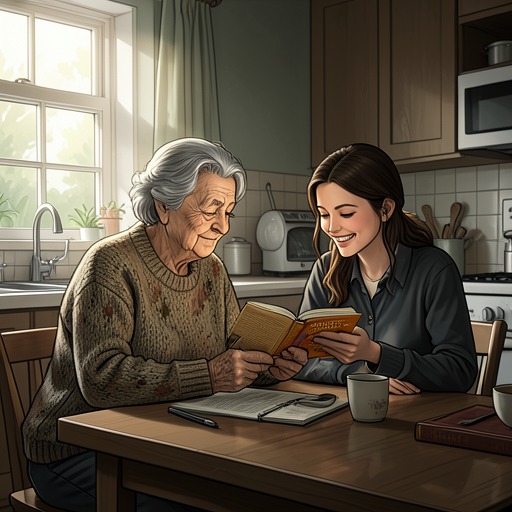
GiGi's home
Happiness for BeginnersGiGi's home is a family refuge and a place where old stories acquire new meaning. After the wilderness has given Helen room to revisit her grief and assumptions about her family, the house brings those memories into conversation: on its sun porch, Grandma GiGi reveals what happened to Helen's mother; in its backyard, Helen and Duncan bury Pickle. The home holds both the family's painful history and the gestures through which its members begin to face that history together.
Family Home and Earlier History
Helen and Duncan came to live with Grandma GiGi, whose home became a central part of Helen's childhood. The circumstances she later reexamines were shaped by losses and strain: Nathan drowned, Helen's parents were overwhelmed by grief, and her father withdrew into work. Duncan arrived in the aftermath, needing attention; Helen, still a child herself, came to resent him and was left babysitting him frequently from the age of thirteen until she left for college. The house belongs to this family history, but Helen's understanding of it changes. In a later conversation with Jake, she sees Duncan not simply as the difficult younger brother she blamed, but as a motherless child seeking attention, and recognizes how much the adults around them were suffering too.
That change in perspective matters to the meaning of home. Helen had long treated leaving for college as the point at which she escaped the family story and became fine on her own. Her later return to Grandma GiGi's household does not erase what happened; instead, it gives her a setting in which to hear more of the past and revise the account she has carried. The home is not presented as a cure for grief. It is a place where memory can be spoken, answered, and sometimes understood differently.
Return and the Sun Porch
After her wilderness experiences, Helen arrives back at GiGi's home the next evening, groggy, overcaffeinated, and hoarse from singing. At the kitchen table, her purse spills its contents onto the floor; Grandma GiGi is cooking and turns at the sound. The small, domestic scene marks a shift from the demands of the wilderness to familiar family life, without implying that Helen has left her new knowledge behind.
On the bar mitzvah morning, Helen faces the past and the future at the same event and struggles to prepare for the day. Rather than immediately getting up to run errands, she lingers in her robe. Grandma GiGi offers to paint her portrait, and Helen sits on the green velvet couch on the sun porch with coffee while she recounts the wilderness: the blizzard, Hugh's evacuation, getting lost on the Solo, the discomforts of pinecone wiping and smelling like a skunk, and her initial fear and shyness. She also tells Grandma GiGi that she made friends and surprised herself by being brave. Grandma GiGi answers that Helen had always been brave. The portrait-making scene turns the porch into a place of recognition: Helen's account of a new kind of courage meets Grandma GiGi's long-standing view of her.
The Disclosure About Helen's Mother
The conversation on the sun porch deepens when Grandma GiGi stops painting, sets down her brush, removes her smock, and takes Helen's hand. She tells Helen that on the night Duncan's crying had frazzled her, Helen had asked her to go home and fetch Softie. Grandma GiGi welcomed the break, drove over, and found Helen's mother in bed after she had taken a bottle of painkillers and crawled in with Nathan's teddy bear.
The disclosure changes how Helen understands her childhood. Grandma GiGi says she believes that Helen and Duncan sensed something was wrong and helped ensure she went back to the house; she tells Helen that they saved their mother. At lunch, as Grandma GiGi makes a mushroom-and-chive frittata, Helen sits with the knowledge and recognizes that she must revise her whole story. The difference is stark: she had understood herself as the child of a mother who did not want her, but now considers that her mother may have been unable to keep caring for her. The kitchen table becomes the immediate setting for absorbing a revelation that recasts old pain, rather than a place where that pain is simply resolved. Helen considers calling her mother while she is in town, and Grandma GiGi encourages the possibility.
The Kitchen and Backyard After Pickle's Death
The house also gathers Helen and Duncan around a more immediate loss. Later, after they have raided Grandma GiGi's pantry for Oreos, they sit at the kitchen table, where Helen asks what the cooler has to do with what has happened. The domestic pause precedes their decision to bury Pickle. Instead of leaving her body to be handled elsewhere, Helen tells Duncan to get the cooler so they can make a grave.
That grave is dug in Grandma GiGi's backyard. Helen does the digging in a pink party dress and heels, while Duncan stands beside her holding Pickle's duct-taped, wrapped body, his face wet with tears and his shirt soaked by the ice water. They choose a place next to the grave of their childhood bulldog, intending that the two animals be together in heaven. The contrast between formal clothes and the practical labor of burial gives the scene its particular tenderness: the siblings are grieving, but they act together, sharing the work and the choice of resting place. In the backyard, the house's family past and present meet not through a revelation, but through a small ritual of care.
Narrative Significance
GiGi's home is associated with different kinds of return. Helen comes back from the wilderness carrying evidence of her own courage; she comes to understand a family secret that had been hidden from her; and, with Duncan, she gives Pickle a burial. The sun porch makes space for testimony and recognition, the kitchen for the ordinary work of receiving difficult news, and the backyard for shared mourning. These rooms and grounds do not remove the history of Nathan's death or Helen's mother's crisis. They make it possible for Helen to see that history with greater compassion for Duncan, her mother, and herself.
The house therefore serves as more than a background for family scenes. It is where inherited memories can be revised through conversation and where affection takes practical form: Grandma GiGi paints Helen, listens to her account of the wilderness, and tells her what she knows; Helen and Duncan choose a place and bury Pickle together. The novel's later reflection that a life is shaped by what its teller chooses to hold on to resonates with this return to domestic space. GiGi's home retains the painful events, but it also holds the acts of care that allow them to become part of a larger story.