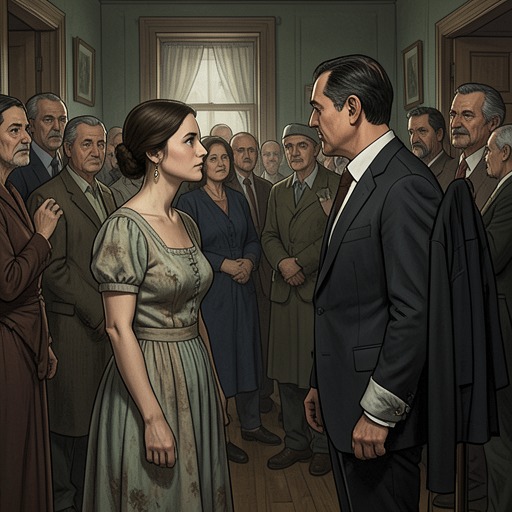
Grandma GiGi
Happiness for BeginnersGrandma GiGi is the grandmother who raised Helen and Duncan after their mother’s life came apart, and the family’s essential source of both shelter and candor. Famous in Helen’s eyes for her vivid style and mischievous humor, she also carries a painful secret about the night Helen’s mother nearly died. When she finally tells Helen what happened, GiGi helps transform a family history organized around abandonment and blame into one that can be understood differently.
Identity and Family Background
Helen remembers GiGi as “nothing-short-of-fabulous”: a white-haired woman who wore a bun held with chopsticks and whom Helen adored. GiGi’s home became the children’s refuge after their mother left them there when Helen was not yet thirteen. The arrangement followed years in which their mother struggled to keep the household running after Nathan’s death and the parents’ separation. Helen recalled unpaid bills, interrupted water and power, neglected laundry and meals, and the gradual collapse of ordinary family routines. GiGi’s care gave the children stability when their mother could no longer manage alone.
That care had begun earlier than the siblings’ move into her home. In telling Helen about the family’s past, GiGi remembered that the children’s mother dropped them off for a sleepover on the day of her crisis. She lingered over them, GiGi recalled, and told them she would see them in the morning. GiGi had wondered whether she already knew she would not return. The memory gives the children’s departure a more complicated shape than the simple account that their mother left: the goodbye held an uncertainty GiGi had carried for years.
Character and Everyday Presence
GiGi’s style makes her immediately recognizable, but her flair is paired with an ease about other people. When she unexpectedly enters Helen’s bedroom and finds Helen and Jake scrambling to compose themselves, she appears to understand what has been happening. Rather than embarrass them, she greets Helen warmly and chooses not to tease. Her affectionate welcome shows her ability to notice intimacy without turning it into an occasion for judgment.
Her humor is equally apparent in her social life. At eighty-six, GiGi tells Helen and Jake that she is the youngest member of her X-rated book club, adding, “We’ve got to find some reason to stay alive.” The group is reading a bawdy series set in Chaucerian England, and GiGi discusses its sexual content with unembarrassed relish. The joke is characteristic: age is not a reason for her to withdraw from pleasure or conversation, but an incentive to keep finding them.
GiGi also offers Helen a concrete method for meeting unfamiliar people. When Helen feels shy walking with Windy, she remembers GiGi’s advice to ask about someone’s home, hobbies, pets, and favorite things. GiGi’s reasoning is practical rather than abstract: “People are always their own favorite topics,” she says, “It’s the only thing they’re experts on.” The advice becomes a small inheritance, a usable social tool Helen can call on when she feels unsure.
Care, Candor, and Helen’s Family History
For much of Helen’s life, she has understood her family’s collapse through guilt and resentment. After Nathan drowned, their mother became frantic, continued searching even after he was found, and woke at night to pace the house. Two months later she was pregnant with Duncan. Helen came to believe that Duncan had displaced Nathan and blamed him for the losses that followed: their father’s departure, their mother’s deterioration, and Helen’s own burden of helping care for her younger brother. In a private conversation with Jake, Helen finally admits that she has not forgiven Duncan for failing to be Nathan.
GiGi later supplies a fact that changes Helen’s understanding of what happened. On the night the children’s mother left them for the sleepover, Duncan’s crying had worn GiGi down. When Helen asked GiGi to go home and retrieve Softie, the familiar comfort object, GiGi was glad to have the break. Returning to the house, she found Helen’s mother in bed with Nathan’s teddy bear after she had taken a bottle of painkillers. GiGi says she found her in time. When she returned from the hospital at four in the morning, Helen was asleep on the sofa in her clothes, and Duncan was tucked into bed.
The revelation makes GiGi’s care more than a story of taking in two children after their mother left. She had also intervened in the earlier crisis that preceded the separation, and she had kept the details from Helen until Helen asked her about that day. Helen carries the truth to Duncan, who confesses that he had always thought their mother left because he had been difficult as a child. Helen tells him that, by being a little child who needed attention, he had saved their mother. GiGi’s disclosure does not erase the family’s pain; it gives Helen and Duncan another way to understand it, and a way to speak to each other without making Duncan the cause of everything that followed Nathan’s death.
Relationships and Recognition
GiGi’s closeness with Helen is expressed through frank affection as well as practical care. When Helen and Jake arrive at her home later than planned, GiGi is out at book club, leaving a note that says not to wait up and asks Helen to rumple Jake’s hair for her. Jake reads the request as evidence that GiGi likes him; Helen refuses to perform the hair-ruffling on command. The note makes GiGi’s warmth toward Jake playful and unmistakable, while showing that she is willing to enjoy Helen’s romantic life rather than police it.
She is also an unusually perceptive witness to Helen’s feelings. When Helen returns from the wilderness course and GiGi remarks that Jake may have gotten over her, Helen looks down and stabs at her salad. GiGi stops chewing, watches until Helen looks up, and asks whether she fell in love with him. The question is direct, but its timing comes from attention: GiGi reads the reaction Helen has not yet put into words. Her insight does not depend on Helen volunteering an explanation first.
Change and Narrative Significance
GiGi’s home remains a point of return. After Helen’s long drive back, tired, overcaffeinated, and hoarse from singing Aretha Franklin songs, she arrives in time for supper to find GiGi cooking. GiGi turns at the clatter of Helen’s purse and smiles to see her back. The ordinary domestic welcome stands in contrast to the upheaval Helen has just undergone, and the kitchen becomes the setting where she discovers Jake’s poem hidden in her purse and later speaks with GiGi about what she feels.
At the family bar mitzvah, GiGi reappears in a red pantsuit and joins the dancing. Helen and Duncan have managed to get the children and then the grandparents onto the floor through improvised dance steps; GiGi arrives with a plus-one and keeps moving when Helen asks what she is doing there. Her entrance gathers the family into a scene of shared celebration, without suggesting that the earlier losses have vanished. Across the story, GiGi’s significance lies in that combination: she provides a dependable home, preserves difficult memories, and meets the people she loves with humor, directness, and room for joy.