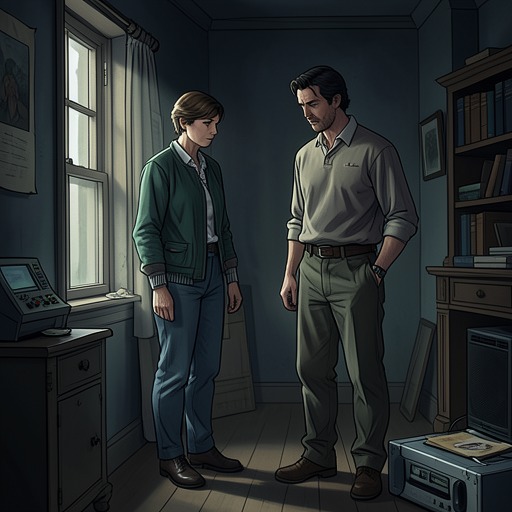
Helen and Jake’s Scrabble Bet
Happiness for BeginnersHelen and Jake’s Scrabble Bet is a playful wager in which an improvised scoring system lets sexual innuendo count as skill and turns a word game into an arrangement for future help. Jake wins, and the bet brings him and Helen to the threshold of the kissing lesson he requested: after putting away the tiles, he edges closer, while she holds still and watches him lean in.
The Rules of the Game
When Helen and Jake discuss how to play, Jake explains a house rule he shares with Duncan: they reject non-words and stick to plain English, but any word that is sexual or can be interpreted sexually earns a double-word score. The convention is not just a way to reward particular vocabulary. Jake describes it as a chance to earn points for style, making suggestion and comic nerve part of the competition alongside ordinary word placement.
Helen likes the idea of style points and tests how far the rule reaches with mounds. Jake agrees that it qualifies for double points and adds that it might even merit triple points. The example establishes the game’s teasing register before the wager is settled: their definitions of good play already allow words to carry both a literal score and a sexual implication. Jake asks whether Helen wants to play by that rule, and she answers that she will not win on skill alone. The exchange frames the match as a contest in which wit and innuendo can matter as much as Scrabble ability.
The Wager and Its Stakes
The bet begins as Jake’s proposal that they help one another with something each might need. When Helen asks what sort of help he has in mind, he points to her inexperience with hiking and the possibility that she will need assistance during the coming weeks. He lists practical examples: carrying her, tying a knot she cannot manage, or teaching her to read contour maps. His argument is concrete rather than abstract; the wilderness skills he offers are the sort of help that might become useful on a demanding hike.
Helen challenges the premise that she will need him, and Jake characterizes her as a beginner. Before he can fully explain his own request, Helen interrupts, saying she can tell from his face that she will not do it. Jake then says that he wants her to teach him how to kiss. He describes himself as a terrible kisser who needs help, making the request at once specific and self-deprecating. The mismatch between the practical assistance he has offered and the intimate instruction he seeks gives the bet its comic tension. Helen is being asked to treat a personal favor as the stakes of a game, not as a conversation detached from it.
Helen initially resists the wager. Jake tries to make the prospect of hiking vivid by listing blisters, wet socks, sore shoulders, long uphill switchbacks, and the effort of fetching water from an icy stream when exhausted. His catalogue shifts her attention from the immediate absurdity of his request to the possibility that his promised expertise could prove useful. Helen has also had half a bottle of wine at the tree house and recognizes that she is not thinking at full capacity. She nevertheless decides she can beat him, reasoning that if Duncan is Jake’s main opponent, the challenge cannot be too hard. She accepts because she believes she will win.
The Match
The result overturns Helen’s confidence. She acknowledges that Jake wins without cheating, relying on skill as well as sexual innuendo. Helen scores seventy-four points with heaving, which she describes as beautifully placed. Jake beats her with swollen and sticky, then places bulbous on a triple-word score. These are not incidental examples: the words demonstrate how the players’ shared rule changes the texture of the game, turning suggestive vocabulary into both a joke and a tactical resource.
The score also gives the wager a clear outcome. Helen’s opening confidence that she will prevail gives way to Jake’s victory, and the win activates the personal request she had anticipated. The match therefore functions as more than flirtatious banter: its rules make innuendo playable, its result settles who has earned the next move, and its agreed stakes carry that result outside the game.
What the Bet Sets in Motion
After the match, Jake puts away the Scrabble tiles, sets the box on the nightstand, and edges closer. He tells Helen that a bet is a bet. The movement from the game to the nightstand gives the bargain a physical consequence: the objects that organized their competition are put aside, and Jake begins to claim the kissing instruction he requested.
Helen’s attention shifts as he approaches. She thinks about how attractive he is, noticing his dark, wavy hair, brown eyes, full lips, and teeth that show he has not been out of braces for long. She recognizes that the irritation she has felt toward him since he was sixteen has obscured the possibility of seeing him differently. Jake leans in; Helen remains very still as he brings his face within inches of hers and looks toward her lips. The passage ends at that charged pause, not with a description of the kiss itself. The bet’s decisive effect is thus the change it makes possible: a contest governed by words and points becomes a direct encounter in which Helen can no longer regard Jake simply through the old lens of annoyance.