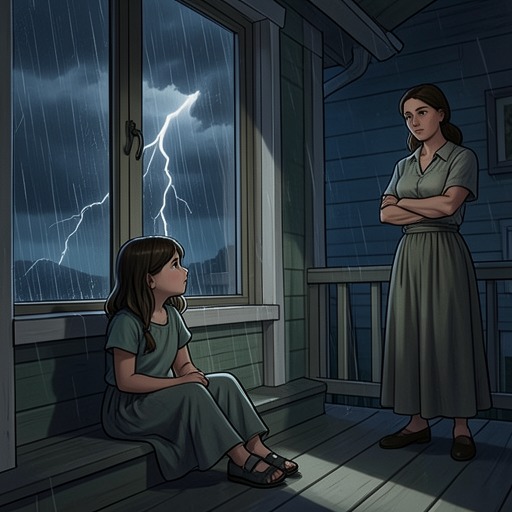
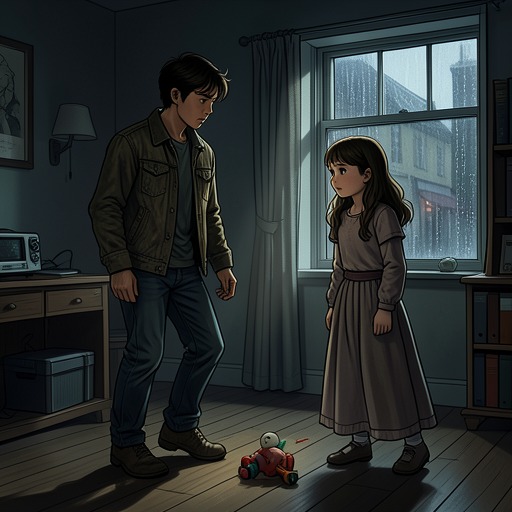
Helen tells Duncan why their mother left
Happiness for BeginnersHelen tells Duncan why their mother left in a childhood hallway, where a family history of abandonment is suddenly revised. The disclosure changes neither sibling’s past nor the fact that their mother went away, but it changes the meaning they had assigned to that departure: Duncan had blamed himself, while Helen had believed their mother simply did not like them. By tracing the discovery of their mother’s suicide attempt to Duncan’s forgotten Softie, Helen gives him a place in the story not as the cause of their mother’s absence but as the child whose distress helped bring Grandma GiGi back in time to find her.
The setting and the decision to speak
The conversation takes place in the house Duncan remembers as his childhood home, specifically in its hallway and entry hall. Helen has recently learned from Grandma GiGi what happened to their mother, and the new knowledge makes seeing Duncan feel different even though, as Helen recognizes, it does not change the events themselves. The distinction is central to the scene: the past remains fixed, but its explanation has shifted.
Helen has been wavering over whether to tell Duncan. One side of her feels that he should never have to carry the knowledge; another insists that both siblings should have known the truth all along. Standing together in the only home Duncan remembers, she stops weighing those impulses and speaks as soon as the decision arrives. The abruptness surprises her as well as Duncan. The disclosure is not presented as a carefully planned conversation; its force comes partly from the way the words emerge at the precise place where their childhood separation is being reconsidered.
The revelation and the remembered day
Helen tells Duncan, “Mom tried to kill herself,” then clarifies that she means the day their mother left and did not return. Duncan is stunned and says he does not remember that day. Helen does. Their differing memories create an asymmetry within the conversation: she carries the scene and its explanation, while he has lived with the consequences through an account he formed without knowing what happened.
Duncan reveals that he had always thought their mother left because he was “such a little shit.” Helen counters that his behavior saved their mother. The explanation is specific rather than abstract. Their mother had forgotten to pack Softie, and Duncan cried for so long that Grandma GiGi finally went back to the house to retrieve it. There she found their mother after she had taken pills, curled up with Nathan’s teddy bear. The chain of events makes Duncan’s childhood distress consequential in a way he could not have understood: the forgotten comfort object prompted the return that exposed the emergency.
That account does not erase the frightening fact of the suicide attempt or make the children responsible for managing it. Instead, it directly contradicts Duncan’s self-blame. His difficult behavior did not drive their mother away; the distress he had interpreted as evidence against himself helped bring Grandma GiGi to the house when their mother needed to be found. Helen’s sentence about having saved her brother’s mother recasts the same childhood behavior that had sustained his guilt.
A shared misunderstanding, revised
Duncan had thought their mother simply did not like them. Helen’s response is not to claim that the new information repairs their childhood, but to recognize that the siblings had carried the same mistaken story. She finds comfort in discovering that she was not alone in having misunderstood their lives: Duncan had been beside her, holding his own version of the same hurt. The scene’s quiet formulation, that they had been alone together, joins two individual experiences of abandonment without pretending they had understood or shared them at the time.
The siblings remain in the entry hall and talk through what Helen knows. Duncan is surprised that Grandma GiGi did not tell her more; Helen explains that she would not have wanted further detail and that the broad explanation is enough. Her preference sets a limit on the revelation. What matters to her here is not reconstructing every aspect of the attempt, but correcting the conclusion that the children were unwanted and that Duncan caused their mother’s departure.
Consequences and significance
The disclosure alters the siblings’ understanding of their family history and their relation to one another. Duncan’s remembered self-accusation meets Helen’s knowledge of the forgotten Softie and Grandma GiGi’s return; the result is a new interpretation grounded in a concrete childhood sequence. Their mother’s absence remains painful, but it is no longer explained by Duncan’s supposed unworthiness or by a simple belief that she disliked them.
The conversation also leads to a practical decision about what comes next. Duncan asks whether he can accompany Helen when she goes to see their mother, and Helen tells him she would be hugely grateful for the company. The request turns the revelation outward: the truth is not only something Duncan must absorb but a reason for the siblings to approach their mother together. The scene thus ends not with the past resolved, but with the two of them choosing shared presence where each had long felt alone.