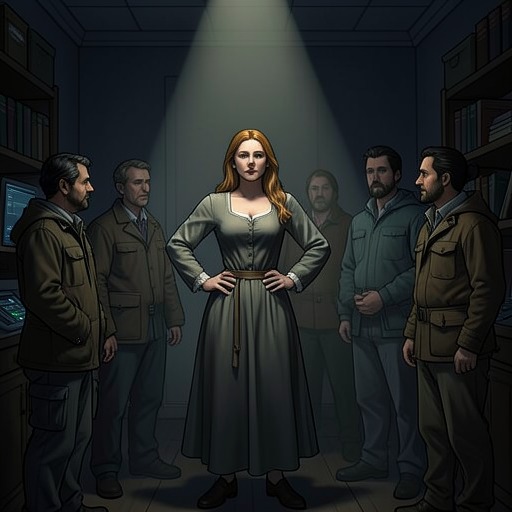
Helen's introduction at the BCSC orientation
Happiness for BeginnersHelen’s introduction at the BCSC orientation is the moment her private sense of having fallen out of step with life becomes a public account—and Jake answers that account with solidarity rather than embarrassment. Asked to introduce herself among college-aged participants, she describes her age, divorce, and thwarted plans for a family, then recounts a promise she made to herself as a teenager and never kept. Her confession leaves the room silent; her blunt conclusion about why she came gives that silence a shape. Jake’s intervention turns the scene from an awkward unveiling into the beginning of a bond.
The Room and the Reluctant Introduction
At check-in, Jake had kept an anonymous distance behind Helen, and at the orientation meeting he chose a seat near the front while she sat toward the back. She was relieved that he seemed not to be watching her, but the relief did not make her feel at home. As the room filled, she saw a crowd of young people who seemed almost interchangeable to her: college students in Greek-letter shirts, nylon shorts, neon sneakers, matching tans, and carefully similar hair and makeup. She had expected people more like the outdoorsy, unconventional participants she associated with a wilderness course. Instead, she felt surrounded by students whose lives and assumptions seemed far removed from her own.
When introductions reached the last two people, Helen and Jake, she waited to see what he would say, hoping she might borrow a little from his example. Jake did not volunteer. Beckett looked between them and asked who was next; Jake pointed to Helen. His small gesture placed the attention she had been dreading directly on her. Facing the group, she framed the questions beneath the formality of an introduction: who she was, and why she had come.
Helen’s Account of a Life Disrupted
Helen began with the facts that set her apart from the students around her. She had graduated from Vassar years earlier, was thirty-two, and had already been through what she described as her life falling apart the previous year. She added that she was divorced and that an attempt to start a family had gone off course. The disclosure was more personal than a routine introduction required. As she spoke, she saw the students’ blank expressions and felt that they could not yet understand what she meant by loss and disappointment. Their silence, instead of stopping her, pushed her to keep explaining.
She reached further back, to the high-school crush she had kept secret for years. The boy was handsome and seemed out of her league; after he once helped her up when she tripped on the stairs, she made a private plan to kiss him at graduation, three years later. She did not expect the kiss to make him fall in love with her. She imagined it as a gift to herself, a way of making something out of the years she had spent longing for him. But when graduation arrived, she decided that the real kiss might spoil the fantasy, and she let the promise lapse. About a year before the orientation, she encountered him at a gas station and did not even say hello. The story made the cost of her inaction concrete: she had not simply missed a romantic possibility; she had broken a promise she had made to herself.
At this point, the introduction’s emotional scope exceeds its biographical facts. Helen ends by telling the students that life is largely a matter of breaking one’s own promises. The line comes from someone who has described herself as divorced and disoriented, but it also names a longer habit of retreating from the things she once imagined doing. She had continued speaking in search of a useful or redemptive point; instead, she became aware of herself through the group’s silence. That recognition left her feeling exposed, but it also released her from trying to make the story sound wise.
From Awkwardness to Purpose
Helen finally gave the introduction a direct purpose: she had come to get stronger, toughen up, care less, and rise from the ashes of her existence like a phoenix. Her deliberately defiant finish was not a polished account of recovery. It was a declaration of what she wanted to become, delivered after she had stopped pretending that her life fit the expectations of the room. The movement from guarded waiting, through increasingly intimate disclosure, to an emphatic statement of purpose gives the scene its turn: Helen begins as an outsider who cannot find a suitable introduction and ends by naming a reason to be there in her own terms.
The audience’s response first deepened the discomfort. The students stayed quiet after her account, and Helen understood their silence as a crushingly awkward glimpse of how she appeared to them. Then Beckett stretched out his response before asking Jake to speak. The pause matters: Helen has finished without receiving the redemption she had hoped her speech might provide. Jake’s reply changes the direction of the moment, not by undoing her embarrassment, but by refusing to leave her alone inside it.
Jake’s Public Answer
Jake began by pointing at Helen and saying, “What she said.” The room erupted in laughter, briefly releasing the tension. Helen laughed too, until she realized that the group was not laughing with her. Jake then let the laughter subside and spoke seriously. He said he agreed with the redhead, correcting himself to strawberry-blond, and argued that life would be hard for everyone, himself included. He described his own reason for joining the course as learning to survive and to push back against what life dealt him. Turning toward Helen, he added, “Like her.”
Jake did not repeat Helen’s painful details or claim to understand them. Instead, he treated her account as a statement of strength and made that interpretation audible to the group. His description of her by hair color rather than name was imperfectly personal, but the look and the comparison affirmed that he had listened. Helen experienced the gesture as rescue. The group’s laughter had made her the object of an uncomfortable moment; Jake redirected attention toward the shared vulnerability in what she had said.
He then introduced himself: he had not attended Vassar, but had just graduated from Harvard. The fact intensified the group’s attention. Jake already stood apart from the students in his vintage Hawaiian shirt, frayed khakis, flip-flops, and tattered fisherman’s hat, rather than the baseball caps, cargo shorts, and outdoor-brand shirts worn by many of the other men. After his answer, the participants regarded him as a natural leader: cool, confident, friendly, and newly graduated. Helen’s judgment was more intimate. Despite the way she had treated him earlier that day, he had taken the trouble to stand beside her when she was struggling.
What the Introduction Begins
The scene makes the orientation more than a roll call. Helen’s account establishes her as older than the other participants and as someone arriving at the course after divorce and a failed attempt to build a family. Her story about the unfulfilled high-school promise also introduces a pattern she will have to confront: imagining a desired act can feel safer than doing it. Yet she does not leave the room with only that pattern on display. By naming a desire to grow stronger, she turns a history of disappointment into a reason for entering the course.
The account is also partial. At the orientation Helen speaks about divorce and the collapse of her plans for a family, not the full history of grief behind her estrangement from her younger brother, Duncan. Later, in a private conversation with Jake, she tells him that the brother she had lost was Nathan. She recalls her mother searching frantically for Nathan after his drowning and becoming pregnant two months later; Helen believed the pregnancy was an attempt to replace someone irreplaceable. She also describes the family’s subsequent unraveling: her parents separated, her father moved to San Diego, and, after struggling to care for Helen and Duncan in Evanston, her mother left them with Grandma GiGi. Helen eventually recognizes that she had not forgiven Duncan for not being Nathan. The contrast clarifies what the orientation speech can and cannot do: it is an exposed beginning, not a complete explanation of her past.
Jake’s support at orientation becomes an early instance of a relationship in which he recognizes capacities Helen struggles to claim for herself. Later, Beckett explains that he paired them because Helen was the group’s best map reader and Jake was nearly blind, because Jake was the medic she might need, and because she did not believe in herself while Jake believed in her. That later explanation gives practical form to the dynamic first visible in the room: Helen speaks from a place of isolation, and Jake responds by treating her as someone worth listening to and following. The introduction does not solve her sense of not belonging, but it marks the first public moment in which another person helps her stand inside her own account.