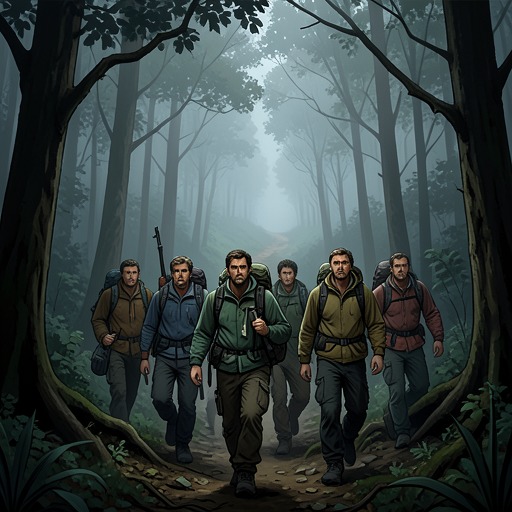
Helen’s Lost Solo Hike
Happiness for BeginnersHelen’s Lost Solo Hike is the navigation crisis at the center of Helen’s twenty-four-hour BCSC Solo: after Mason takes a shortcut that leads the group away from its assigned route, Helen uses a compass and map to get them back to the trail, then leads them safely home the following day. The episode tests more than wilderness skill. Helen enters the exercise hoping to avoid Jake, declines to assert her ability when Mason takes charge, and ends it recognized by both her group and Beckett as the person who found the way through.
The Solo and Helen’s Unwanted Group
The episode begins as the BCSC trip enters its third and final week. Beckett announces that the culminating exercise will send three groups out separately for twenty-four hours. Each group must navigate, find water, make and break camp, and keep making sound decisions without the instructors beside them. Beckett asks everyone to list the four people they most want in their group, warning them to take the choice seriously and be careful what they wish for.
Helen would have liked to hike with Windy, but she assumes Windy will choose Jake and that Jake will choose Windy. Rather than spend her final days in the Absarokas speculating about their relationship, Helen decides she needs distance from both of them. She writes “Anybody but Jake” on her slip, circles it twice, folds it, and hands it in. Beckett collects the requests and says he will take a couple of days to assemble the groups. His eventual choice defeats Helen’s effort: he assigns Jake to her group, and she tells herself that she must be grateful for the opportunity.
On the morning of the exercise, Beckett reviews each group’s route on a map. The participants wave goodbye and set off in three directions, with the hope of seeing one another the next afternoon. Helen understands that the hazards are not abstract: the group could encounter a falling tree, a bear, an avalanche, a shortage of water, an icy river, or the consequences of getting lost. The Solo makes ordinary decisions feel consequential because the group must manage its own route and survival for the full outing.
The Shortcut and the Lost Trail
Beckett has told Helen that she is the best map reader in the group, but Mason has not heard that assessment. Helen knows Mason as a fast and intimidating hiker, with a habit of humiliating or punishing people who cross him. She also wonders why Beckett has placed the relentlessly fast Mason with Dosie, who cannot keep up. Still, after Beckett’s earlier reassurance about his judgment, Helen chooses to trust the group assignment.
As they start walking, Mason lifts the map from Helen’s hands and says, “I’ll take that, thanks.” Helen lets him keep it. She has no desire to prove herself or make a show of her map-reading skill; knowing that she is capable is enough. Mason walks far ahead and periodically waits for the others. Dosie brings up the rear, calling for the group to hold up when she loses sight of Helen. Helen and Jake walk together at a comfortable, conversational pace.
The easy companionship has a cost. Helen and Jake joke as they hike and fail to notice that the route has gone wrong. Around noon, they catch up with Mason, who has been waiting for Dosie. He admits that the trail seems to disappear. Helen recognizes that the route should have taken them around a hill, not over it. Mason says they are taking a shortcut; Helen objects that Beckett had prohibited that choice. Mason replies that nobody had said not to, and Jake reminds him that Beckett had.
When Helen asks when they left the trail, Mason estimates that it was two or three hours earlier. He explains his reasoning by tracing the map’s oxbow-shaped trail around a hill: cutting across seemed shorter than following the curve. The underlying mistake is not merely that he chose a shorter line. Mason has taken them onto a route without a trail, and the group has lost hours before realizing it. Helen takes out her compass and rotates the map until its north arrow aligns with the compass. Mason whistles as the map comes into proper orientation, exposing the basic navigational error behind his confidence.
Bushwhacking Back to the Trail
Helen leads the group back down the hill with her compass held out to maintain a straight line. The return is easier under the trees than where they thin and the underbrush grows denser. After an hour, the four are bushwhacking through brush; their legs are scratched and bloody, and each has stumbled. Jake falls most often and also scratches his arms and face. Animal trails offer tempting ways around the worst of the brush, but following them could take the group off course again. The difficulty instead brings them together: they continue as a unified group of four.
Dosie asks what will happen if they cannot find water that night. Helen answers that they will find it the next day. The group’s immediate problem, however, is to recover the marked route. Four hours after beginning the backtrack, they reach the trail. They are breathless and bleeding, but the relief is so great that they hug. Their return is not yet complete: they have rejoined the trail at a point they had already passed, and the stream crossing is still about a mile away. It is five in the afternoon.
The final mile takes another hour. At the crossing, Helen discovers that the stream lies roughly a hundred feet down in a steep ravine, and the trail crosses it by a rickety rope bridge. From the bridge’s edge, the group looks toward the creek bed and fears that the stream may be dry after all. It is wet. The discovery supplies the water they need after the long, disorienting detour, and Helen closes her eyes in relief.
The Return and the Meaning of the Crisis
The second day of the Solo is easier than the first. In the morning, the group sees flattened oval patches of grass around camp, evidence that they had spent the night in an area crowded with large animals; the animals are gone by the time they pack. Dosie and Jake make Helen the leader for the return, and Mason does not contest the choice. Mason addresses her as “Holdup,” turning the nickname associated with Dosie’s calls to slow down into an acknowledgment that Helen is now guiding the group.
Helen leads them confidently back along the trail. She credits the map being right side up and her map-reading ability, while keeping that assessment to herself. The group stays together and on route. Its only serious difficulty is the rope bridge, which proves harder for Jake than for the others because his glasses are held together with duct tape. The bridge creaks and sways as they cross, but all four make it safely to the far side.
They are the first group to return. As they tell Beckett what happened, he shakes his head and asks whether anyone had been paying attention, then adds, “Besides Calamity Jane?” Helen answers the recognition with finger guns, echoing the playful gesture she had made earlier when Jake asked about her nickname. The joke marks a reversal: the person who had tried to avoid responsibility for the group’s route has become the one credited with getting it home.
The other groups also return with serious incidents to report, including a bear sighting, a twisted ankle, and a swollen-river crossing that brought near-drowning, CPR, and hypothermia. Their experiences underline the risk of the exercise, while the uncertainty surrounding Hugh makes the apparent survival of everyone else feel provisional. Within Helen’s own group, the danger has arisen from a shortcut, misread directions, and delayed recognition; its resolution depends on correcting the map’s orientation, staying together through the brush, and following the trail once found. The Solo thus turns Helen’s private knowledge of her own competence into visible leadership, without requiring her to claim authority through confrontation.