Helen's confession about Nathan and Duncan
Happiness for BeginnersHelen's confession about Nathan and Duncan is the moment she names the loss beneath her long-standing resentment of her younger brother. Speaking quietly with Jake before an evacuation, she moves from identifying Nathan as the brother who died to recognizing how grief, neglect, and guilt had shaped her understanding of the family—and her failure to forgive Duncan for being someone other than the brother she lost.
The Confession and Its Setting
The disclosure comes during a night when Helen and Jake are lying close together, whispering while the rest of the group sleeps. Helen has already brought up a brother, and realizes that she could pass the reference off as Duncan. Instead, she chooses to tell Jake the truth. He is twenty-two, and the intimacy of the moment makes a previously unspoken family history newly sayable: as Helen puts it, “My other brother.” When Jake identifies him as the brother she lost, she confirms the name: Nathan.
The scene is quiet rather than ceremonious. Helen describes the choice as one between lying and telling the truth, and finds that, for reasons she cannot fully explain, honesty suddenly feels possible. Jake listens without pressing her to disguise the loss as something simpler. His response gives Helen room to say not only that Nathan died, but also what the death left behind in the family and in her own sense of responsibility.
Nathan's Death and the Family's Grief
Helen recounts her mother's reaction after Nathan died. At the lake, her mother searched frantically; even after Nathan was found in the water, she continued acting as if the search could not end. She woke repeatedly through the night and paced around the house. Two months later, she was pregnant. Helen believes the pregnancy was intentional, an attempt to replace the child who had died, but insists that Nathan could not be replaced. The sequence makes the grief visible not as a single reaction but as a force that continued to organize the household after the immediate search was over.
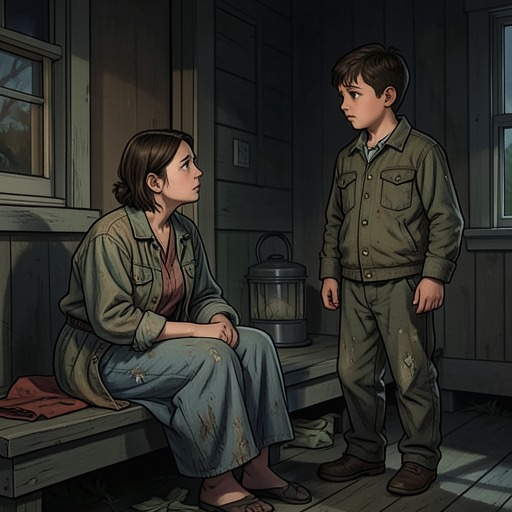
Helen's account turns next to the way she experienced that aftermath. Her parents separated within a year. Her father moved to San Diego, remarried, and became someone she hardly saw. For two years, her mother remained in the family's Evanston house, trying to raise Helen and Duncan alone, but could not keep up with the demands. Bills went unpaid; the water and power were repeatedly shut off, sometimes for days. Laundry accumulated until clean and dirty clothes could not be distinguished, dinner was forgotten, and the lawn grew several feet high after the lawn-care worker stopped coming. The backyard pool developed a sheet of algae. These concrete signs of disorder give shape to Helen's succinct judgment of her place in the household: “I just got forgotten.”
Resentment Toward Duncan
Helen says that she tried to take up some of the work at home, including folding clothes and learning to heat soup. The wider history she recalls explains how responsibility and resentment became entangled: after Nathan's death, she believed Duncan's arrival helped mark the point at which her father disappeared, her mother's condition worsened, and her own needs went unnoticed. Duncan had been a colicky baby, then an exhausting toddler and a mischievous child. Their grandmother, Grandma GiGi, loved them but had little tolerance for children, so Helen was left babysitting Duncan from the age of thirteen until she went to college.
Leaving home brought relief, not a reconsideration of what had happened. Helen had told herself that she survived, moved away, and was fine; Duncan remained, in her account, an annoying younger brother she could not stand to be around. That explanation preserved a simple assignment of blame: he was the problem, and his behavior was the cause. In the present conversation, however, she recognizes that the explanation had lasted partly because she had never gone back to examine it.
A Different Reading of the Past
The turning point is Helen's admission, “I guess I haven’t forgiven him for not being Nathan.” Hearing the thought in her own words feels surreal. Jake does not dispute the feeling, but points out that Duncan did not choose to be born and was drawn into the same upheaval as Helen. The exchange distinguishes Helen's real burden of childhood responsibility from the blame she had attached to Duncan for circumstances neither sibling controlled.
As she revisits the family's history, Helen begins to see Duncan as a child without dependable maternal attention, hungry for notice even from her. His stealing Grandma GiGi's car at eight, once another example of his mischief, appears in this changed perspective as an effort to get attention. Helen also imagines the depth of her mother's grief, guilt, and regret, and recognizes that her father, buried in work and sorrow, was unable to help. The shift does not erase what Helen endured or restore what was lost. Instead, it changes the moral arrangement of the memory: Duncan, too, was a child caught in the aftermath, while the person whose absence could have made the family whole was the one who was gone.
Helen had described herself as having lost everybody, but Jake reminds her that Duncan is still there. The confession ends not with a resolution of their relationship but with a new understanding of its injury. The next day's evacuation remains imminent; Jake notes that Helen will have plenty to think about during it. What has changed is the story she can tell herself: Duncan's failure to be Nathan was never a wrong he could have chosen to correct.